Battle rope exercises: a battle ropes workout for beginners
How to anchor battle ropes safely, the wave and slam patterns to learn first, and how to program a battle rope conditioning session.
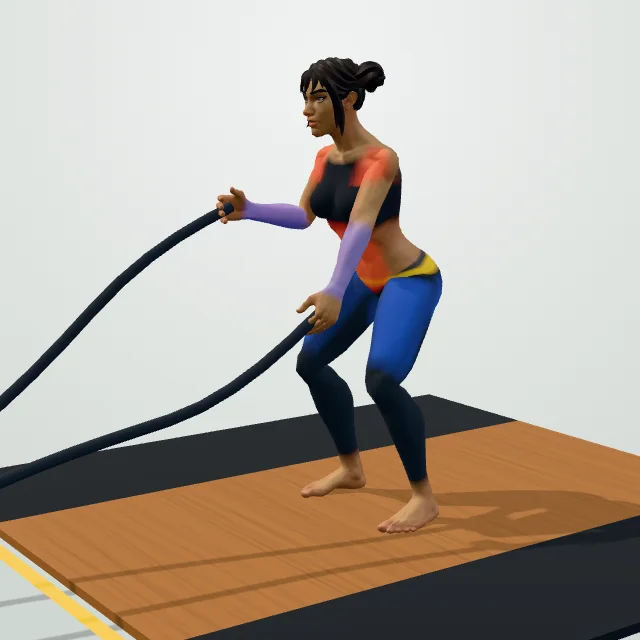
Battle rope exercises turn a thick, heavy rope into a full-body conditioning tool — the classic wave pattern loads the shoulders, arms and core continuously while your heart rate climbs fast, which is why a short battle ropes workout can feel harder than it looks. The 3D coach shows the wave pattern and posture for battle rope waves.
Anchoring battle ropes safely
Battle ropes need a fixed anchor point — wrap the middle around a sturdy post, rack upright, or heavy anchor point rated for the pulling force, since a rope that comes loose mid-set is a real hazard. Give yourself space in front and to the sides for the rope's slack to move without catching furniture or other people.
Wave and slam technique
Stand with feet shoulder-width, knees soft, core braced — most of the power for a wave comes from the shoulders and a light hip drive, not from swinging the whole torso wildly. Keep waves rhythmic and controlled rather than chaotic; a clean, steady wave trains the target muscles better than a fast but sloppy one. Alternate waves (one arm up while the other is down) hit the core with an anti-rotation demand; double waves (both arms together) are simpler to learn first.
Safety
Battle ropes are demanding on the shoulders and grip, so beginners should start with short intervals (15–20 seconds) rather than a continuous long set. If you have existing shoulder issues, start with slower, smaller waves and build up range and speed gradually. As with any high-intensity interval work, stop for chest pain, dizziness or unusual breathlessness, and check with a doctor first if you have a heart condition. Anyone with a shoulder impingement or rotator cuff issue should get clearance before adding fast overhead-style waves, and can start with smaller, slower waves at a lower intensity in the meantime.
Sample battle rope workout for beginners
| Block | Work | Rest |
|---|---|---|
| Alternating waves | 20 s × 6 rounds | 30–40 s between rounds |
| Double waves | 20 s × 4 rounds | 30–40 s between rounds |
How to program battle rope training
Battle ropes work best as short, high-intensity intervals rather than long steady sets — 15–30 seconds of work with 30–45 seconds of rest, repeated 6–10 times, builds both conditioning and grip/shoulder endurance. Use the interval timer to keep the work-rest ratio consistent, and treat battle ropes as a conditioning finisher after strength work or as a standalone short cardio session, similar in role to jump rope or kettlebell swings.
Battle ropes vs jump rope
Both deliver a fast, efficient cardio hit in a small space, but they load the body differently: battle ropes emphasize the upper body — shoulders, arms and grip — with the legs providing a stable base, while jump rope emphasizes the calves and lower-body coordination with the arms playing a smaller role. If your shoulders or arms are already fatigued from an upper-body strength session, jump rope is the gentler finisher; if your legs are fatigued from squats or running, battle ropes let you still get a hard conditioning effect without extra leg impact.
Ropeless and cordless battle rope options
Compact "ropeless" or handle-based battle rope alternatives exist for small apartments where a full-length rope and anchor point aren't practical — they mimic the wave motion's shoulder and arm demand without needing the same floor space, though they can't fully replicate the momentum and grip challenge of a real heavy rope. If you're limited on space, these are a reasonable substitute for the cardio and shoulder-endurance benefit, even if the exact movement feel differs.
Battle ropes for women and general fitness
Battle rope training builds the same shoulder, arm, grip and cardiovascular fitness regardless of gender, and the starting intervals and rope thickness recommended above apply equally. If you're newer to the shoulder-intensive demand of waves, choosing a slightly thinner, lighter rope and shorter work intervals is a sensible way to build the pattern before increasing rope weight or interval length, rather than adjusting based on gender alone.
Where battle ropes fit into your training
Battle rope intervals pair naturally with other conditioning tools in fat-loss and HIIT-style sessions — see the 15-minute HIIT workout for a similar interval structure. Use the plan builder to add conditioning finishers to your own weekly plan.