Cardio · Gym
Battle ropes: build conditioning with continuous waves
Battle rope waves send rippling waves down two heavy ropes by moving your arms up and down continuously, delivering a demanding shoulder and cardio workout with almost no impact on your joints.
- Primary
- Front deltsAbs
- Level
- Beginner
- Type
- Compound · Alternate sides
- Sets × reps
- 4 × 30 s
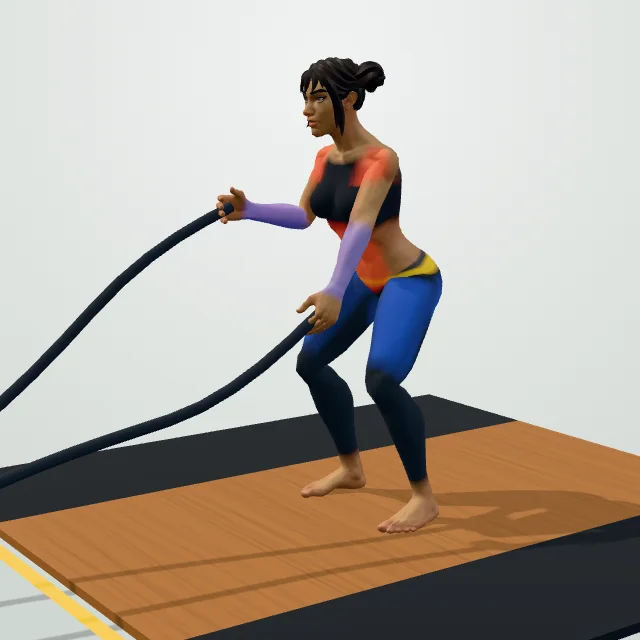
How to do it
- Anchor the ropes and stand facing the anchor, feet shoulder-width.
- Hold one end in each hand with a slight bend in your knees.
- Brace your core and sit into a quarter-squat.
- Whip one arm down as the other rises, sending a wave down the rope.
- Keep alternating arms at a steady, sustainable pace.
- Rest, then repeat for the next interval.
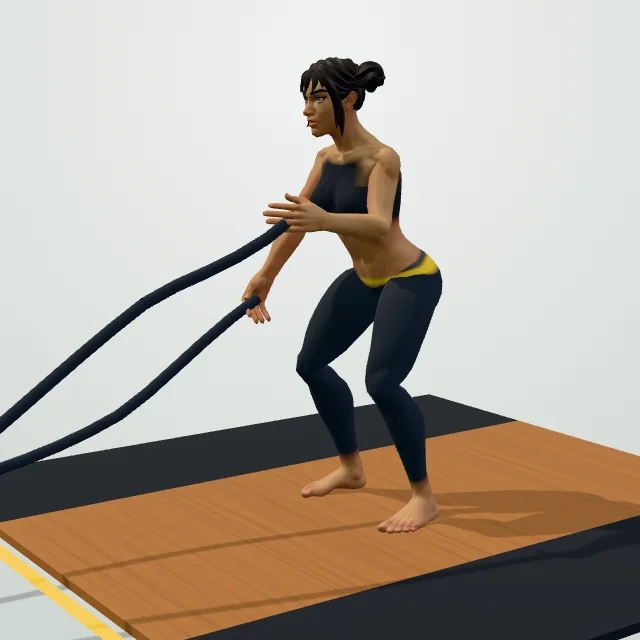
Coach cues
- Quarter-squat stance, core braced.
- Whip one arm down as the other rises.
- Keep the waves even and continuous.
- Stay low, let your legs share the work.
Breathing: Breathe steadily and continuously through the nose or mouth as you work.
Common mistakes
Make it easier / Make it harder
Battle rope waves anchor two thick, heavy ropes to a fixed point and send continuous ripples down them by moving your arms up and down, alternating or together, while holding a low athletic stance. It is one of the few conditioning tools that trains your upper body and cardio system hard at the same time, without any running, jumping or landing.
What muscles do battle ropes work
Your front delts drive the up-and-down whip of the ropes continuously, which is why your shoulders fatigue quickly even without heavy weight involved. Your abs brace throughout to keep your torso stable, and your forearms grip the rope ends hard, while your quads and glutes hold the low squat stance that lets your legs share some of the load instead of your lower back.
Benefits of battle rope training
- Builds shoulder and grip endurance through sustained, repetitive effort rather than a single heavy lift.
- Delivers serious cardio conditioning in short bursts, comparable to sprinting but without any impact on your joints.
- Scales easily by pace, so both beginners and advanced trainees can use the same ropes at different intensities.
- Works well in circuits, pairing naturally with other conditioning moves like burpees or medicine ball slams.
How to do battle rope waves with proper form
Stance
Stand facing the anchor point, feet shoulder-width apart, holding one rope end in each hand with a slight bend in your knees. Brace your core and sit into a quarter-squat rather than standing bolt upright.
The waves
Whip one arm down as the other rises, sending a wave down the rope, then keep alternating arms at a steady, sustainable pace rather than sprinting the first few reps and fading fast. Rest, then repeat for the next interval.
Alternating waves vs double waves and side-to-side waves
Alternating waves, one arm up while the other is down, are the standard starting pattern and the easiest on your shoulders to sustain. Double waves, moving both arms together, demand more core and shoulder stability. Side-to-side waves, sweeping both ropes together from one side to the other, add a rotational core challenge and are a useful variation once the basic wave feels controlled.
Sets, reps and how to program it
Battle ropes are almost always programmed by time rather than reps: 20–40 second work intervals with 30–60 seconds of rest, repeated for 4–8 rounds, work well as a standalone conditioning finisher or inside a circuit — see the interval timer for pacing your rounds. Pace your effort so you can sustain a steady wave for the whole interval rather than burning out in the first ten seconds.
Variations and alternatives
If you do not have access to battle ropes, medicine ball slams or mountain climbers can deliver a similar short, high-intensity conditioning stimulus at home. Lighter, thinner ropes or a shorter length reduce the intensity for beginners, while thicker or longer ropes increase it for more advanced training.
Safety and who should modify it
Standing tall with locked knees is the main technique fault, since it shifts more strain onto your lower back — sit into a quarter-squat instead and let your legs share the work. People with a current shoulder or lower-back injury, or high blood pressure or heart disease, should check with a doctor or physiotherapist before this kind of sustained, high-intensity effort, and everyone should stop for chest pain, dizziness or unusual breathlessness rather than pushing through it.
More exercises for cardio
Questions people ask
What is a battle rope?
Are battle ropes an effective workout?
What muscles do battle ropes work?
Are battle ropes good cardio?
How do I use battle ropes at home without owning a set?
How long should a battle rope interval be?
What size battle rope should I get?
General fitness information, not medical advice. Check with a doctor or physiotherapist before starting if you have a health condition, an injury or are pregnant. Stop if you feel chest pain, dizziness or sharp pain.