Trap bar exercises: the hex bar deadlift explained
Why the trap bar is often the easiest deadlift variation to learn, how to set it up, and how to program trap bar training.
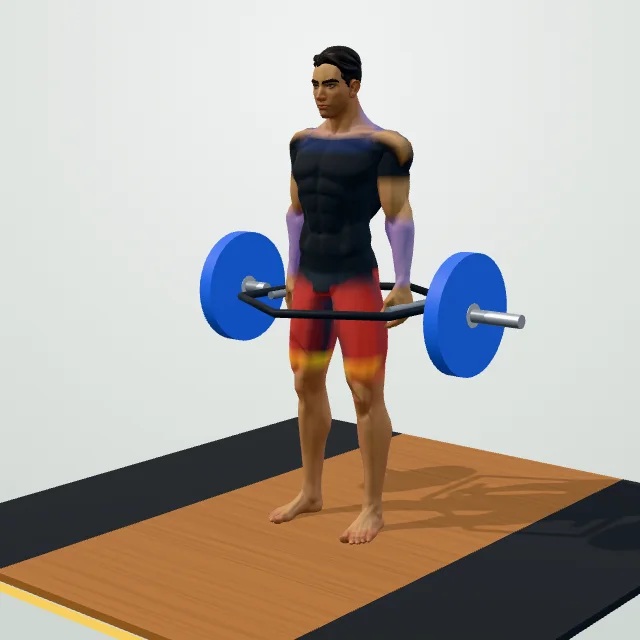
The trap bar (also called a hex bar for its six-sided shape) is a barbell you stand inside rather than in front of, and the trap bar deadlift is widely considered the easiest deadlift variation for beginners to learn. Standing inside the frame shifts the load closer to your center of gravity and lets you use a more upright torso than a conventional barbell deadlift, reducing lower-back strain while still training the same hip-hinge pattern. The 3D coach shows the setup and pull for the trap bar deadlift.
What is a trap bar, and what does it work?
A trap bar is a hexagonal or diamond-shaped frame with parallel handles on each side; you step inside, grip the handles, and lift with the weight distributed evenly around your body rather than in front of it. It primarily trains the glutes, quads and hamstrings, with the traps, forearms and lower back working to hold the position — the name "trap bar" reflects the trap involvement, not that traps are the primary mover.
Safety and setup
Step into the middle of the frame so the load is centered, brace your core, keep a neutral spine, and push the floor away with your legs rather than yanking with your back. Because the trap bar allows a more upright torso than a straight bar deadlift, it's often recommended for beginners and for lifters with a history of lower-back discomfort on conventional deadlifts, though technique still matters — don't round the back to compensate for a heavy weight.
Trap bar vs barbell deadlift
Both train the same hip-hinge pattern and the same major muscle groups, but the trap bar's centered load and more upright torso reduce shear stress on the lower back and generally allow slightly more weight to be lifted safely by beginners. A conventional barbell deadlift demands more hip flexion and hamstring involvement and is the standard for competitive powerlifting, but for general strength and safety, many coaches recommend starting with the trap bar and progressing to a straight bar once technique is solid.
Sample trap bar session
| Exercise | Sets × reps | Rest |
|---|---|---|
| Trap bar deadlift | 4 × 4–8 | 2–3 min |
How to program trap bar training
Use lower reps (4–8) with longer rest (2–3 minutes) for strength-focused work, since the deadlift pattern is fatiguing for the whole body. Beginners can progress with small, regular weight increases once the movement feels controlled; the one-rep max calculator and plate calculator both help plan working weights and loading. Pair the trap bar deadlift with an upper-body push and pull exercise in the same session for a balanced full-body day.
Who benefits most from the trap bar
Beginners learning the deadlift pattern, lifters with a history of lower-back discomfort on conventional deadlifts, and athletes who want a more upright pulling pattern for sport carryover all tend to benefit most from prioritizing the trap bar. Competitive powerlifters still need to practice the conventional or sumo barbell deadlift specifically, since that's what's tested in competition, but even they often use the trap bar as an accessory or a lower-back-friendly training day option.
Other trap bar exercises: shrugs and carries
Beyond the deadlift, many trap bars have a raised handle option that lets you stand fully upright while holding the weight — useful for trap bar shrugs (targeting the traps directly) and trap bar farmer's walks (a loaded carry that builds grip, core and overall strength). These are lower-skill accessory moves compared with the deadlift itself and make a good addition once the main lift is comfortable.
High handle vs low handle
Trap bars with two handle heights let you choose a "high handle" position (shorter range of motion, more upright torso, easier on the back) or a "low handle" position (closer to a conventional deadlift range and torso angle, more demanding). Beginners and anyone prioritizing lower-back comfort should start with the high handle if available, moving to the low handle as the hip hinge and back strength improve.
Workout plans that use a trap bar
The trap bar deadlift is a strong substitute for a conventional deadlift in most strength-focused plans, including the 5×5 strength program and leg day workout, when your gym has one available. Use the plan builder to build a plan around your available equipment.