Sled push: benefits, technique and how to train it
What the sled push actually trains, how to set the right weight, and how to fit it into a strength or conditioning plan.
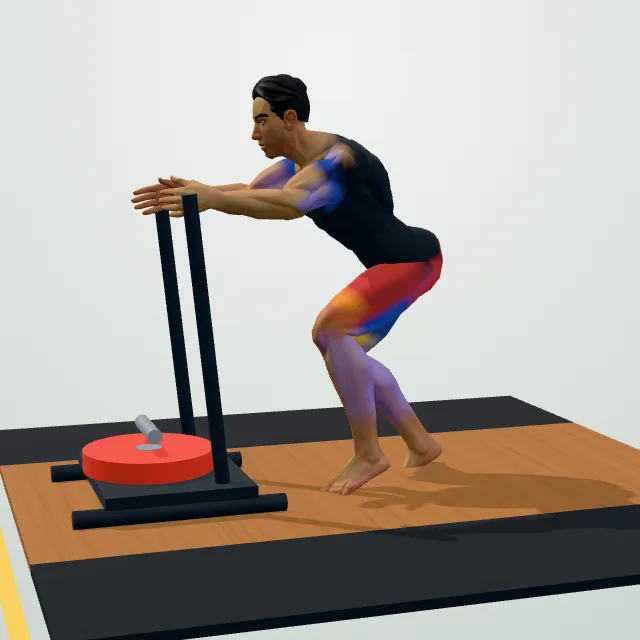
The sled push — driving a weighted sled across the floor — is one of the most joint-friendly ways to build leg drive and conditioning at the same time, and sled push benefits show up in both strength and endurance training because there's no eccentric (lowering) phase to cause muscle soreness, only concentric pushing. That makes it a useful tool even on days you want intensity without the next-day soreness of squats or lunges. The 3D coach shows setup and posture for sled push.
What does the sled push work?
Sled pushing trains the quads, glutes and calves primarily, with the core and upper body bracing to transfer force through the handles. Because you're constantly driving forward against resistance, it builds a kind of leg power and work capacity that's hard to replicate with traditional squats or lunges, which is why it's popular in Hyrox, CrossFit and general athletic conditioning.
How much weight to use
Weight depends heavily on the sled and surface (turf vs a smoother floor changes friction significantly), so there's no universal number — start light enough to maintain a steady, driving stride without leaning excessively on the handles, and add weight gradually. As a rough starting point, many beginners push a moderate load for 15–20 meters and adjust from there based on how challenging that felt.
Sled push technique
Keep a forward lean from the ankles (not just bending at the hips), drive through the whole foot, and take controlled, powerful strides rather than tiny shuffling steps. Keep your arms mostly extended with a slight bend, using the handles for direction and stability rather than pulling yourself along with your arms. Breathe steadily rather than holding your breath through the whole push, especially at heavier loads.
Safety
Warm up the hips and ankles before a heavy push, and start with lighter loads and shorter distances until your technique and conditioning are established — sled pushes are demanding on the cardiovascular system as well as the legs, so ease in rather than going all-out on your first attempt. Stop for chest pain, dizziness or unusual breathlessness, particularly if you have a heart condition.
Sample sled push workout
| Block | Distance | Rest |
|---|---|---|
| Sled push, moderate load | 20 m × 6 rounds | 60–90 s between rounds |
How to program sled training
Sled pushes work well as a strength-conditioning hybrid: heavier loads over shorter distances (10–20 m) build power and leg strength, while lighter loads over longer distances (30–50 m) or repeated rounds build conditioning. Use it as a finisher after a leg day or as its own short conditioning session, and because there's minimal eccentric loading, recovery is generally faster than after heavy squats, allowing more frequent use.
Alternatives if you don't have a sled
Without access to a sled, kettlebell swings, goblet squats for high reps, or hill sprints can build similar leg power and conditioning. Some gyms also allow pushing a loaded barbell plate along the floor as an improvised substitute, which recreates a similar sustained leg-drive demand without needing a dedicated sled.
Sled push in Hyrox and competitive training
Sled push and sled pull are both standard stations in Hyrox racing, where a fixed distance is covered under time pressure at a prescribed load. Training for this specifically means practicing at or near race weight over the race distance, in addition to general sled work at varied loads — if you're not training for a specific event, the general strength-and-conditioning approach described above is more useful than trying to match competition-specific loading.
Sled push vs squats for leg training
Squats and sled pushes both build leg strength but stress the body differently: a squat has a clear eccentric (lowering) and concentric (rising) phase and typically causes more muscle soreness, while a sled push is almost purely concentric, meaning less soreness and often faster recovery. This makes the sled push a good complement to squat-based training rather than a replacement — use squats to build maximal strength and the sled to add conditioning and work capacity without excessive extra fatigue.
Where the sled push fits into your training
Sled work complements barbell leg training and appears in the leg day workout as a conditioning finisher. Use the plan builder to include conditioning work in your own plan.