Full body · Gym
Sled push: build leg drive without loading your spine
The sled push drives a weighted sled forward with both hands, building powerful, low-impact leg strength and conditioning without a barbell loaded on your back.
- Secondary
- CalvesHamstringsFront deltsTriceps
- Level
- Intermediate
- Type
- Compound · Alternate sides
- Sets × reps
- 4 × 20 s
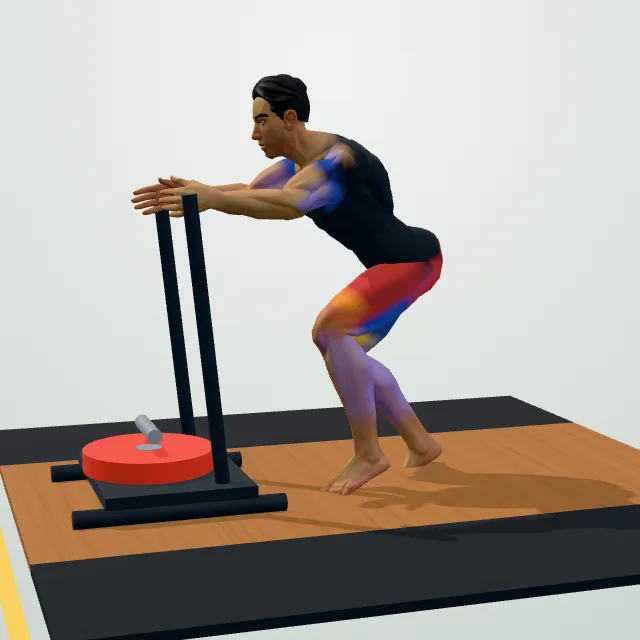
How to do it
- Load the sled and stand behind it with hands on the high or low handles.
- Set your feet, lean your chest toward the sled at about 45 degrees.
- Brace your core and take short, driving steps.
- Drive through the balls of your feet with each step.
- Keep your arms mostly straight, pushing rather than steering.
- Push for the set distance or time, then walk back to reset.
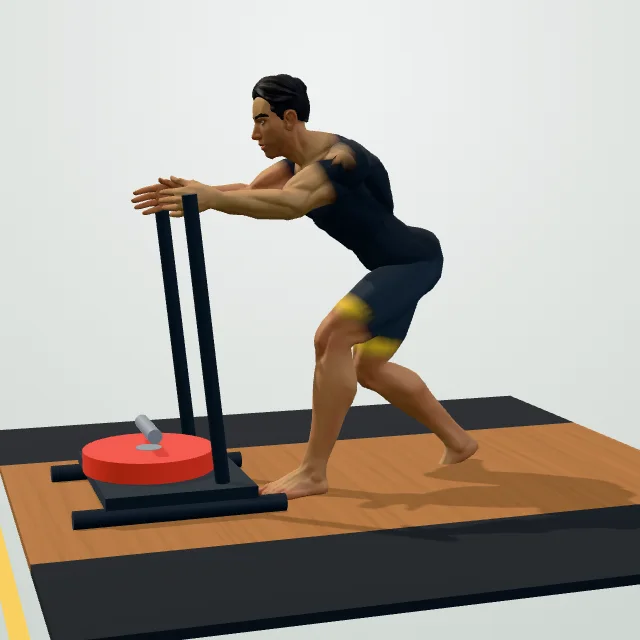
Coach cues
- Lean into the sled, chest toward your hands.
- Short, driving steps, push the ground away.
- Keep your arms mostly straight.
- Stay low and keep pushing to the finish.
Breathing: Breathe rhythmically with your steps; do not hold your breath through the push.
Common mistakes
Make it easier / Make it harder
The sled push loads a weight sled and drives it forward across the floor with both hands, leaning into it and taking short, powerful steps. Because the sled is always in contact with the ground and never gets lifted or thrown, it puts almost no compressive load on your spine, making it one of the safest ways to train heavy leg drive.
What muscles does the sled push work
Your quads and glutes drive each step, extending your hip and knee to push the sled forward, with your calves and hamstrings assisting through the stride. Your front delts and triceps stay engaged to hold the handles steady and keep pushing rather than pulling, which is why a sled push also builds noticeable upper-body endurance despite being a leg-dominant exercise.
Benefits of the sled push
- Builds leg strength with almost no spinal loading, since there is no bar on your back and no eccentric lowering phase to control.
- Very low technical skill required, making it accessible to beginners once the sled is loaded appropriately.
- Doubles as conditioning, since pushing a heavy sled for distance or time raises your heart rate fast.
- A common benchmark movement in HYROX and similar hybrid-fitness events.
How to do the sled push with proper form
Low push vs high push
Gripping the low handles and leaning further forward emphasizes your quads and glutes more, while gripping the high handles with a more upright torso shifts more work onto your shoulders and calves. Both are valid; many people alternate between them within a set.
The push
Set your feet, lean your chest toward the sled at roughly 45 degrees, and brace your core. Take short, driving steps, pushing through the balls of your feet with each stride, and keep your arms mostly straight so you are pushing with your legs rather than steering with your arms.
Sled push vs prowler push
These names describe the same exercise — "prowler" is simply the name of a popular brand of push sled, and the terms are used interchangeably in most gyms and programs. Whichever sled you use, the technique and muscles trained are the same.
Sets, reps and how to program it
Because the sled push is measured by distance or time rather than reps, 4–6 sets of a set distance (such as 15–20 meters) or 20–30 seconds of continuous pushing, with 60–90 seconds of rest, works well for most goals. Load is relative to the individual — choose a weight you can push continuously for the whole distance or time without stalling, and increase it gradually as your technique and conditioning improve. It fits well as a conditioning finisher or as a lower-body strength accessory alongside squats and lunges.
Variations and alternatives
A sled pull, dragging the sled backward or toward you with a rope, trains the opposite muscle groups and is often paired with the push in the same session. If you do not have access to a sled, walking lunges or high knees can provide a comparable low-impact leg and conditioning stimulus.
Safety and who should modify it
Standing too upright behind the sled shifts load onto your lower back, so lean your chest forward and keep your steps short and driving rather than long and bouncy. People with a current knee, hip or back injury, or high blood pressure or heart disease, should check with a doctor or physiotherapist before this kind of sustained, high-effort pushing, and everyone should stop for sharp joint pain, dizziness or unusual breathlessness.
More exercises for full body
Questions people ask
What is a sled push?
What is a prowler?
What muscles does sled push work?
How much weight should I sled push?
Is the sled push good for beginners?
How do I do a sled push at home without a sled?
Is a sled push good cardio?
General fitness information, not medical advice. Check with a doctor or physiotherapist before starting if you have a health condition, an injury or are pregnant. Stop if you feel chest pain, dizziness or sharp pain.