Calves · Home, no equipment
Bodyweight calf raise: training your calves anywhere
Calf raises need nothing but your body weight and a place to stand — rise up onto your toes, lower with control, and repeat. Simple to describe, easy to underdose without paying attention to range and tempo.
- Primary
- Calves
- Level
- Beginner
- Type
- Isolation · Both sides together
- Sets × reps
- 3 × 15-25 reps
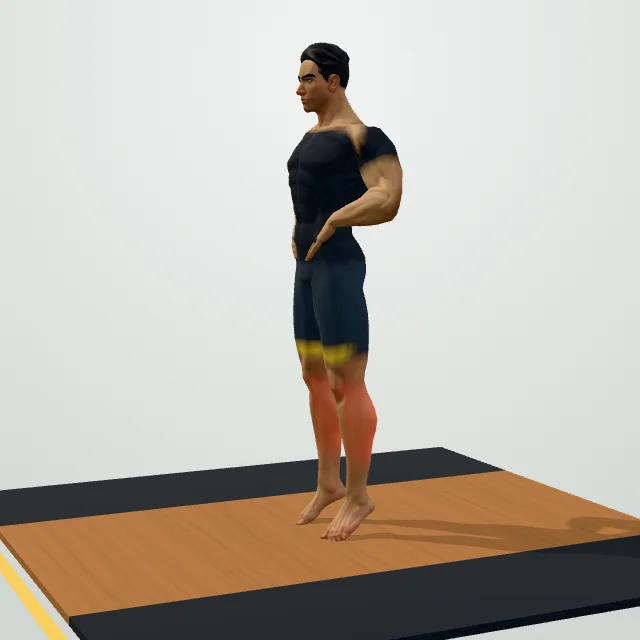
How to do it
- Stand with feet hip-width apart, balls of feet on a raised edge if possible.
- Let your heels drop below your toes into a full stretch.
- Rise up onto your toes as high as you can.
- Pause and squeeze at the top for a moment.
- Lower slowly back down over 2–3 seconds.
- Repeat for the set without bouncing at the bottom.
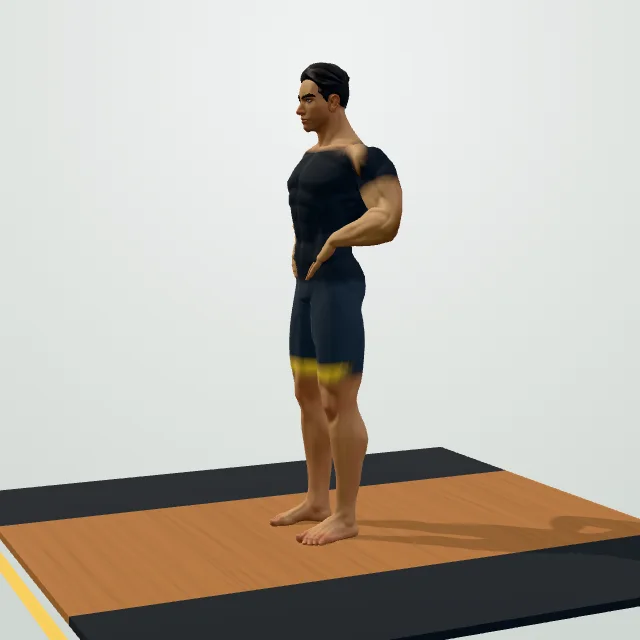
Coach cues
- Lower into a full stretch.
- Rise up high on your toes.
- Pause, squeeze at the top.
- Lower slowly, no bouncing.
Breathing: Breathe out as you rise onto your toes, breathe in as you lower back down.
Common mistakes
Make it easier / Make it harder
Sets and reps by goal
| Goal | sets | reps | Rest |
|---|---|---|---|
| Strength | 4–5 | 6–8 | 90–120 s |
| Muscle growth | 3–4 | 10–15 | 60–90 s |
| Endurance | 2–3 | 15–25+ | 30–60 s |
The bodyweight calf raise is the simplest calf exercise there is: stand tall and rise up onto your toes, then lower back down. It needs no equipment, works anywhere you can stand, and is where almost everyone starts before adding load.
Muscles worked and why range matters more than reps
The calves — the gastrocnemius and soleus — drive the movement, pressing your heel up through your ankle joint. Bodyweight alone is a light load for most people's calves, which is one reason so many people feel like calf raises "do not work": doing a small, quick range of motion with body weight barely challenges the muscle. A full, deep stretch at the bottom and a hard squeeze at the top change that considerably, even without any added weight, so treat range and tempo as the two levers you control before reaching for extra load.
Benefits
Calves absorb impact and generate push-off in almost every standing activity — walking, running, jumping, stairs — so strengthening them supports general daily function as much as sport performance, and weak calves are a common, overlooked contributor to tired legs late in the day. Because bodyweight calf raises need no equipment, they are one of the easiest exercises to fit into a busy day, whether as a few sets while brushing your teeth or a proper set at the end of a home workout.
Technique in detail
Stand with your feet hip-width apart, ideally with the balls of your feet on a step or raised edge so your heels can drop below the level of your toes. Lower your heels into a full stretch, then rise up onto your toes as high as you can, pausing with a squeeze at the top. Lower slowly back down rather than dropping — a slow lowering phase (2–3 seconds) is what turns an easy bodyweight movement into a genuinely useful exercise. Try counting the lowering phase out loud for your first few sets until the tempo becomes automatic.
How to program it
Because body weight alone is light, higher reps make more sense here than for most exercises — 3 sets of 15–25 reps is a reasonable starting point, moving toward single-leg reps once two-leg sets stop being challenging. Calves generally tolerate frequent training well; most people can do calf raises most days without excess soreness, though it is still fine to treat them like any other muscle and allow rest between hard sessions.
Progressions: from bodyweight to loaded
Once standard two-leg calf raises feel easy for 25 or more reps, move to single-leg calf raises, which roughly double the load on each calf without needing any equipment. From there, holding dumbbells, wearing a loaded backpack, or moving to a dedicated standing calf raise or seated calf raise machine lets you keep adding weight as bodyweight versions stop being enough of a challenge.
Bodyweight calf raise vs. weighted standing calf raise
The bodyweight version is the right starting point for beginners and a convenient option anywhere, but progress eventually stalls once your calves adapt to your own body weight. The weighted standing calf raise allows continued progressive overload with dumbbells, a barbell, or a machine once bodyweight reps are no longer challenging enough to drive further adaptation.
Safety notes
Hold onto a wall or rail for balance if needed, especially on single-leg reps or when standing on a raised edge. Avoid bouncing at the bottom of the stretch, which can irritate the Achilles tendon. Anyone with Achilles pain, plantar fasciitis, or a recent calf strain should reduce range and check with a physiotherapist before continuing, and stop if you feel sharp pain rather than a muscular burn.
Building calf raises into daily life
Because the exercise needs no equipment and barely any space, it fits naturally into a short home routine, a work-from-home break, or the end of any bodyweight workout. Doing a set while waiting for the kettle to boil or brushing your teeth is a genuinely reasonable way to add extra volume without needing a dedicated training block.
Workout plans with this exercise
More exercises for calves
Questions people ask
Do bodyweight calf raises actually work?
How many calf raises should I do a day?
How do I make bodyweight calf raises harder?
Do I need a step for calf raises?
Can calf raises help with plantar fasciitis?
When should I add weight to calf raises?
Do calf raises help you jump higher?
General fitness information, not medical advice. Check with a doctor or physiotherapist before starting if you have a health condition, an injury or are pregnant. Stop if you feel chest pain, dizziness or sharp pain.