Calves · Home or gym
Standing calf raise: building calves through full range
The standing calf raise rises up onto your toes with straight legs, a simple movement that builds calf size and strength when the range and tempo are done properly.
- Primary
- Calves
- Level
- Beginner
- Type
- Isolation · Both sides together
- Sets × reps
- 3 × 12-15 reps
How to do it
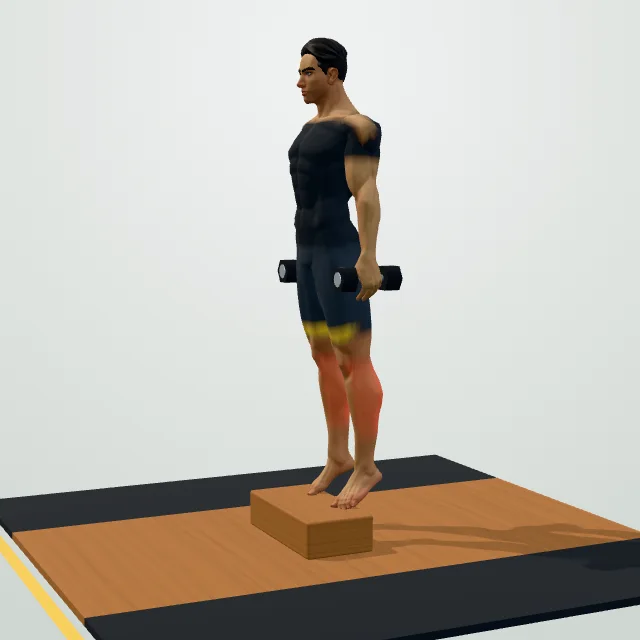
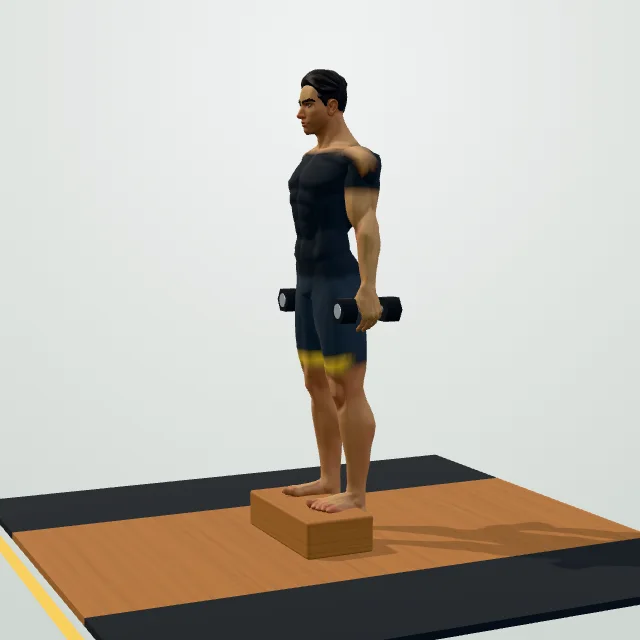
- Stand with the balls of your feet on a raised platform, heels hanging off.
- Hold dumbbells or grip a machine's pads for resistance.
- Lower your heels down into a full stretch.
- Rise up onto your toes as high as you can.
- Pause and squeeze at the top for a moment.
- Lower slowly back to the stretched position.
Coach cues
- Lower into a full stretch.
- Rise up high on your toes.
- Pause, squeeze at the top.
- Lower slowly, no bouncing.
Breathing: Breathe out as you rise onto your toes, breathe in as you lower back down.
Common mistakes
Make it easier / Make it harder
Sets and reps by goal
| Goal | sets | reps | Rest |
|---|---|---|---|
| Strength | 3–5 | 6–8 | 90–120 s |
| Muscle growth | 3–4 | 10–15 | 60–90 s |
| Endurance | 2–3 | 15–20 | 30–60 s |
The standing calf raise has you rise up onto your toes with your legs straight, either on a dedicated machine, holding dumbbells, or with just body weight on a raised edge. Straight knees are the key detail — they put most of the work on the larger of your two calf muscles.
Muscles worked and why the knee position matters
The calves are made up of two main muscles: the gastrocnemius, which crosses both the knee and ankle, and the soleus, which only crosses the ankle. With your knees straight, the gastrocnemius is stretched and in a strong position to contribute, which is why the standing raise is considered the better exercise for building the visible, rounded shape of the upper calf.
Benefits
Calves are used in almost every standing, walking, and running movement, but many lifters under-train them compared with bigger muscle groups, which is a common reason calf development lags behind the rest of the legs. The standing calf raise builds ankle push-off strength that supports running speed and jumping, and because the range of motion is small, it is one of the safer high-rep exercises to add extra training volume without heavy joint stress elsewhere in the body.
Technique in detail
Stand with the balls of your feet on a raised platform or the edge of a step, heels hanging off the back, holding dumbbells or a machine's shoulder pads for resistance. Lower your heels as far as a comfortable stretch allows — this deep bottom stretch is where a lot of the exercise's value comes from, and many people cut it short. Rise up onto your toes as high as you can, pausing for a moment at the top with a hard squeeze, then lower slowly back to the stretched position. Keep your knees straight but not locked throughout. If you feel more strain in your shins or ankles than your calves, the range is probably too aggressive for your current mobility — reduce the depth slightly and rebuild from there.
How to program it
3 sets of 12–15 reps works well for most lifters, though calves respond well to slightly higher reps too — up to 20 per set is common. Because the calves are used constantly in daily life, they can often handle more frequent training than other muscles; twice a week is a reasonable starting point, with some lifters training them most days without excess soreness. Slow the tempo down, especially on the lowering phase, since rushing through reps with a bouncing motion is the most common way people waste this exercise's potential.
Standing vs. seated calf raise
The standing version, with straight knees, favors the larger gastrocnemius muscle. The seated calf raise bends the knee to roughly 90 degrees, which slackens the gastrocnemius and shifts more of the work to the soleus underneath. Most complete calf-training plans include both, since they emphasize different parts of the muscle group.
Variations: single-leg and equipment options
A single-leg standing calf raise doubles the load on each calf and is useful once two-leg reps with a dumbbell start to feel too easy. If no machine or platform is available, the bodyweight calf raise trains the same pattern from flat ground, and holding dumbbells adds load without needing any specialized equipment.
Safety notes
Avoid bouncing at the bottom of the stretch — a controlled tempo protects the Achilles tendon, which can be irritated by fast, jerky reps under load. Anyone with Achilles tendon pain or a recent calf strain should reduce range and load and check with a physiotherapist before continuing. Stop if you feel sharp pain in the ankle or Achilles rather than a muscular burn in the calf.
Where it fits in your workout
Place calf raises near the end of a lower-body session, after your main squat, deadlift, or lunge work, since they need little recovery time and do not interfere with heavier compound lifts earlier on. They also work well as a quick finisher on upper-body days if your leg sessions are already full, since the exercise takes very little time and minimal equipment to add in.
Workout plans with this exercise
Build muscle · Intermediate
Push Pull Legs Split (6 Days)
Strength · Intermediate
Upper/Lower Split (4 Days)
Build muscle · Intermediate
4-Day Muscle-Building Workout Plan
Build muscle · Intermediate
5-Day Body-Part Split (Bro Split)
Build muscle · Intermediate
Leg Day Workout (Gym)
More exercises for calves
Questions people ask
What muscles does the standing calf raise work?
Standing vs. seated calf raise: what is the difference?
How many standing calf raises should I do?
Why do my calves not grow from standing calf raises?
Can I do standing calf raises without a machine?
How do I make standing calf raises harder?
Are standing calf raises enough for calf development?
General fitness information, not medical advice. Check with a doctor or physiotherapist before starting if you have a health condition, an injury or are pregnant. Stop if you feel chest pain, dizziness or sharp pain.