Legs · Home, no equipment
The wall sit: how long to hold it and why it works
The wall sit is a static hold that builds quad endurance using nothing but a wall. Here is how to set up, how long to hold it, and how it compares to squats.
- Primary
- Quads
- Secondary
- GlutesInner thighs
- Level
- Beginner
- Type
- Compound · Both sides together
- Sets × reps
- 3 × 40 s hold
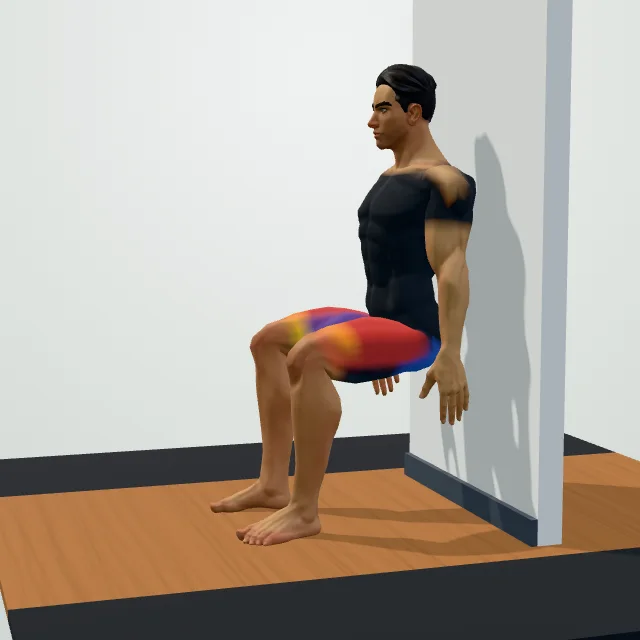
How to do it
- Stand with your back against a wall, feet shoulder-width apart.
- Walk your feet forward and slide down the wall.
- Stop when your thighs are close to parallel with the floor.
- Press your lower back flat against the wall and brace your core.
- Hold the position, keeping your knees over your ankles.
- Slide back up the wall to stand when the set time ends.
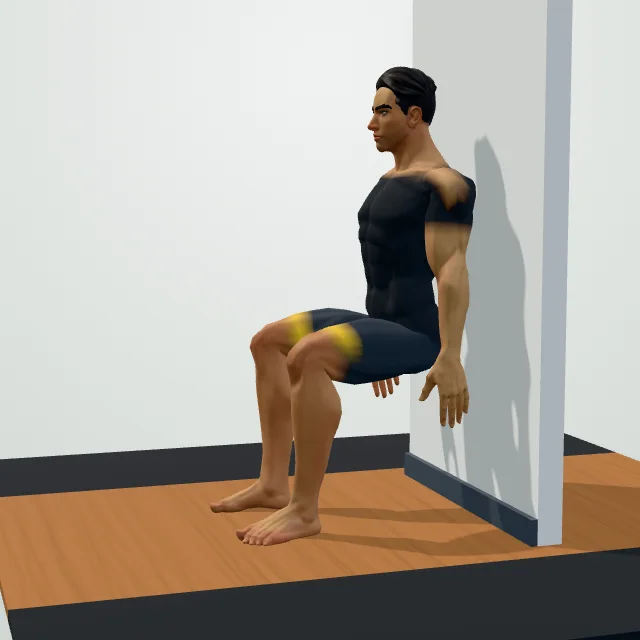
Coach cues
- Back flat against the wall, feet shoulder-width apart.
- Slide down until your thighs are close to parallel.
- Knees stay stacked over your ankles.
- Breathe steadily and hold the position.
Breathing: Breathe slowly and steadily throughout the hold and do not hold your breath.
Common mistakes
Make it easier / Make it harder
A wall sit is an isometric hold: you slide down a wall into a squat position and stay there, still, for time instead of reps. It takes nothing but a flat wall, which is why the wall sit exercise, also called a wall squat or wall squat hold, shows up in gym class fitness tests, viral wall sit challenges, and as a quad-burning finisher at the end of a leg workout.
What muscles does a wall sit work?
Because you hold one fixed knee and hip angle instead of moving through a range, a wall sit is dominated by your quads, the muscles on the front of your thigh that keep your knee from buckling under your body weight. Your glutes work isometrically to keep your hips from sagging, your adductors (inner thigh) help keep your knees from drifting inward, and your core braces to keep your back flat, a wall sit for core stability as much as legs. Because nothing is moving, it trains muscular endurance, how long a muscle keeps producing force, rather than the strength or power a full-range squat builds.
Wall sit benefits
- Quad endurance with no equipment. All you need is a wall, one of the most accessible wall sit exercises to do at home, at work, or while travelling.
- Low-impact loading. No repeated bending and straightening of the knee, so it can suit people easing back into training, provided it does not cause joint pain.
- A ready-made challenge. The simple "how long can you hold it" format is why wall sits turn up in school fitness tests and 30-day wall sit challenges.
- Blood pressure research. Studies on isometric holds such as wall sits suggest they can help lower resting blood pressure over time alongside regular aerobic activity. If you have high blood pressure or heart disease, check with a doctor first and never hold your breath during the hold.
How long should you hold a wall sit?
There is no single correct answer for how long to hold a wall sit, it depends on your level and why you are doing it.
| Level | Typical hold | Sets |
|---|---|---|
| Beginner | 15-30 sec | 2-3 |
| Intermediate | 30-45 sec | 3 |
| Advanced / fitness test | 60-90+ sec | 2-3 |
A two-minute wall sit is a strong result for most non-athletes, and some fitness tests use wall sit hold time as a simple, repeatable score to track over weeks. Competitive wall sit world record holds run past an hour, but that is a specialized feat, not a useful target for general fitness, build your hold time up gradually instead.
Wall sit technique
Stand with your back against a wall and walk your feet forward, then slide down until your hips and knees sit at roughly a right angle, thighs close to parallel with the floor. How far your feet sit from the wall sets the angle: feet further out make the hold harder on the quads, while feet closer to the wall give an easier, higher position. Press your lower back flat against the wall and brace your core so it does not arch, and keep your knees stacked over your ankles rather than pushed out past your toes. Keep your weight through your whole foot, and breathe steadily instead of holding your breath.
Wall sit vs squats
Is a wall sit a good exercise on its own? For endurance and convenience, yes, but it works best paired with a moving exercise like the bodyweight squat. A squat moves your knee and hip through a full range, building strength through the whole motion, including the drive back up. The wall sit removes the movement and instead asks your quads to keep producing force at one angle for a stretch of time, useful for muscular endurance, but it will not build the same strength through range that a squat, or an isolation move like the leg extension, does.
Wall sit variations and progressions
- Single leg wall sit: lift one foot slightly off the floor to shift almost all the load onto the other leg — a significant jump in difficulty.
- Weighted wall sit: rest a light dumbbell or plate across your thighs once bodyweight holds past 60 seconds feel manageable.
- Wall sit with calf raises: add small heel raises during the hold to bring the calves into play.
- Wall sit with an overhead hold: hold light dumbbells overhead to add an upper-body endurance challenge to the same lower-body hold.
- Higher-angle wall sit: step your feet closer to the wall for a shallower, easier knee angle while you build up your base hold time.
Wall sit karne ke liye deewar se peeth tikaakar neeche is tarah slide karein ki jaanghein farsh ke samaanaantar ho jaayein. Ghutne pairon ki ungliyon se aage na jaayein, aur saans normal roop se lete rahein. Yah quads aur glutes ke liye ek accha bina-equipment wala exercise hai, khaaskar beginners aur seniors ke liye.
Wall sit safety
Stop for sharp knee or joint pain, chest pain, dizziness, or unusual breathlessness, mild burning and shaking in the thighs is normal fatigue, not a warning sign.
If you have knee pain, keep your knees from tracking past your toes and try a higher, shallower angle. Warm up first, and build hold time up gradually rather than jumping to a long hold. If you have a heart or blood-pressure condition, are pregnant, or are recovering from a knee or hip injury, check with a doctor or physiotherapist first, and never hold your breath through the hold. See our guide to exercise for knee pain, exercise for high blood pressure, or exercise for seniors for more detail.
More exercises for legs
Questions people ask
How long should you hold a wall sit?
What muscles does a wall sit work?
Do wall sits help lower blood pressure?
Are wall sits bad for your knees?
Wall sit vs squats: which is better?
Can wall sits tone your legs or help you lose weight?
What is a good wall sit time for a beginner?
General fitness information, not medical advice. Check with a doctor or physiotherapist before starting if you have a health condition, an injury or are pregnant. Stop if you feel chest pain, dizziness or sharp pain.