Legs · Gym
Leg press: quad and glute strength without a spotter
The leg press lets you load your quads and glutes hard on a fixed, machine-guided path, so you can push close to failure without needing a spotter. Foot placement and seat angle change which muscles do the most work.
- Secondary
- HamstringsInner thighs
- Level
- Beginner
- Type
- Compound · Both sides together
- Sets × reps
- 3 × 10-12 reps
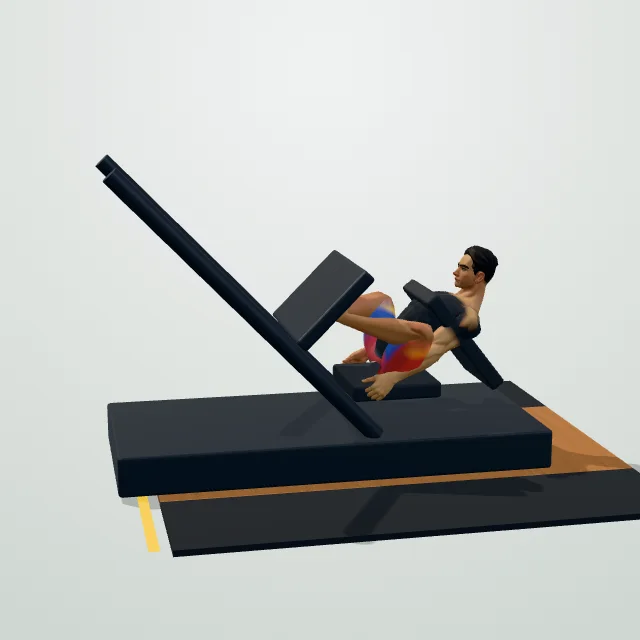
How to do it
- Sit in the leg press with your back and head against the pad.
- Place your feet on the platform at shoulder width, toes slightly out.
- Release the safety catches and lower the platform under control.
- Stop when your knees reach about 90 degrees or your lower back starts to round.
- Press through your whole foot to extend your legs without locking out hard.
- Re-engage the safety catches after your last rep.
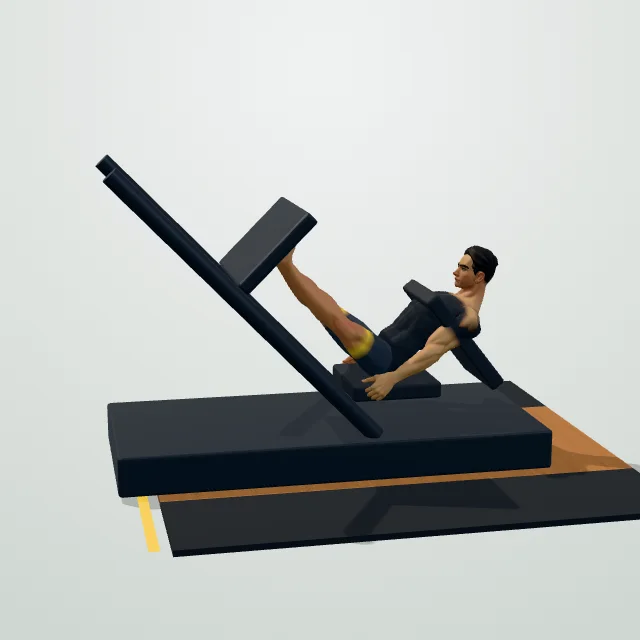
Coach cues
- Knees track over your toes, not caving in.
- Lower under control, keep your back flat on the pad.
- Press through your whole foot.
- Stop just short of locking your knees out.
Breathing: Breathe in as you lower the platform, then breathe out as you press it away.
Common mistakes
Make it easier / Make it harder
Sets and reps by goal
| Goal | sets | reps | Rest |
|---|---|---|---|
| Strength | 3–5 | 3–6 | 2–4 min |
| Muscle growth | 3–4 | 6–12 | 90–150 s |
| Endurance | 2–3 | 15–20 | 30–60 s |
The leg press lets you push a weighted platform away from your body along a fixed track while your back stays supported by a pad, so your quads and glutes do the work without your core and spine having to stabilize a free bar. Because the machine guides the path, it's one of the safest ways to train your legs close to failure without a spotter, which is why it earns a place in almost every leg day workout.
Muscles worked and why foot placement matters
The quads and glutes share the main work, straightening the knee and driving hip extension as you push the platform away, while the hamstrings assist the glutes and the adductors help stop your knees from caving inward. Because the seat and backrest fix your hip angle for you, small changes in where you place your feet shift which of those two prime movers carries the biggest share of the work — good leg press form starts with foot placement, not how much weight is stacked on the sled.
Benefits
The leg press machine's fixed path removes the balance and coordination demands of a barbell squat, so beginners can learn to push hard through their legs before they also have to learn to brace a bar overhead. Because the machine controls the weight rather than your own balance, you can safely push a set close to failure without a spotter, which is useful for high-effort accessory work after your main squat or deadlift. These leg press benefits are also why it suits lifters whose lower back, not their legs, is the limiting factor — it isolates leg drive without loading the spine the way a standing squat does.
Foot placement and seat angle
Foot placement is the main lever you have for shifting emphasis on the leg press. A higher, narrower position moves more of the work onto the glutes and hamstrings, since it increases hip flexion at the bottom of the rep — a better leg press for hamstrings and glutes. A lower, wider stance with toes turned out slightly shifts more load onto the quads and inner thighs, since the knees travel further forward relative to the hips — a better leg press for quads. Seat angle matters too: a more upright 45 degree leg press asks less of your hips and lower back than a horizontal seated leg press, where your torso and thighs fold together more at the bottom.
Setup and a safe range of motion
Set the seat so your knees track over roughly the middle of your feet, not caving inward, when the platform is at its lowest comfortable point. Lower the platform under control until your knees reach about 90 degrees, or slightly further if your hips and lower back stay flat against the pad — the moment your tailbone starts to lift or your lower back rounds off the pad, that's your true depth limit for the day, not a fixed number of degrees. Press back up without locking your knees out hard at the top, and never rest with your knees fully unlocked while weight is loaded on the sled.
How to program the leg press
For muscle size, 3–4 sets of 10–15 reps with 60–90 seconds of rest works well; for strength-focused work, 3–4 sets of 6–10 reps with about 2 minutes of rest and a slightly slower tempo builds more control at heavier loads. Either way, pick a weight that leaves 1–3 reps in reserve on your working sets — the RPE and RIR guide explains how to judge that. Train it once or twice a week as part of a wider leg session, and add small jumps in weight once every rep looks the same as your first, following the progressive overload approach.
Leg press vs squat
The barbell back squat asks your whole body to stabilize a load on your back, so it builds full-body bracing strength that carries over to sport and daily movement, but it also demands more mobility, balance, and technique to load heavy. The leg press strips that stabilizing demand away, letting you isolate leg strength and push closer to failure safely, which makes it a strong complement to — not a full replacement for — squatting. Many programs use the back squat as the main lift and the leg press as a higher-volume finisher.
Variations
Single leg press form — one leg at a time — is useful for finding and fixing a strength difference between sides. If you don't have access to a leg press machine, the hack squat is a strong leg press alternative that gives a similar fixed-path quad workout, and the goblet squat is a good free-weight substitute for leg press at home training.
Safety
Keep your knees tracking in line with your toes rather than letting them cave inward, especially as the weight gets heavy. If you feel sharp pain at the front of the knee or in your lower back rather than normal muscle fatigue, stop, reduce the depth or weight, and check with a physiotherapist if it doesn't settle within a few days — this matters especially if you have a history of knee pain. Never let your lower back round off the pad to chase extra depth, and avoid holding your breath through a heavy set if you have high blood pressure or a heart condition; breathe out as you press instead. Warm up with a lighter set or two before loading up, and add weight gradually.
Workout plans with this exercise
General fitness · Beginner
Beginner Full-Body Gym Workout
Build muscle · Intermediate
Push Pull Legs Split (6 Days)
Strength · Intermediate
Upper/Lower Split (4 Days)
Build muscle · Intermediate
5-Day Body-Part Split (Bro Split)
Build muscle · Intermediate
Leg Day Workout (Gym)
General fitness · Beginner
Beginner Gym Workout Plan for Women
Questions people ask
What muscles does the leg press work?
Is the leg press as good as squats?
Where should I put my feet on the leg press for glutes?
Is the leg press bad for your knees or lower back?
How much weight should a beginner leg press?
Can I do a leg press at home without a machine?
Single-leg vs double-leg press — what is the difference?
General fitness information, not medical advice. Check with a doctor or physiotherapist before starting if you have a health condition, an injury or are pregnant. Stop if you feel chest pain, dizziness or sharp pain.