Biceps · Home or gym
Resistance band bicep curl: build arms anywhere, no dumbbells needed
The resistance band bicep curl trains the same muscles as a dumbbell curl using a band underfoot or anchored to a door, making it one of the easiest biceps exercises to do at home or while traveling.
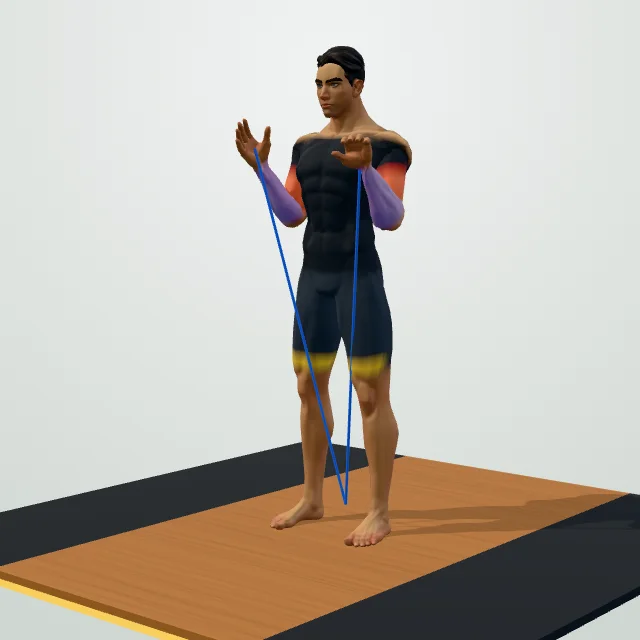
How to do it
- Stand on the middle of the band with feet shoulder-width apart.
- Hold one end in each hand, palms facing forward.
- Keep elbows pinned to your sides.
- Curl your hands up toward your shoulders.
- Squeeze briefly at the top without leaning back.
- Lower slowly, letting the band control the descent.
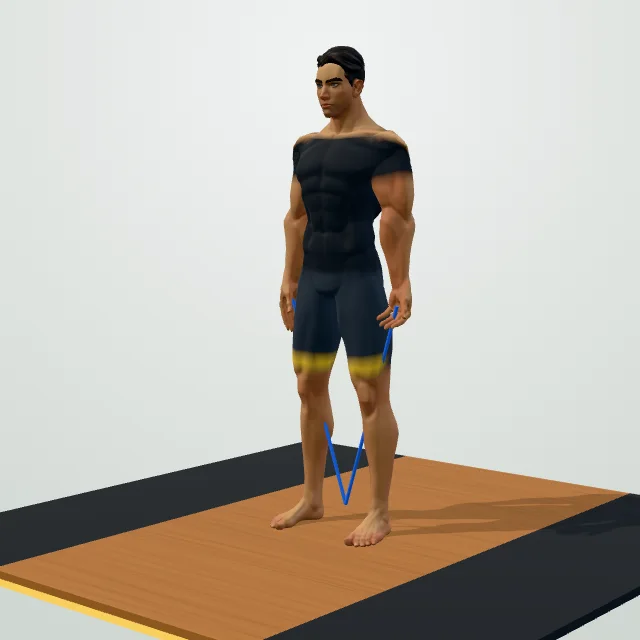
Coach cues
- Stand on the band, feet apart.
- Elbows stay pinned to your sides.
- Curl up without leaning back.
- Lower slowly against the band.
Breathing: Breathe out as you curl your hands up, and breathe in as you lower them back down.
Common mistakes
Make it easier / Make it harder
Sets and reps by goal
| Goal | sets | reps | Rest |
|---|---|---|---|
| Strength | 3–5 | 6–8 | 90–120 s |
| Muscle growth | 3–4 | 10–15 | 60–90 s |
| Endurance | 2–3 | 15–20 | 30–60 s |
The resistance band bicep curl trains the same elbow-flexing motion as a dumbbell curl, but the resistance comes from stretching an elastic band instead of lifting a weight against gravity. Stand on the band or anchor it low to a door, and you have a full biceps exercise with equipment that fits in a bag — useful for home workouts, hotel rooms, or as a lighter option when your joints need a break from free weights.
Bands also load the muscle differently than dumbbells: resistance increases the further you stretch the band, so the top of the curl — where a dumbbell curl often feels easiest — is where a band curl feels hardest. See the resistance band exercises hub for more band-based training.
Muscles the resistance band bicep curl works
The band curl trains the biceps brachii through elbow flexion, with the brachialis assisting underneath, the same as any curl variation. The forearm flexors and grip muscles also work to hold the band handle or loop throughout the set. Because bands provide increasing resistance as they stretch, the biceps works especially hard in the top half of the rep, which is a useful complement to dumbbell curls, where that same range is the easiest part of the lift.
Benefits of the resistance band bicep curl
- Portable: a band packs into a small bag, making it practical for home, travel, or outdoor training.
- Joint-friendly: the smooth, elastic resistance is often gentler on the elbows and wrists than a heavy dumbbell.
- Increasing resistance: the band gets harder to stretch near the top of the curl, which challenges the peak contraction in a way free weights do not.
- Cheap and scalable: bands come in different resistance levels, or you can shorten the band for more tension.
Technique: anchor, grip and tempo
Stand on the middle of the band with both feet shoulder-width apart, holding one end in each hand with palms facing forward. Keep your elbows pinned to your sides and curl your hands up toward your shoulders, resisting the urge to lean back as the band gets harder to stretch near the top. Squeeze briefly at the top, then lower slowly over 2–3 seconds, letting the band's tension control the descent rather than dropping your hands.
If the band feels too easy at the bottom and too hard at the top, shorten it by wrapping an extra turn around your hands, or step further apart on the band to increase the starting tension. A door anchor, set at a low point, works the same way and lets you curl from a standing or seated position.
How to program the resistance band bicep curl
| Goal | Sets | Reps | Rest |
|---|---|---|---|
| Strength | 3 | 10–12 | 60–90 seconds |
| Muscle (hypertrophy) | 3 | 12–15 | 60 seconds |
| Endurance | 2–3 | 15–20 | 45 seconds |
Because bands do not have fixed weight increments, progress by using a heavier resistance band, standing further apart on it, or slowing the tempo once the current band feels easy for the full rep range — the progressive overload guide covers all three approaches. This exercise fits well into the resistance band full-body workout or as a biceps finisher on days you train at home.
Variations and progressions
- Band hammer curl: hold the handles with palms facing each other for more brachialis and forearm involvement.
- Seated band curl: anchor the band under a chair leg for a more stable base.
- Single-arm band curl: curl one side at a time, anchoring the band under one foot.
- Band curl to shoulder press: add a press at the top for a combined arm and shoulder movement.
If you progress past what your bands can offer, the dumbbell curl or cable curl are natural next steps once you have access to weights.
Resistance band curl vs dumbbell curl
A dumbbell curl is hardest in the middle of the range, where gravity pulls most directly against the arm, and easiest at the top. A resistance band curl flips that: it is easiest at the bottom and hardest at the top, as the band stretches further. Neither is more effective for biceps growth in general — bands are simply a practical, portable substitute when dumbbells are not available, and many home workouts rely on them for exactly that reason.
Safety and who should modify it
Check your band regularly for nicks or thinning, since a worn band can snap under tension. Anchor it securely — under both feet or through a solid door anchor — before pulling hard, and keep your grip firm so the handles do not slip. If you have wrist or elbow pain, a band is usually gentler than a dumbbell, but stop if you feel sharp pain rather than normal muscle fatigue, and ease into new resistance levels gradually.
Workout plans with this exercise
More exercises for biceps
Questions people ask
Can resistance bands actually build biceps?
What muscles does the resistance band bicep curl work?
How do I make a band curl harder?
Is a band curl as effective as a dumbbell curl?
How do I anchor the band for a standing curl?
Are band curls safe for wrist or elbow pain?
General fitness information, not medical advice. Check with a doctor or physiotherapist before starting if you have a health condition, an injury or are pregnant. Stop if you feel chest pain, dizziness or sharp pain.