Biceps · Home or gym
Concentration curl: one-arm peak contraction for the biceps
The concentration curl braces your elbow against your inner thigh so one arm curls in complete isolation. It is a favorite for building mind-muscle connection and finishing an arm workout.
- Primary
- Biceps
- Level
- Beginner
- Type
- Isolation · One side, then the other
- Sets × reps
- 3 × 10-12 reps per side
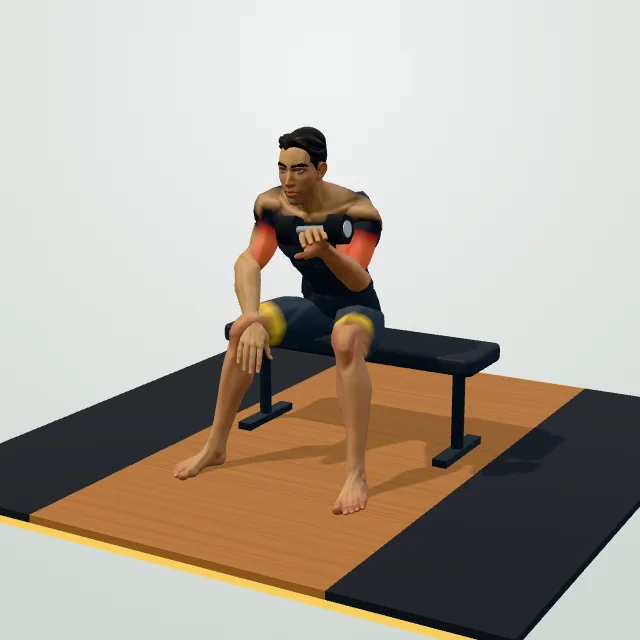
How to do it
- Sit on a bench with feet wide apart, dumbbell in one hand.
- Lean forward and brace the back of your upper arm against your thigh.
- Let the dumbbell hang for a full stretch at the bottom.
- Curl the dumbbell up toward your shoulder, elbow braced.
- Squeeze the biceps for a second at the top.
- Lower slowly back to a full stretch, then repeat or switch arms.
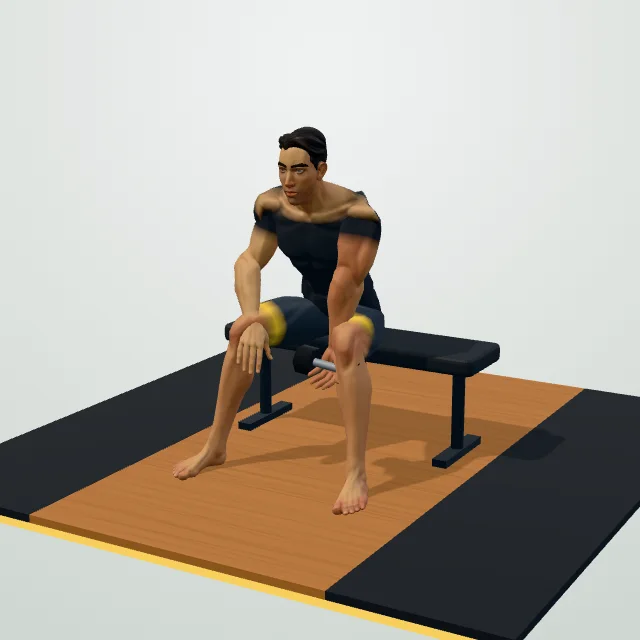
Coach cues
- Brace your elbow against your thigh.
- Let the weight stretch down fully.
- Curl up and squeeze at the top.
- Keep your torso still, no rocking.
Breathing: Breathe in as you lower the dumbbell into the stretch, and breathe out as you curl it up.
Common mistakes
Make it easier / Make it harder
Sets and reps by goal
| Goal | sets | reps | Rest |
|---|---|---|---|
| Strength | 3–5 | 6–8 | 90–120 s |
| Muscle growth | 3–4 | 10–15 | 60–90 s |
| Endurance | 2–3 | 15–20 | 30–60 s |
The concentration curl is a seated, one-arm dumbbell curl where you brace the back of your upper arm against the inside of your thigh, removing almost every way to cheat the weight up. With momentum taken out of the equation and full attention on a single arm, it is one of the best exercises for learning what a hard biceps contraction actually feels like — hence the name.
No preacher bench or special equipment is needed, just a dumbbell and something to sit on, which makes it one of the more accessible biceps exercises for a home gym or a busy gym floor.
Muscles the concentration curl works
The concentration curl isolates the biceps brachii, and the seated, braced position is often cited as emphasizing the peak of the muscle at the top of the rep — the "flex" most people picture when they think of a biceps curl. The brachialis, underneath the biceps, assists with elbow flexion throughout. Because the working arm is completely supported, there is essentially no contribution from the shoulders, back, or opposite arm, which is exactly what makes this exercise so good for correcting a weaker side.
Benefits of the concentration curl
- Fixes side-to-side imbalances: training one arm at a time with no assistance from the other makes a weaker arm easy to spot and correct.
- Builds mind-muscle connection: the braced, slow setup makes it easier to feel the biceps working, which can improve technique on other curls too.
- No special equipment: just a dumbbell and a bench or chair, unlike the preacher curl, which needs an angled pad.
- Strong peak squeeze: the stable base lets you pause and squeeze hard at the top of every rep.
Technique: setup, grip and range
Sit on the edge of a bench with your feet wide apart. Pick up a dumbbell and lean forward slightly, resting the back of your working upper arm against the inside of the same-side thigh — this is what locks the arm in place. Let the dumbbell hang all the way down for a full stretch, then curl it up toward your shoulder by bending only at the elbow. Pause and squeeze at the top for a second, then lower slowly over 2–3 seconds. Your torso should stay still; if you find yourself leaning back or rocking to finish the rep, the weight is too heavy.
Keep your wrist neutral rather than curling it forward or back, and let your palm gradually rotate to face your shoulder as you lift, which follows the arm's natural path and keeps tension on the biceps rather than the forearm.
How to program the concentration curl
| Goal | Sets | Reps | Rest |
|---|---|---|---|
| Strength | 2–3 | 6–8 | 90 seconds |
| Muscle (hypertrophy) | 3 | 10–12 | 60 seconds |
| Endurance | 2–3 | 15+ | 45 seconds |
Since this is a strict single-arm isolation move, most people use a lighter dumbbell than they would on a two-arm curl — that is expected. Work one arm fully before switching, and if one side is weaker, do it first while you are fresh. It fits well as a finishing exercise after a compound pull like the barbell row or lat pulldown; see the sets and reps guide and rest between sets guide for more on structuring an arm-focused block.
Variations and progressions
- Standing concentration curl: brace your elbow against your inner thigh while bent over, useful if a bench is not available.
- Cable concentration curl: a low cable pulley keeps tension on the biceps even at the bottom of the rep — see cable machine exercises.
- Reverse-grip concentration curl: an overhand grip shifts more emphasis onto the brachialis and forearm.
- Slower eccentric: once the standard rep feels easy, add a 4-second lowering phase before adding weight.
Concentration curl vs preacher curl
Both exercises isolate the biceps by removing shoulder swing, but they do it differently. The preacher curl uses an angled pad and usually a bar, which lets you load both arms at once but needs specific equipment. The concentration curl uses your own leg as the brace, works one arm at a time, and needs nothing but a dumbbell — a practical choice for home training or when the preacher bench is busy. Many lifters rotate between the two rather than picking one permanently.
Safety and who should modify it
The concentration curl is a low-risk, low-impact exercise, but avoid yanking the dumbbell up with your torso if the weight feels heavy — that defeats the purpose and can strain the lower back. If you have wrist or elbow pain, keep the range of motion pain-free and reduce the weight before progressing. As with any new exercise, warm up the arm with a lighter set first.
Workout plans with this exercise
More exercises for biceps
Questions people ask
What muscles does the concentration curl work?
How do I brace my arm for a concentration curl?
Is the concentration curl better than a regular bicep curl?
How heavy should a concentration curl be?
Can I do concentration curls without a bench?
Are concentration curls good for beginners?
General fitness information, not medical advice. Check with a doctor or physiotherapist before starting if you have a health condition, an injury or are pregnant. Stop if you feel chest pain, dizziness or sharp pain.