Biceps · Gym
Cable curl: constant tension biceps training on the pulley
The cable curl keeps tension on the biceps through the entire rep, including the top, where a dumbbell curl goes slack. Here is how to set it up and which attachment to pick.
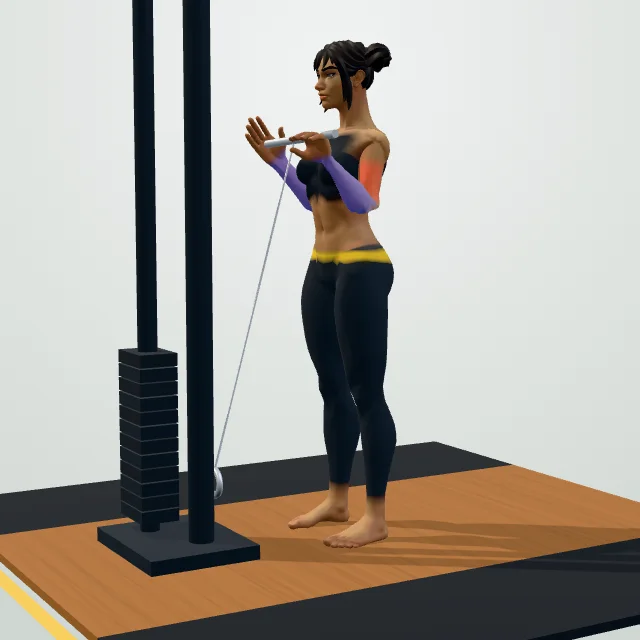
How to do it
- Set the pulley low and attach a straight bar, EZ-bar, or rope.
- Stand back with a slight forward lean and elbows at your sides.
- Curl the attachment up toward your shoulders.
- Squeeze the biceps at the top without flaring your elbows.
- Lower under control, keeping tension on the muscle.
- Repeat without letting your elbows drift forward.
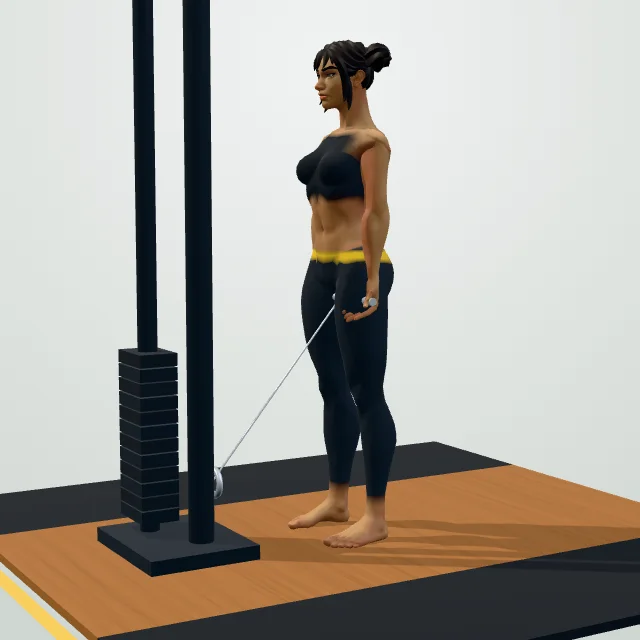
Coach cues
- Elbows stay pinned to your sides.
- Lean back slightly to keep tension on.
- Curl up and squeeze at the top.
- Lower slowly, keep a slight bend.
Breathing: Breathe out as you curl the attachment up, and breathe in as you lower it back down.
Common mistakes
Make it easier / Make it harder
Sets and reps by goal
| Goal | sets | reps | Rest |
|---|---|---|---|
| Strength | 3–5 | 6–8 | 90–120 s |
| Muscle growth | 3–4 | 10–15 | 60–90 s |
| Endurance | 2–3 | 15–20 | 30–60 s |
The cable curl replaces a dumbbell or barbell with a low pulley, so the resistance comes from a cable rather than gravity pulling straight down. That matters because it keeps constant tension on the biceps through the whole range, including the top of the curl, where free weights lose most of their resistance as the arm nears vertical. It is a straightforward way to add variety and a different training stimulus to your biceps routine.
Muscles the cable curl works
The cable curl trains the biceps brachii through elbow flexion, with the brachialis assisting underneath. Grip strength and the forearm flexors also work to hold the attachment, more so with a straight bar or EZ-bar than with a rope. Because the cable pulls at a constant angle rather than straight down, the muscle stays under tension even in the top third of the rep, a range where a dumbbell curl gives the biceps a break.
Benefits of the cable curl
- Constant tension: no resting point at the top of the rep, which many lifters feel as a harder peak contraction.
- Adjustable angle: stepping back from the machine changes the resistance curve, something free weights cannot do.
- Attachment options: a straight bar, EZ-bar, rope, or single-arm handle each shift the grip and slightly change which part of the biceps feels the most work.
- Joint-friendly: the smooth cable path is often more comfortable on the wrists and elbows than a heavy barbell curl.
Technique: stance, path and grip
Set the pulley to the lowest position and attach a straight bar, EZ-bar, or rope. Stand far enough back that the cable is angled rather than running straight up your body, with a slight forward lean from the hips — this is what keeps tension on the biceps at the top of the rep instead of letting the resistance point straight down through your arm. Keep your elbows pinned to your sides, curl the attachment up toward your shoulders, and squeeze at the top without letting your elbows drift forward. Lower under control until your arms are almost straight, keeping a small bend so tension stays on the muscle rather than the joint.
With a straight bar, a slightly narrower or wider grip changes the emphasis slightly; with a rope, let your hands rotate outward at the top for a stronger peak squeeze, similar to a hammer curl finish.
How to program the cable curl
| Goal | Sets | Reps | Rest |
|---|---|---|---|
| Strength | 3 | 8–10 | 90 seconds |
| Muscle (hypertrophy) | 3 | 10–15 | 60–90 seconds |
| Endurance | 2–3 | 15–20 | 45 seconds |
Cable curls are a good exercise for higher-rep, constant-tension finishing sets or drop sets, since dropping the pin on a stack is faster than swapping dumbbells. Because there is no eccentric "dead spot," many people find they can push closer to failure safely here than on a free-weight curl — the RPE and RIR guide explains how to judge that. Use it as a second or third biceps exercise after a heavier free-weight curl, and see the progressive overload guide for adding load week to week.
Variations and progressions
- Rope cable curl: a neutral, hammer-style grip that shifts some emphasis to the brachialis and forearm.
- Single-arm cable curl: lets you check for side-to-side strength differences and add a slight twist at the top.
- Bayesian (face-away) cable curl: facing away from the machine so the cable pulls the arm back at the bottom, creating a deep stretch — an increasingly popular variation for biceps growth.
- Cable drag curl: the bar drags up the torso with elbows moving back, which reduces front-delt involvement and increases biceps tension at the top.
No cable machine at home? The resistance band bicep curl gives a similar constant-tension feel.
Cable curl vs dumbbell curl
A dumbbell curl is resisted by gravity, so tension is highest when your forearm is roughly horizontal and drops off near the top and bottom of the rep. A cable curl keeps the resistance more even across the whole range because the cable's pull angle does not depend on gravity the same way. Neither is more effective for building the biceps overall — most well-rounded arm programs use both a free-weight curl and a cable or machine curl across the week.
Safety and who should modify it
Cable curls are generally low-impact, but avoid leaning back excessively or using your hips to heave the bar up — that shifts load onto the lower back instead of the biceps. If you feel elbow or wrist strain, try a rope attachment instead of a straight bar, which allows a more natural wrist angle. Anyone with existing elbow tendon pain should reduce the load and range of motion before progressing.
Workout plans with this exercise
More exercises for biceps
Questions people ask
What muscles does the cable curl work?
Is the cable curl better than a dumbbell curl?
Which cable attachment is best for biceps?
How do I stand for a cable curl?
Can I do cable curls at home without a machine?
What is a bayesian cable curl?
General fitness information, not medical advice. Check with a doctor or physiotherapist before starting if you have a health condition, an injury or are pregnant. Stop if you feel chest pain, dizziness or sharp pain.