Biceps · Home or gym
Dumbbell curl: build even biceps, one arm at a time
Curling a dumbbell in each hand lets your arms move independently and rotate naturally, which is why it remains the most common way people start training biceps.
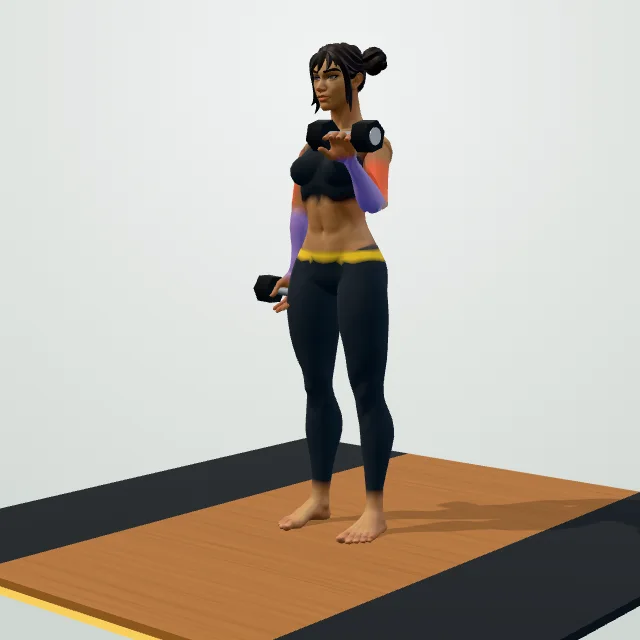
How to do it
- Stand tall holding a dumbbell in each hand at your sides.
- Keep your elbows close to your torso.
- Curl the dumbbell up by bending your elbow.
- Rotate your palm to face your shoulder as you curl.
- Squeeze briefly near the top of the movement.
- Lower with control back to a full arm extension.
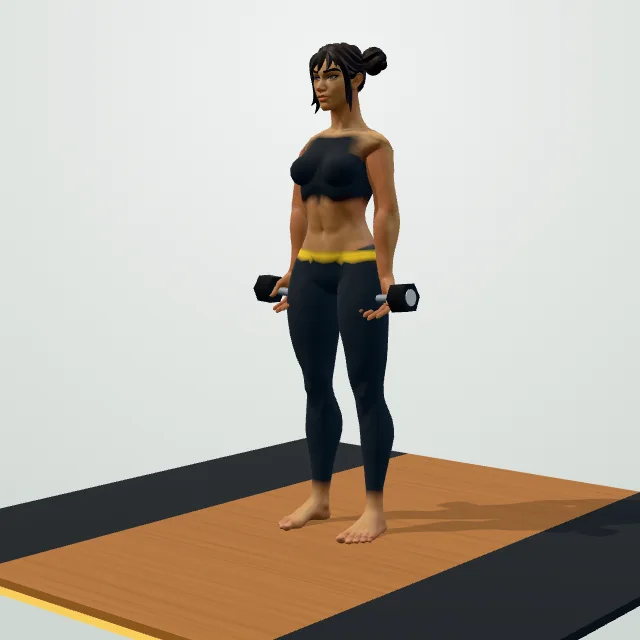
Coach cues
- Elbows pinned close to your sides.
- Curl up, rotate palm toward your shoulder.
- Squeeze briefly at the top.
- Lower fully with control.
Breathing: Breathe out as you curl the dumbbell up, and breathe in as you lower it back down.
Common mistakes
Make it easier / Make it harder
Sets and reps by goal
| Goal | sets | reps | Rest |
|---|---|---|---|
| Strength | 3–5 | 6–8 | 90–120 s |
| Muscle growth | 3–4 | 10–15 | 60–90 s |
| Endurance | 2–3 | 15–20 | 30–60 s |
The dumbbell bicep curl bends your elbow to bring a dumbbell from your thigh up toward your shoulder, done with one arm at a time or both together. Because each dumbbell moves independently, your wrist can rotate naturally through the curl and a weaker arm cannot rely on a stronger one to move a shared bar.
Muscles worked by the dumbbell curl
The biceps drive the curl, bending the elbow against the dumbbell's weight, and your forearms grip and stabilize throughout. Rotating your palm to face up as you curl — common with dumbbells since each hand is free to turn — adds a small extra contraction at the top compared with a fixed barbell grip, which some lifters feel targets the biceps peak slightly more directly.
Benefits
- Fixes side-to-side imbalances. Each arm has to lift its own weight, so a weaker side cannot hide.
- Natural wrist rotation. Dumbbells let your grip turn through the curl rather than staying fixed.
- Flexible loading. Curl both arms together, alternate, or work one arm at a time.
- Accessible anywhere. A pair of dumbbells is often the easiest way to train biceps at home.
- Works well at any experience level. Easy to learn for beginners, yet still useful loaded heavier for experienced lifters.
Technique
Stand tall holding a dumbbell in each hand at your sides, palms facing your thighs or already turned slightly forward. Keeping your elbows close to your torso and mostly still, curl the dumbbell up by bending your elbow, rotating your palm to face your shoulder as it rises if you started palms-in.
Squeeze briefly near the top, then lower with control back to a full arm extension at the bottom — cutting the range short at the bottom is a common way lifters lose out on biceps growth. If alternating arms, keep a steady, even tempo rather than rushing from one side to the other, and keep your torso still instead of twisting to help the weight up. A short pause with your arm fully straight at the bottom of each rep is a good check that you are using a full range rather than short, bouncy pulses.
Sets, reps and progression
| Goal | Sets × reps | Rest | Load |
|---|---|---|---|
| Strength | 3 × 8–10 | 60–90 sec | RPE 7–8 |
| Muscle growth | 3 × 10–12 | 60 sec | RPE 8–9 |
| Endurance | 2–3 × 15+ | 45 sec | Light to moderate |
Use the dumbbell curl as a main biceps exercise on an arm workout, or as accessory volume after rows and pull-ups on a back and biceps workout. Progress in small 1–2 kg jumps once you can complete every set with full range and no swinging.
Dumbbell curl vs barbell curl vs hammer curl
Against the barbell curl, dumbbells usually mean lifting a bit less total weight, but each arm works independently and the wrist can rotate naturally. A hammer curl keeps your palms facing each other throughout, shifting some of the work onto your forearms and the outer arm muscle alongside the biceps, so rotating between the two adds useful variety.
Warming up before you load up
A light set with very light dumbbells before your working weight helps you feel the biceps working through a full range and check that your elbows feel good that day. If you are new to structured training, our gym for beginners guide explains how to fit isolation exercises like this one around your main lifts.
Safety notes
If your elbows ache, check that you are not swinging the weight up with your shoulders or torso, and make sure you are lowering to a full extension rather than bouncing out of a partial range. Keep the weight light enough to control the whole rep — biceps strains usually come from swinging a weight that is too heavy rather than from the exercise itself.
Simple, adjustable and easy on the joints when done with control, the dumbbell curl is one of the safest and most reliable ways to build biceps size over time.
Workout plans with this exercise
More exercises for biceps
Questions people ask
What muscles does the dumbbell curl work?
Dumbbell curl vs barbell curl — which builds more muscle?
Should I curl both arms together or alternate?
How do I do a dumbbell bicep curl with correct form?
Will dumbbell curls build noticeably bigger biceps?
What size dumbbells should I use for bicep curls?
Why do my shoulders take over during dumbbell curls?
General fitness information, not medical advice. Check with a doctor or physiotherapist before starting if you have a health condition, an injury or are pregnant. Stop if you feel chest pain, dizziness or sharp pain.