Abs and core · Home, no equipment
Mountain climbers: a core and cardio move in one
Mountain climbers turn a plank into a running motion, driving your knees toward your chest one at a time. Here is the setup, the pace that works, and where it fits in a workout.
- Primary
- AbsHip flexors
- Secondary
- Front deltsQuads
- Level
- Beginner
- Type
- Compound · Alternate sides
- Sets × reps
- 3 × 30 s
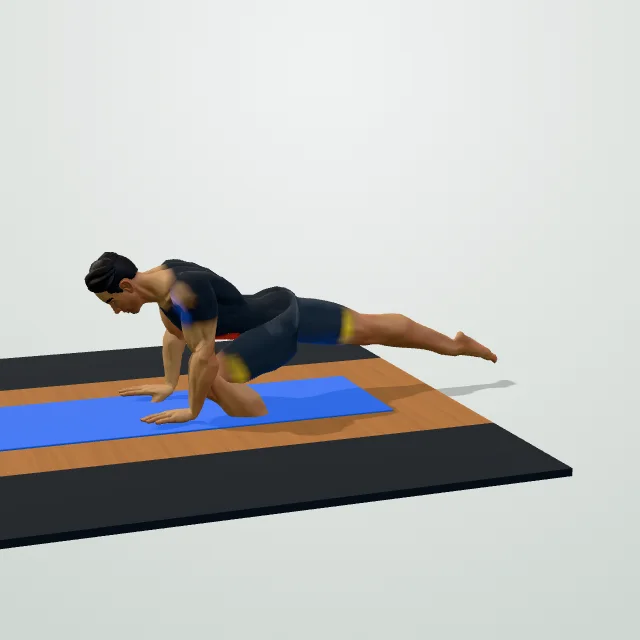
How to do it
- Start in a high plank, hands under your shoulders.
- Brace your core, body in a straight line.
- Drive one knee toward your chest.
- Return that foot to the plank as the other knee drives forward.
- Keep alternating legs at a controlled pace.
- Keep your hips level throughout, avoid sagging or piking.
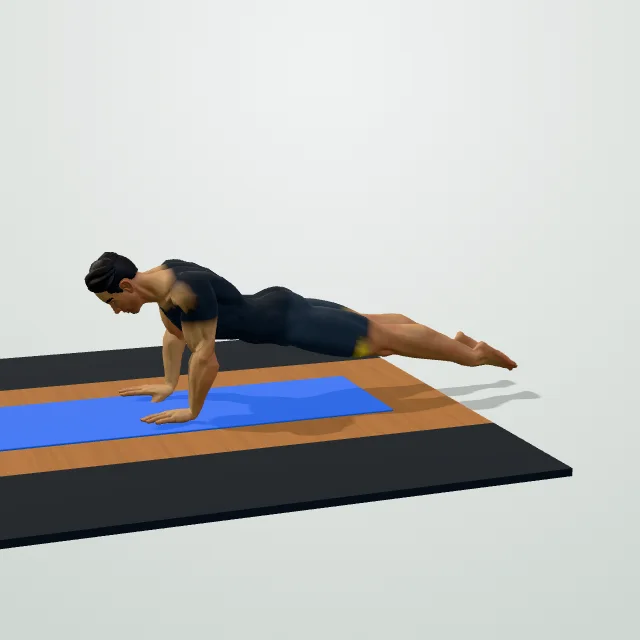
Coach cues
- High plank, hands under shoulders.
- Brace your core, hips stay level.
- Drive one knee in, then the other.
- Keep a steady, controlled pace.
Breathing: Breathe in a steady rhythm with your leg drive; do not hold your breath, especially at a fast pace.
Common mistakes
Make it easier / Make it harder
Mountain climbers put a running motion on top of a high plank: your hands stay planted while your knees drive toward your chest, one leg at a time, at a pace that ranges from a slow, controlled crawl to a fast sprint. That range is what makes the exercise so common, done slowly it is a core and shoulder stability move, done fast it turns into a demanding cardio interval, and most people use it as both.
What muscles do mountain climbers work?
The prime movers are your abs and hip flexors: your abs brace to stop your hips sagging or piking as you move, while your hip flexors drive each knee forward. Your front shoulders, chest and triceps support your bodyweight on your hands throughout, and your quads assist the drive of each leg. Because your torso is meant to stay still while your legs move underneath it, mountain climbers train the same anti-extension core control as a plank, just under the added challenge of shifting your weight rep after rep.
Benefits
- Core and cardio in one move. A fast set raises your heart rate quickly, which is why mountain climbers show up so often in HIIT and circuit workouts, while a slow set is a genuine core stability drill.
- No equipment, minimal space. It needs only enough floor space for a plank, making it one of the most portable cardio-core exercises for home workouts or travel.
- Hip flexor and shoulder conditioning. The repeated knee drive and shoulder loading builds a kind of durability that carries over to running and other plank-based exercises.
- Scalable intensity. The same movement pattern works as a gentle warm-up or a maximal-effort interval, just by changing the pace.
Technique: plank position and pace
Start in a high plank with your hands under your shoulders and your body in a straight line from head to heels, the exact position you would hold in a static plank. Brace your core before you move a single leg. Drive one knee forward toward your chest without letting your hips rise into a pike or sag toward the floor, then return that foot to the plank position as you drive the other knee forward. Keep your hips level and roughly still throughout, the movement should come from your hips and legs, not from your lower back rounding. Beginners should master a slow, controlled pace with a brief pause in the plank position between reps before trying to move quickly.
How to program mountain climbers
For a core-focused set, 2-3 sets of 20-30 total reps (10-15 per side) at a controlled pace works well, resting 30-45 seconds between sets. For a cardio interval, 20-40 seconds of fast mountain climbers followed by 20-40 seconds of rest, repeated for 4-8 rounds, is a standard HIIT format, track your intervals with an interval timer so you are not guessing at the clock. Two to four sessions a week is reasonable, whether as a warm-up, a core finisher, or part of a dedicated HIIT workout.
Variations and progressions
- Slow mountain climbers: pause briefly in the plank between each knee drive, prioritizing hip control over speed, a good starting point for beginners.
- Cross-body mountain climbers: drive each knee toward the opposite elbow instead of straight forward, adding rotation and more oblique work.
- Incline mountain climbers: hands on a bench or step reduce the load and difficulty, useful for beginners or anyone building shoulder tolerance.
- Sliders or gliders: using furniture sliders or socks on a smooth floor keeps constant tension on the working leg instead of lifting it off the ground.
- Fast mountain climbers: once form holds up at a slow pace, increase speed for a genuine cardio interval.
Mountain climbers vs running
Both raise your heart rate, but they load the body differently. Running is a standing, weight-bearing cardio exercise that mainly trains your legs and cardiovascular system over distance or time. Mountain climbers add a core and upper-body stability demand on top of a similar leg-driving pattern, done in short bursts rather than sustained distance, which makes them a useful low-space substitute for a cardio interval when you cannot get outside or on a machine.
Safety: wrists, shoulders and lower back
Stop for sharp wrist or shoulder pain, or if your lower back starts to ache rather than your abs and legs working. Fast breathing and muscle fatigue from the pace are normal.
If your wrists hurt, try performing the exercise on your forearms or on a raised surface. If your lower back sags or arches noticeably as you speed up, slow down until you can keep your hips level, speed is not worth losing position for. People with wrist, shoulder or lower-back injuries, or who are in later pregnancy, should choose a gentler core exercise and check with a doctor or physiotherapist first. As with any single exercise, mountain climbers alone will not spot-reduce belly fat, they are one useful tool inside an overall fat-loss approach and a broader core routine.
Workout plans with this exercise
General fitness · Beginner
30-Day Home Workout Plan (No Equipment)
Fat loss · Intermediate
15-Minute HIIT Workout (No Equipment)
Fat loss · Advanced
20-Minute Tabata Workout
Fat loss · Beginner
4-Week Fat-Loss Workout Plan
More exercises for abs and core
Questions people ask
What muscles do mountain climbers work?
Are mountain climbers cardio or a core exercise?
How many mountain climbers should I do?
Are mountain climbers good for abs?
Can mountain climbers help with weight loss?
Why does my lower back hurt during mountain climbers?
Are mountain climbers upper or lower body?
General fitness information, not medical advice. Check with a doctor or physiotherapist before starting if you have a health condition, an injury or are pregnant. Stop if you feel chest pain, dizziness or sharp pain.