Forearms and grip · Home or gym
Dead hang: the simplest test of your grip
Hang from a bar with straight arms and just let your bodyweight stretch you out — a plain exercise that builds grip endurance and shoulder health at the same time.
- Primary
- Forearms
- Secondary
- LatsUpper back
- Level
- Beginner
- Type
- Compound · Both sides together
- Sets × reps
- 3 × 30 s hold
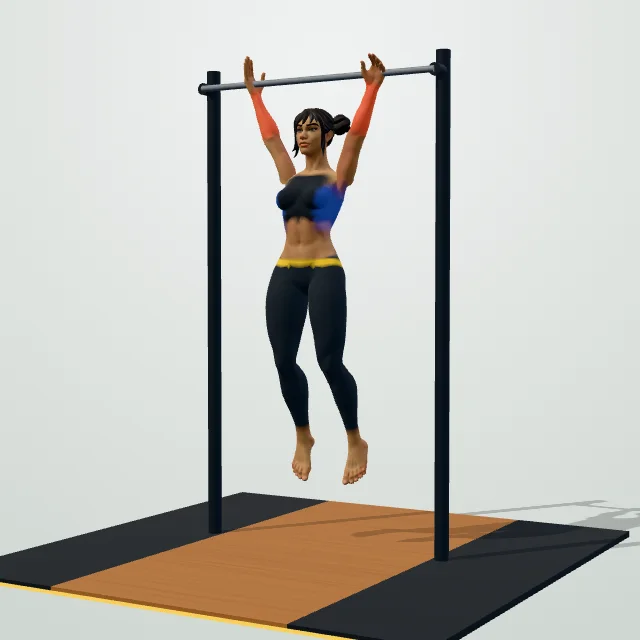
How to do it
- Grip the bar slightly wider than shoulder-width, palms facing away.
- Step or jump up so your arms are fully straight and feet are off the floor.
- Relax your shoulders down away from your ears.
- Brace your core lightly and keep your legs still.
- Hold for time, then lower yourself down under control.
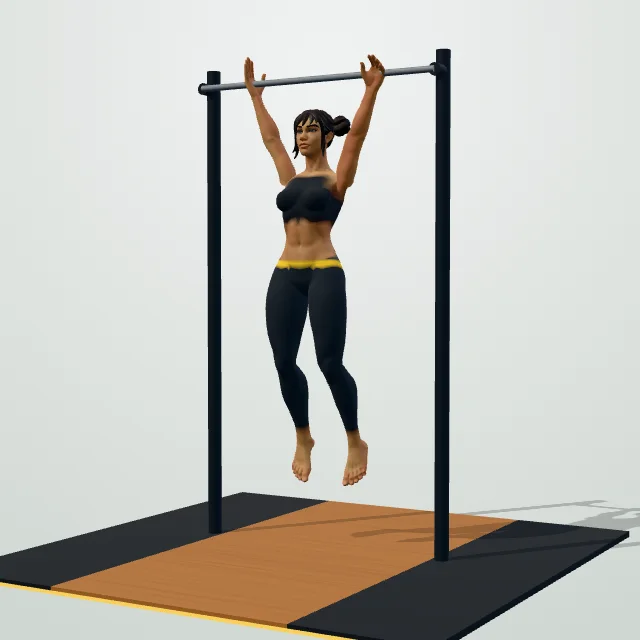
Coach cues
- Arms straight, palms facing away.
- Relax your shoulders down.
- Keep your legs still, no swinging.
- Breathe normally through the hold.
Breathing: Breathe slowly and steadily throughout the hold rather than holding your breath.
Common mistakes
Make it easier / Make it harder
What muscles does a dead hang work
The dead hang is primarily a grip and forearm exercise — your hand and forearm muscles work isometrically the entire time just to keep you on the bar. Your lats and upper back also engage to stabilize your shoulder blades and stop your shoulders from shrugging up toward your ears, which is why it is often used as an assessment or warm-up for pulling exercises like pull-ups.
Benefits
Grip endurance is frequently the first thing to fail in pulling exercises and carries, so training it directly with dead hangs can raise the ceiling on how long you can hold a bar during pull-ups, carries or climbing. The hang also puts your shoulders through a full, relaxed overhead range under light traction, which some people find helps shoulders that feel stiff or compressed from a day of sitting, though it is not a substitute for treatment of a diagnosed shoulder problem. Grip strength itself is also linked with general health markers in research on older adults, which is one reason dead hangs get recommended well beyond just gym training. It is also one of the few exercises that gives immediate, honest feedback: your hold time either improved since last time or it did not, with no room to fudge the number.
Technique: grip, shoulder position and hold
Grip the bar slightly wider than shoulder-width, palms facing away from you, and step or jump up so your arms are fully straight and your feet are off the floor. Let your shoulders relax down away from your ears rather than shrugging up defensively — a slightly "active" hang, with your shoulder blades gently set rather than fully slack, tends to feel more stable and is usually recommended over letting your shoulders hike up around your neck. Keep your core lightly braced and your legs still, resisting the urge to swing.
Hold for time, breathing normally rather than holding your breath, and lower yourself down under control rather than dropping suddenly when your grip gives out. If your hands slip before your target time is reached, that is useful information about where your grip currently stands, not a failure.
How to program dead hangs
3 sets, holding as long as you can with good form (many beginners start around 15–30 seconds, building toward a minute or more over weeks), resting 60–90 seconds between attempts, is a reasonable structure. Dead hangs pair naturally with negative pull-ups and grip work in a pull-up progression plan, or as a simple grip-training addition at the end of any upper-body session.
Variations
An active hang (shoulder blades gently set down, as described above) emphasizes shoulder stability more than a fully passive hang, which just lets gravity stretch the shoulders and spine. A single-arm hang, or alternating hands mid-set, adds extra grip and core demand once a two-handed hang past a minute feels easy. If you have no pull-up bar, a sturdy tree branch or playground bar works just as well, and a resistance band looped over the bar under one foot can take a little bodyweight off if a full hang is currently too demanding on your grip.
Safety
Make sure whatever bar you use can hold your bodyweight securely before committing to a full hang. If you have a shoulder injury, recent surgery, or a condition affecting your wrists or elbows, check with a doctor or physiotherapist before adding hanging exercises, since the joint is under continuous load for the whole hold. Stop for any sharp pain — general grip fatigue and forearm burn are expected, joint pain is not. Building up gradually over several weeks is a safer route than testing a maximum hold on your very first attempt.
More exercises for forearms and grip
Questions people ask
What muscles does a dead hang work?
How long should a beginner dead hang for?
Is hanging from a bar good for your back?
Does hanging from a bar increase height?
Active hang vs passive hang: what is the difference?
Are dead hangs good for shoulder pain?
General fitness information, not medical advice. Check with a doctor or physiotherapist before starting if you have a health condition, an injury or are pregnant. Stop if you feel chest pain, dizziness or sharp pain.