Back · Home or gym
Pull-up: the real test of back and grip strength
A bodyweight back exercise where you hang from a bar and pull your chin over it — simple to describe, and one of the hardest moves to earn.
- Primary
- Lats
- Secondary
- BicepsUpper backForearmsAbs
- Level
- Intermediate
- Type
- Compound · Both sides together
- Sets × reps
- 3 × 5-10 reps
How to do it
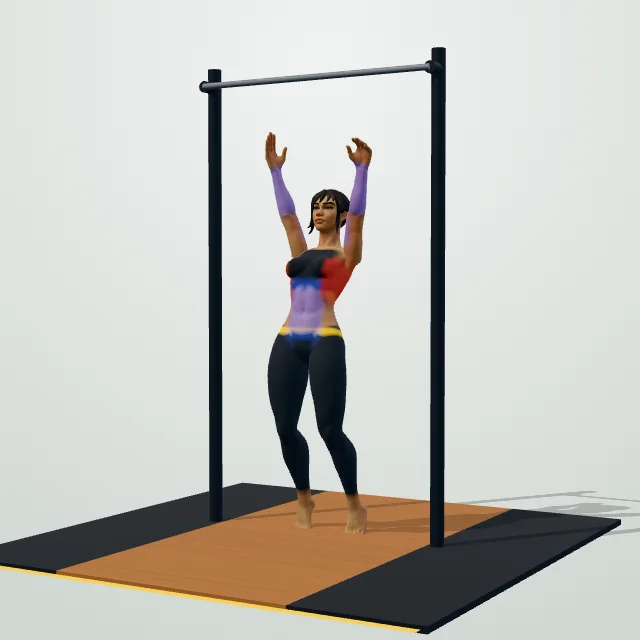
- Grip the bar just wider than shoulder-width, palms facing away from you.
- Hang with straight arms and your shoulder blades set down and back.
- Pull your elbows down toward your hips until your chin clears the bar.
- Pause briefly at the top without craning your neck forward.
- Lower back to a full hang under control, arms fully straight.
Coach cues
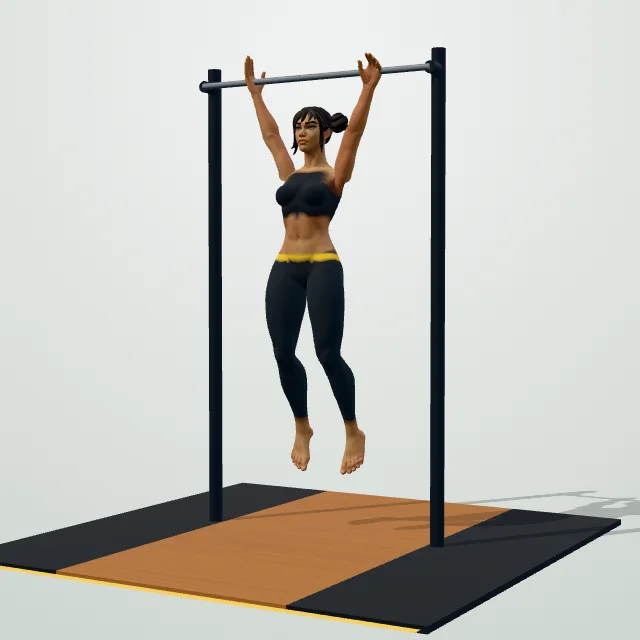
- Start from a full, dead hang.
- Set your shoulder blades before you pull.
- Drive your elbows down, chin over the bar.
- Lower slowly, all the way down.
Breathing: Breathe in at the bottom of the hang, breathe out as you pull yourself up.
Common mistakes
Make it easier / Make it harder
Sets and reps by goal
| Goal | sets | reps | Rest |
|---|---|---|---|
| Strength | 3–5 | 3–6 | 2–4 min |
| Muscle growth | 3–4 | 6–12 | 90–150 s |
| Endurance | 2–3 | 15–20 | 30–60 s |
What muscles does the pull-up work
The main driver is your lats, which pull your upper arms down and back to raise your body. Your biceps bend the elbow through the second half of the rep, your forearms and grip work the entire time just to keep you on the bar, and your upper back and rear delts pull your shoulder blades down and together at the top. Your abs brace to stop your legs from swinging. Very few gym exercises recruit this much upper-body muscle at once, which is why pull-ups build width and thickness through the back faster than most single-joint moves.
Benefits
Because the pull-up trains grip, arms and back together against your own bodyweight, it carries over well to daily pulling and carrying tasks, and a strong pull-up is linked with better relative upper-body strength than most machine exercises can build. It is also completely scalable — banded, assisted, negative and weighted versions let a total beginner and an advanced lifter train the same movement pattern for years.
Proper pull-up technique
Grip the bar slightly wider than shoulder width, palms facing away from you. Start from a full dead hang with your arms straight — this is where most reps go wrong, because starting from a bent-arm position skips the hardest, most valuable part of the movement. Pull your shoulder blades down and back first, then drive your elbows toward your hips rather than thinking about your hands; this keeps the pull coming from your back instead of your arms alone. Bring your chin over the bar without craning your neck forward, then lower back to a full hang under control — the lowering phase (2–3 seconds) builds just as much strength as the pull itself and is where most people cut corners.
Keep your ribs down and your legs still; a small amount of kip or momentum from the hips turns a strict pull-up into a different exercise entirely and hides how strong you actually are. If your chin barely clears the bar, that still counts — do not sacrifice the bottom stretch or the top position to grind out extra reps.
Pull-up vs chin-up
An overhand, shoulder-width grip is what most people mean by "pull-up"; an underhand grip is a chin-up. Chin-ups recruit more biceps and are usually a little easier for the same person, so they are a sensible stepping stone if a strict overhand pull-up is out of reach. Neither is "better" — alternate between them or use whichever grip is comfortable for your wrists and shoulders.
How to build your first pull-up
If you cannot yet do a full rep, do not wait until you can — train the pieces instead. A negative pull-up (jump or step up to the top, then lower slowly for 4–5 seconds) builds the same strength through the full range. Dead hangs build the grip endurance that often fails before the back does, and a resistance band looped over the bar removes some bodyweight so you can practice full reps sooner. Most beginners improve fastest by combining 3 sets of negatives, dead hangs and banded pull-ups two to three times a week rather than only testing for a full rep every session — see our pull-up progression plan for a full week-by-week layout.
How to program pull-ups
For strength and back size, 3–4 sets of as many strict reps as you can do while stopping 1–2 reps short of failure works well, resting 90 seconds to 2 minutes between sets so grip can partly recover. If bodyweight reps get easy (comfortably past 10–12), add load with a dip belt rather than chasing endless high reps. Pull-ups pair naturally with pushing exercises in an upper/lower split or with rows and curls in a back and biceps session.
Safety
Warm your shoulders up before working sets, and avoid kipping or swinging if you have any shoulder or elbow discomfort — that momentum adds load exactly where a joint is least stable. Sharp shoulder pain, not general fatigue, is the signal to stop and scale back to negatives or an assisted machine.
Workout plans with this exercise
Build muscle · Intermediate
Push Pull Legs Split (6 Days)
Strength · Intermediate
Upper/Lower Split (4 Days)
Build muscle · Intermediate
4-Day Muscle-Building Workout Plan
Build muscle · Intermediate
5-Day Body-Part Split (Bro Split)
Build muscle · Intermediate
Back and Biceps Workout
Strength · Beginner
Pull-Up Progression Plan (0 to 10 Pull-Ups)
Questions people ask
What muscles do pull-ups work?
How many pull-ups is good for a beginner?
Why can I do lat pulldowns but not a pull-up?
Pull-up vs chin-up: which builds more muscle?
How do I do a pull-up without a bar?
Are pull-ups bad for your shoulders?
General fitness information, not medical advice. Check with a doctor or physiotherapist before starting if you have a health condition, an injury or are pregnant. Stop if you feel chest pain, dizziness or sharp pain.