Abs and core · Gym
Cable woodchop: rotate with power from your hips
The cable woodchop trains your core to generate and control rotation, swinging the cable diagonally the way an axe swings through wood — hence the name.
- Primary
- Obliques
- Secondary
- AbsFront deltsGlutes
- Level
- Intermediate
- Type
- Compound · One side, then the other
- Sets × reps
- 3 × 10-12 reps per side
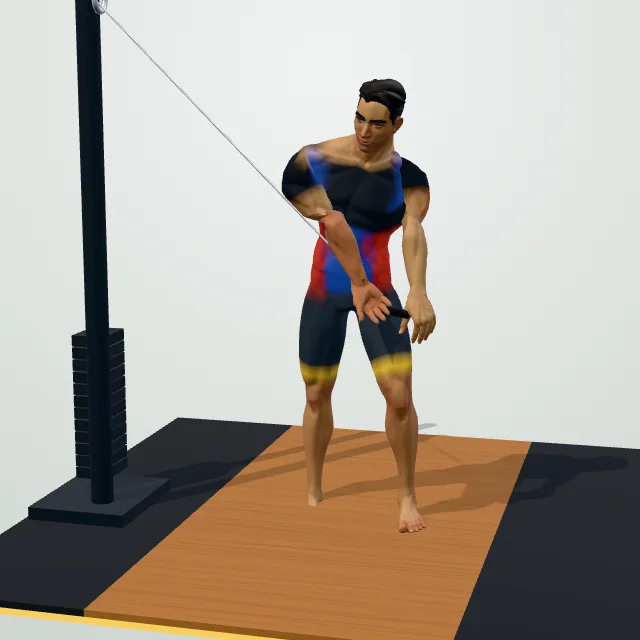
How to do it
- Set the pulley above head height and stand side-on to the machine.
- Grab the handle with both hands, turn your torso up and toward the machine.
- Brace your core before you start the pull.
- Pull the handle down and across your body in a straight diagonal line.
- Let your back foot pivot and your hips rotate with the movement.
- Control the handle back up to the start.
- Finish all reps on one side, then switch.
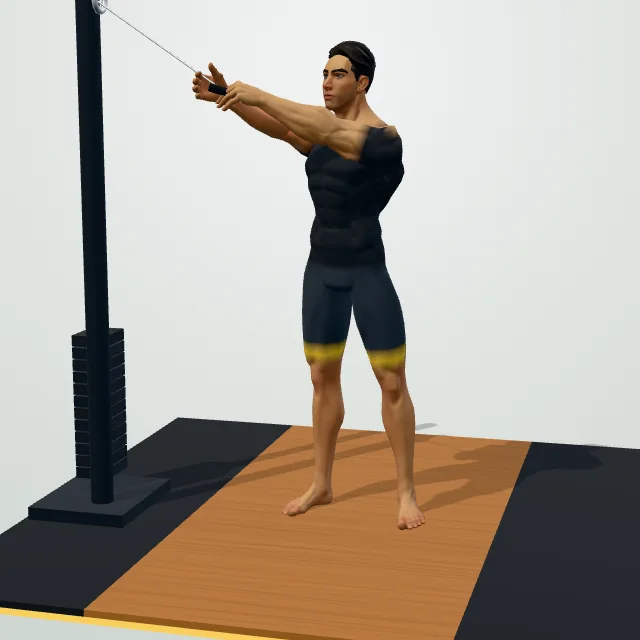
Coach cues
- Turn from your hips, not just your arms.
- Pull the cable down and across your body.
- Let your back foot pivot with the turn.
- Control the return, don’t let it snap back.
Breathing: Breathe out as you pull across and rotate, breathe in as you return to the start.
Common mistakes
Make it easier / Make it harder
Sets and reps by goal
| Goal | sets | reps | Rest |
|---|---|---|---|
| Strength | 3–5 | 3–6 | 2–4 min |
| Muscle growth | 3–4 | 6–12 | 90–150 s |
| Endurance | 2–3 | 15–20 | 30–60 s |
The cable woodchop pulls a cable diagonally across your body — high to low or low to high — while your torso rotates like it would swinging an axe. Unlike most ab exercises that just flex or brace the spine, the woodchop trains the rotational power your core actually uses in sport and daily life: swinging a racket, throwing, or turning to lift something off the floor.
What muscles the cable woodchop works
The obliques are the prime movers, rotating your ribcage over your pelvis as you pull the cable across your body. Your rectus abdominis braces to keep the rotation coming from your trunk rather than your lower back, your front delts and shoulders guide the cable's path, and your glutes and hips drive the initial turn on the high-to-low version — a lot of the power should come from pivoting your back foot and rotating your hips, not just your arms pulling.
Benefits of the cable woodchop
- Trains rotational power. Most core exercises resist rotation; the woodchop is one of the few that trains you to produce it under control.
- Carries over to sport and daily tasks. Swinging a golf club, throwing a ball, or twisting to move a box all use the same hip-driven rotation.
- Works the obliques through a full range. The diagonal cable path loads the obliques more completely than a crunch-style exercise.
- Adjustable difficulty. Pulley height, cable weight, and stance width let you dial the challenge up or down easily.
Technique: how to do the cable woodchop correctly
For the classic high-to-low woodchop, set the pulley above head height and stand side-on to the machine, feet shoulder-width apart. Grab the handle with both hands and turn your torso and hips toward the machine so your arms are extended up and across your body. From here, pull the handle down and across your body in a straight diagonal line, finishing near your opposite hip, and let your back foot pivot as your hips rotate — the movement should look like chopping wood, driven by your trunk turning, with your arms mostly just transmitting the force rather than doing the pulling themselves.
Keep your arms at a fairly constant length throughout rather than bending and unbending your elbows, and control the return back to the start just as carefully as the pull — most of the core benefit comes from resisting the cable on the way back, not just powering through on the way down. Do all reps on one side, then switch.
How to program the cable woodchop
| Goal | Sets | Reps (each side) | Rest |
|---|---|---|---|
| Rotational power | 3 | 6–8 | 60–90s |
| Muscle / control | 3 | 10–12 | 45–60s |
Choose a weight that lets you rotate smoothly and under control on every rep — if your lower back starts twisting to compensate near the end of a set, the weight is too heavy. Train both sides equally, and increase load gradually the way you would for any other lift, following the same progressive overload principle. Two sessions a week, placed after your main lifts, is enough for most people.
Variations
The low-to-high woodchop reverses the pulley position and the direction of the pull, finishing with your arms extended up and away from your body, and emphasizes the upward, "lifting" part of rotational power rather than the downward "chopping" part. A half-kneeling woodchop, with your back knee down, removes the legs from the movement and forces the rotation to come purely from the trunk, which is a useful regression if you feel your hips doing too much of the work standing. Without a cable machine, a resistance band anchored at a similar height, or a Russian twist, are reasonable substitutes.
Cable woodchop vs. Russian twist vs. pallof press
All three train the obliques, but they ask for different things from your core. The woodchop and the Russian twist both train you to produce rotation under load, while the pallof press trains your core to resist rotation instead. If your priority is rotational power for sport, the woodchop is the better choice; if you are managing a sensitive lower back or want a gentler entry point into rotational core work, the pallof press is usually the safer place to start.
Safety: who should modify or avoid it
Stop if you feel pain in your lower back rather than muscle effort in your obliques — this usually means the movement is coming from your spine twisting rather than your hips pivoting and your trunk rotating as one unit. Anyone with a current back injury, disc issues, or who is early in pregnancy should check with a doctor or physiotherapist first, and may do better starting with the pallof press instead.
More exercises for abs and core
Questions people ask
What muscles does the cable woodchop work?
Is the cable woodchop the same as a Russian twist?
Cable woodchop vs pallof press: which should I do?
How do I do a cable woodchop without a machine?
Why does my lower back hurt during woodchops?
High-to-low or low-to-high woodchop: what is the difference?
General fitness information, not medical advice. Check with a doctor or physiotherapist before starting if you have a health condition, an injury or are pregnant. Stop if you feel chest pain, dizziness or sharp pain.