Abs and core · Home or gym
Pallof press: train your core to resist rotation
The pallof press is a core exercise where your job is to stop a cable or band from twisting you sideways as you press it out from your chest.
- Secondary
- Front deltsGlutes
- Level
- Beginner
- Type
- Compound · One side, then the other
- Sets × reps
- 3 × 10-12 reps per side
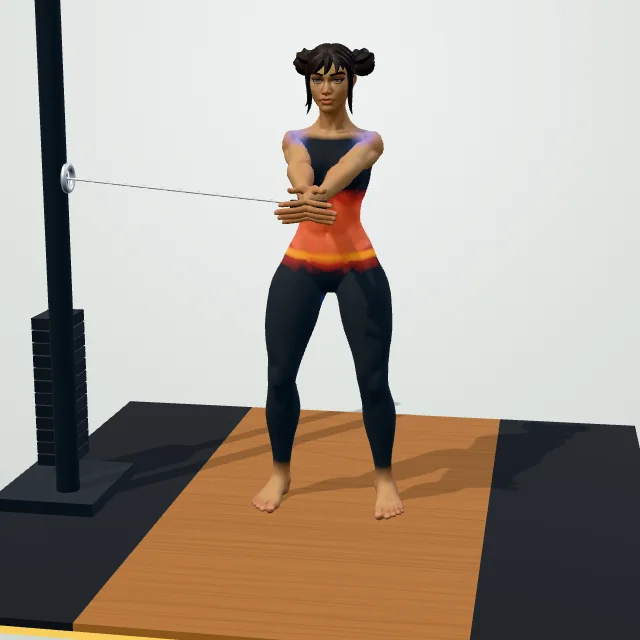
How to do it
- Set a cable or band anchor at chest height, stand side-on to it.
- Hold the handle with both hands at your chest, feet shoulder-width apart.
- Brace your core before you press.
- Press the handle straight out until your arms are extended.
- Hold, keeping your hips and shoulders square, resisting the pull.
- Bring the handle back to your chest under control.
- Complete all reps on one side, then turn and repeat on the other.
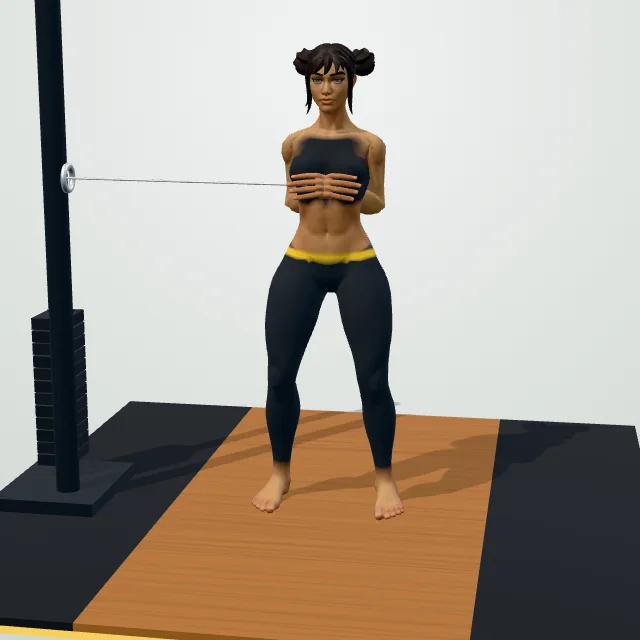
Coach cues
- Brace your core before you press.
- Press straight out, arms fully extended.
- Keep your hips and shoulders square.
- Don’t let the cable turn you.
Breathing: Breathe out as you press out, breathe in as you bring the handle back to your chest.
Common mistakes
Make it easier / Make it harder
Sets and reps by goal
| Goal | sets | reps | Rest |
|---|---|---|---|
| Strength | 3–5 | 3–6 | 2–4 min |
| Muscle growth | 3–4 | 6–12 | 90–150 s |
| Endurance | 2–3 | 15–20 | 30–60 s |
The pallof press is a standing or kneeling core exercise where you hold a cable or band anchored to your side and press it straight out from your chest, then bring it back, while your torso resists being pulled sideways. Unlike a crunch or a woodchop, nothing here actually moves your spine — the whole point is to stay perfectly still while a cable tries to rotate you.
What muscles the pallof press works
The obliques and rectus abdominis are the prime movers, contracting isometrically to stop the cable's pull from rotating your ribcage toward the anchor point. Your glutes and hips help keep your lower body from being dragged sideways too, and your front delts and shoulders control the press itself, but the exercise lives or dies on how still your trunk stays — any twist means the core has lost the battle for that rep.
Benefits of the pallof press
- Builds anti-rotation strength. A core that resists unwanted rotation protects your spine during squats, deadlifts, carries, and everyday twisting.
- Low-impact on the back. Because nothing actually moves through your spine, it is one of the gentler ways to load the core and is commonly used in rehab for people recovering from low-back issues.
- Easy to scale. Cable weight, band tension, and stance (kneeling vs. standing) all let you dial the challenge up or down.
- Carries over to sport. Resisting a tackle, holding your ground under a push, or stabilizing while swinging a bat or racket all use this same anti-rotation strength.
Technique: how to do the pallof press correctly
Set a cable pulley or band anchor at roughly chest height and stand side-on to it, a step or two away so there is tension in the line. Hold the handle with both hands at your chest, feet shoulder-width apart, knees soft, and brace your core before you move — this brace has to hold for the entire rep, not just at the end.
Press the handle straight out in front of your chest until your arms are extended, and hold for a moment. The cable will try to pull your arms and torso toward the anchor; your job is to keep your hips and shoulders square and facing forward the whole time, resisting that pull rather than fighting it after it has already turned you. Bring the handle back to your chest under the same control, and repeat for all reps on one side before turning around and doing the other.
How to program the pallof press
| Goal | Sets | Reps or hold | Rest |
|---|---|---|---|
| Core stability | 3 | 10–12 presses each side | 45–60s |
| Isometric strength | 3 | 20–30s hold each side | 45–60s |
Pick a resistance where you can keep your hips and shoulders completely still for every rep — if you start to twist toward the anchor, the load is too heavy for now. Increase resistance or hold time gradually, following the same progressive overload approach used for any lift, and train both sides equally. It fits well as part of a core finisher two to three times a week, or inside a dedicated abs workout.
Variations
A half-kneeling pallof press, with your back knee down, removes the legs from the stability equation and forces the core to do more of the work, making it a good regression if the standing version feels too easy to control. A pallof press with a walkout — stepping away from the anchor after pressing out, then back — adds an extra anti-rotation challenge for more advanced lifters. At home, a resistance band anchored around a door frame or heavy furniture works just as well as a cable machine.
Pallof press vs. cable woodchop
The pallof press and the cable woodchop train opposite skills. The woodchop asks your core to produce rotation with power; the pallof press asks it to resist rotation entirely. If you are new to rotational core training, are managing a sensitive back, or simply want the gentler of the two, start with the pallof press before adding woodchops.
Safety: who should modify or avoid it
Because it does not move the spine, the pallof press is often one of the safer core exercises for people easing back into training after a back issue, though anyone with a current injury should still check with a doctor or physiotherapist first. Stop if you feel any twisting strain in your lower back rather than a controlled brace in your abs — that usually means the resistance is too heavy for your current position.
Workout plans with this exercise
More exercises for abs and core
Questions people ask
What muscles does the pallof press work?
Is the pallof press good for lower back pain?
Pallof press vs cable woodchop: what is the difference?
Can I do a pallof press with a resistance band?
Should I do the pallof press standing or half-kneeling?
How heavy should the pallof press be?
General fitness information, not medical advice. Check with a doctor or physiotherapist before starting if you have a health condition, an injury or are pregnant. Stop if you feel chest pain, dizziness or sharp pain.