Abs and core · Home, no equipment
Side plank: build a stronger waist and hips
The side plank is a static hold on one forearm that trains the muscles down the side of your body. Here is the setup, how long to hold it, and where it fits next to the plank.
- Primary
- Obliques
- Secondary
- AbsOuter hipsSide delts
- Level
- Beginner
- Type
- Compound · One side, then the other
- Sets × reps
- 3 × 25 s hold per side
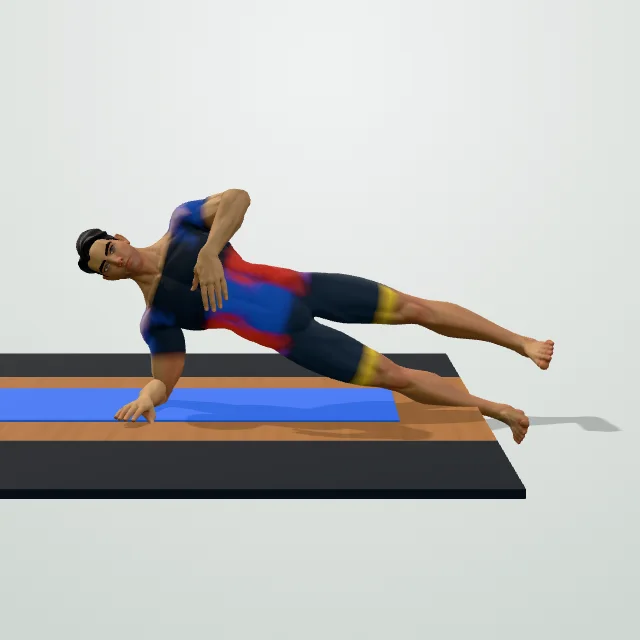
How to do it
- Lie on your side, elbow stacked directly under your shoulder.
- Stack or stagger your feet, then brace your core.
- Press through your forearm and the side of your bottom foot.
- Lift your hips until your body forms a straight line.
- Hold, keeping your hips level and your neck neutral.
- Lower with control and switch sides.
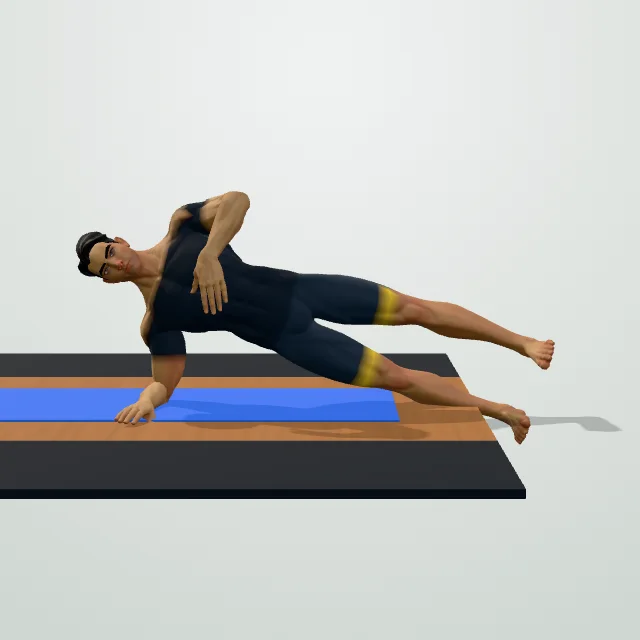
Coach cues
- Elbow stacked under your shoulder.
- Lift your hips into a straight line.
- Keep your hips level, don’t let them sag.
- Breathe steadily and hold.
Breathing: Breathe slowly and steadily through the hold; do not hold your breath.
Common mistakes
Make it easier / Make it harder
The side plank is an isometric hold: you prop yourself on one forearm and the side of one foot, keep your body in a straight line, and hold it still for time. It looks simple, but it is one of the most direct ways to train the muscles that stop your torso from sagging or twisting sideways, the kind of strength you rely on every time you carry a bag on one shoulder or catch your balance on uneven ground.
What muscles does a side plank work?
The main target is the obliques on the side facing up, the muscles that rotate and side-bend your trunk; here they work isometrically to resist gravity pulling your hips toward the floor. Your underside shoulder and the abductors of your top hip (the muscles on the outside of your glutes) also work hard to keep your pelvis level, which is why a side plank often feels as much like a hip and shoulder exercise as an ab one. Your rectus abdominis and lower back brace throughout to keep your spine in a neutral, straight line rather than banana-shaped.
Side plank benefits
- Anti-rotation and anti-side-bend strength. Most core exercises train you to resist forward bending; the side plank is one of the few common moves that trains resisting a sideways pull, which carries over to carrying, lifting, and twisting sports.
- Hip stability. The abductor work in a side plank supports the same muscles that keep your knee tracking well when you run, squat or lunge on one leg.
- Low equipment, low impact. Nothing but floor space is needed, and there is no repeated bending of the spine, which makes it a common substitute when regular crunches or sit-ups bother someone's back.
- Easy to scale. Dropping to your knees, shortening the hold, or building up in small time steps makes the side plank workable for a wide range of starting points.
Side plank technique
Lie on your side with your elbow stacked directly under your shoulder, forearm flat on the floor at roughly 90° to your body. Stack your feet on top of each other, or stagger the top foot slightly forward for more balance. Press through your forearm and the side of your bottom foot to lift your hips off the floor until your head, shoulders, hips and ankles form one straight line, no sagging at the hips and no piking upward at the waist. Keep your top hand resting on your hip or reaching straight up; look forward or slightly down, not up at the ceiling, to keep your neck in line with your spine.
The most common technical error is letting the hips drop and rotate forward or back, which turns the hold into a much easier position and takes tension off the obliques. Think about pulling your hip up toward your ribs on the working side rather than just "holding still."
How long should you hold a side plank?
| Level | Hold per side | Sets |
|---|---|---|
| Beginner (from knees or shortened) | 10-20 sec | 2-3 |
| Intermediate | 20-40 sec | 3 |
| Advanced | 40-60+ sec, or add a leg lift / weight | 3 |
Train both sides for equal time, even if one feels weaker, that side usually needs the work more, not less. Once a strict 45-60 second hold with good form feels easy, add a top-leg lift, a slow reach-under rotation, or a light weight across the hip rather than just chasing a longer clock time.
Side plank variations and progressions
- Side plank from the knees: bend both knees behind you and stack them, shortening the lever arm for an easier entry point for beginners.
- Side plank with hip dips: lower the hips a few centimeters toward the floor and lift back up for reps instead of a static hold, adding a small range of motion.
- Side plank with a leg lift: once the basic hold is solid, lift the top leg a few inches for extra work through the hip abductors.
- Side plank with reach-under (rotation): thread your top arm under your torso and back to the ceiling, adding a controlled rotation for more oblique work.
- Weighted side plank: rest a light plate on your top hip once bodyweight holds past 45-60 seconds feel manageable.
Side plank vs plank
The standard plank mainly resists your hips folding forward, training the front of your core; the side plank resists your hips folding sideways, training the obliques and hip abductors instead. They are complementary rather than interchangeable: a well-rounded core routine typically uses both, along with a rotation or anti-rotation move like the Russian twist.
Side plank safety
Stop for sharp pain in the shoulder, wrist or lower back, dizziness or unusual breathlessness. Mild shaking and fatigue in the working side is normal.
Side planks do not fix a structural spinal curve such as scoliosis and they will not "burn" fat from your waist on their own, no exercise removes fat from one specific area, visible fat loss comes from an overall calorie deficit across your whole diet and activity. If you have shoulder pain, drop to your knees or shorten the hold and check with a physiotherapist if pain continues. People with a recent abdominal or back injury, or who are pregnant, should get individual guidance before holding a side plank, see our guide to exercise for back pain for more general advice. Build up the load and time gradually rather than jumping straight to a long hold, and add the side plank to your routine alongside a structured abs workout rather than as your only core exercise.
More exercises for abs and core
Questions people ask
How long should you hold a side plank?
What muscles does the side plank work?
Is the side plank better than the regular plank?
Can side planks get rid of love handles?
Why do my hips sag in a side plank?
Do side planks help with scoliosis?
What is a good side plank progression for beginners?
General fitness information, not medical advice. Check with a doctor or physiotherapist before starting if you have a health condition, an injury or are pregnant. Stop if you feel chest pain, dizziness or sharp pain.