Abs and core · Home, no equipment
Plank shoulder taps: train your core to resist rotation
Plank shoulder taps turn a static hold into a moving anti-rotation drill: your hips have to stay still while one hand lifts to tap the opposite shoulder.
- Secondary
- Front deltsTriceps
- Level
- Beginner
- Type
- Compound · Alternate sides
- Sets × reps
- 3 × 16 reps per side
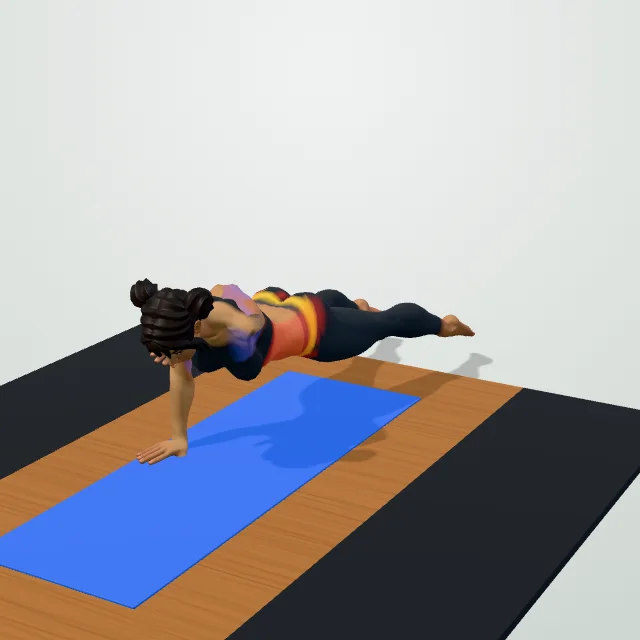
How to do it
- Start in a high plank, hands under shoulders, feet set wide.
- Brace your core and squeeze your glutes.
- Lift one hand and tap the opposite shoulder.
- Place the hand back in the same spot, without rotating your hips.
- Repeat on the other side, alternating.
- Keep hips and shoulders square to the floor throughout.
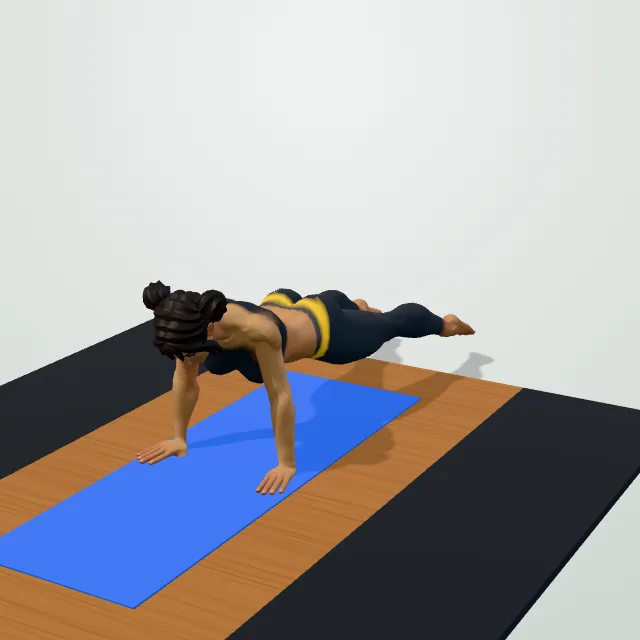
Coach cues
- High plank, hands under shoulders.
- Brace your core, hips stay square.
- Tap the opposite shoulder, slow and controlled.
- Place the hand back without rocking.
Breathing: Breathe steadily throughout; do not hold your breath while tapping.
Common mistakes
Make it easier / Make it harder
Sets and reps by goal
| Goal | sets | reps | Rest |
|---|---|---|---|
| Strength | 4–5 | 3–6 | 2–4 min |
| Muscle growth | 3–4 | 6–12 | 90–150 s |
| Endurance | 2–3 | 15–25+ | 30–60 s |
Plank shoulder taps take a static hold and add movement: from a high plank, you lift one hand to tap the opposite shoulder while everything else stays as still as possible. That stillness is the whole point, the shoulder taps exercise is really a test of how well your core resists your hips twisting and rocking every time you move an arm.
What muscles do plank shoulder taps work?
Your abs and obliques do the main job here, not by crunching, but by bracing isometrically to stop your hips and shoulders from rotating toward the lifted arm. That is what makes this an anti-rotation exercise rather than a simple ab move. The front shoulders and triceps of the supporting arm work hard to keep you stable on one hand at a time, and your glutes help keep your hips from sagging or hiking up. If your hips swing side to side with every tap, your core is losing the battle, not your arms.
Benefits
- Anti-rotation core strength. Most ab exercises train forward bending; shoulder taps train resisting rotation, a skill that carries over to running, throwing and lifting with one arm.
- Shoulder and wrist stability. Supporting your full weight briefly on one hand builds pressing stability that carries into push-ups and presses.
- No equipment, easy to scale. Feet width alone can make it easier or much harder, so it fits beginner and advanced routines alike.
- Doubles as a warm-up or finisher. Because it is low-impact and short, it works well before an upper-body session or at the end of a core circuit.
Technique: feet width, tempo and hip control
Start in a high plank (top of a push-up), hands under your shoulders, feet set wide enough for a stable base, this is the single biggest lever for difficulty. Brace your core and squeeze your glutes before you move a hand at all. Lift one hand slowly and tap the opposite shoulder, then place it back in exactly the same spot, keeping your hips and shoulders square to the floor the entire time. Alternate sides. The tap should be slow and controlled: speeding up is usually a sign that your hips are rocking to help you rather than staying still, which defeats the purpose of the exercise.
How to program plank shoulder taps
Because this is a stability drill rather than a strength lift, program it by total taps rather than heavy load: 2-3 sets of 16-24 total taps (8-12 per side) is a good general target, resting 30-60 seconds between sets. Use it as a finisher after an upper-body or full-body session, or pair it with a static hold like the plank or dead bug in a short core circuit two to three times a week as part of a wider abs workout.
Variations and progressions
- Wider feet (easier): a wider stance gives a bigger, more stable base, a good starting regression for beginners.
- Feet together (harder): narrowing your stance removes stability and forces your core to work much harder to stop rotation.
- Elevated plank shoulder taps: hands on a bench or step reduces the load through the shoulders, useful while building up strength.
- Slow-tempo taps: a 3-second lift and lower on every rep increases time under tension without adding load.
- Shoulder tap to push-up: add a push-up between taps once both movements feel controlled on their own.
Safety: wrists, shoulders and who should modify it
Stop for sharp wrist, shoulder or lower back pain. Mild shakiness in your supporting arm or core is normal fatigue.
If your wrists hurt, try performing the exercise on fists or forearms, or on an elevated surface to reduce the angle. People with a current shoulder injury, or who feel pinching pain at the front of the shoulder, should regress to a static plank or check with a physiotherapist before loading one arm at a time. This move will not "flatten your stomach" by itself, no single exercise removes fat from one area, it is a strength and stability exercise that works best alongside a full overall approach to fat loss if that is your goal.
More exercises for abs and core
Questions people ask
How many plank shoulder taps should I do?
What muscles do plank shoulder taps work?
How do I stop my hips from swinging during shoulder taps?
Are plank shoulder taps a good core exercise?
Can plank shoulder taps replace a plank?
How do I make plank shoulder taps harder?
Do plank shoulder taps burn belly fat?
General fitness information, not medical advice. Check with a doctor or physiotherapist before starting if you have a health condition, an injury or are pregnant. Stop if you feel chest pain, dizziness or sharp pain.