Triceps · Home or gym
Triceps kickback: hinge and extend for a strict triceps squeeze
The triceps kickback isolates the back of the arm by fixing your upper arm parallel to the floor and extending the elbow against gravity. Here is the setup and common mistakes.
- Primary
- Triceps
- Secondary
- Rear delts
- Level
- Beginner
- Type
- Isolation · Both sides together
- Sets × reps
- 3 × 12-15 reps
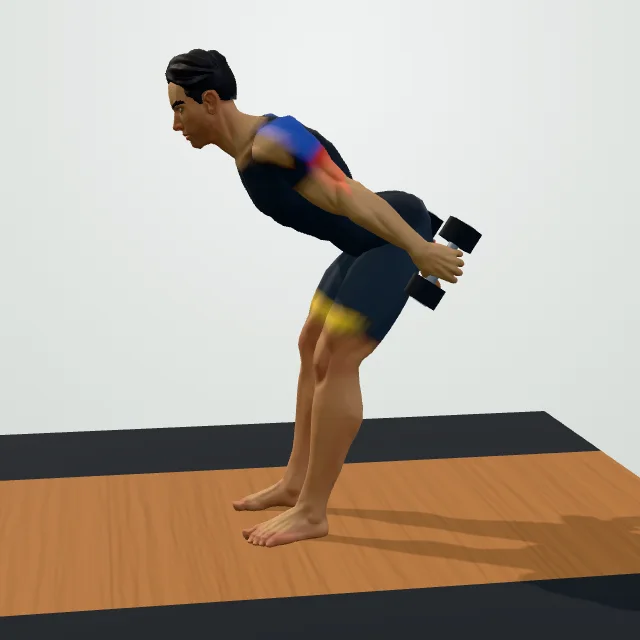
How to do it
- Hold a dumbbell in one hand, supporting yourself on a bench.
- Hinge forward until your torso is close to parallel to the floor.
- Raise your upper arm parallel to the floor and hold it still.
- Extend your elbow to straighten your arm fully behind you.
- Squeeze the triceps at the top.
- Bend the elbow back to about 90 degrees and repeat.
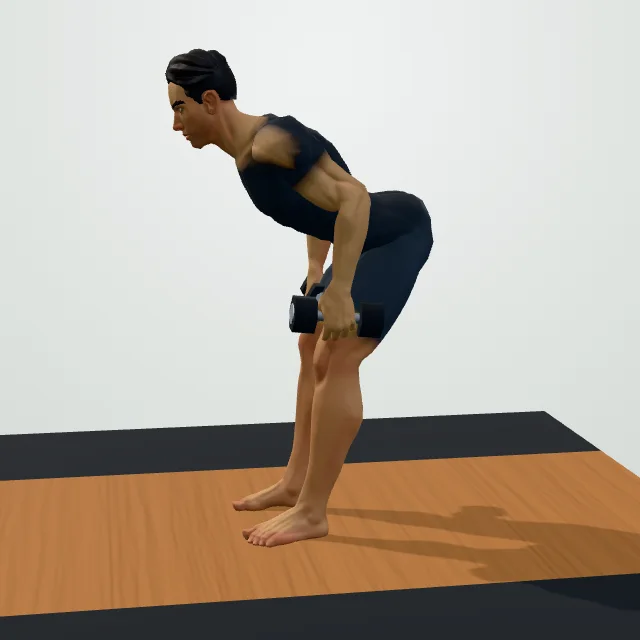
Coach cues
- Upper arm stays parallel to the floor.
- Extend the elbow, straighten the arm.
- Squeeze the triceps at the top.
- No swinging from the shoulder.
Breathing: Breathe out as you extend your arm back, and breathe in as you bend the elbow to reset.
Common mistakes
Make it easier / Make it harder
Sets and reps by goal
| Goal | sets | reps | Rest |
|---|---|---|---|
| Strength | 3–5 | 6–8 | 90–120 s |
| Muscle growth | 3–4 | 10–15 | 60–90 s |
| Endurance | 2–3 | 15–20 | 30–60 s |
The triceps kickback is done bent forward with your upper arm held parallel to the floor, extending the elbow to swing a dumbbell backward until your arm is straight. Because the upper arm stays fixed and the movement is entirely elbow extension against gravity, a strict kickback is a genuine isolation exercise for the triceps — though it is also one of the easiest exercises to do wrong by turning it into a swinging shoulder movement instead.
It needs only a single dumbbell (or a cable or band), which makes it a practical addition to a triceps routine at home or in the gym.
Muscles the triceps kickback works
The kickback isolates the triceps brachii through elbow extension, with the rear deltoid working isometrically to help hold the upper arm in position. Because your torso is bent forward and the upper arm stays roughly parallel to the floor, the exercise loads the triceps hardest right at the top of the movement, where the arm is fully extended and working directly against gravity — a different loading pattern than a pushdown or overhead extension.
Benefits of the triceps kickback
- Strong peak contraction: the top of the movement, arm fully extended, is where the triceps works hardest — good for a hard squeeze.
- Simple equipment: just one dumbbell, band, or a low cable.
- Works one arm at a time: useful for correcting a weaker side.
- Low joint stress: a light, controlled movement that most people tolerate well even with sensitive elbows.
Technique: torso angle, elbow position and range
Hold a dumbbell in one hand, hinge forward from the hips until your torso is close to parallel with the floor, and support yourself with your free hand on a bench. Raise your upper arm until it is parallel to the floor and hold it there for the whole set — this fixed position is what makes the exercise an isolation move rather than a swinging one. Extend your elbow to straighten your arm fully behind you, squeeze the triceps at the top, then bend the elbow back to about 90 degrees to reset.
Keep the movement slow and controlled rather than using momentum to swing the dumbbell backward — if you find yourself needing to jerk your upper arm to get the weight moving, the load is too heavy for strict form.
How to program the triceps kickback
| Goal | Sets | Reps | Rest |
|---|---|---|---|
| Strength | 2–3 | 10–12 | 60–90 seconds |
| Muscle (hypertrophy) | 3 | 12–15 | 60 seconds |
| Endurance | 2–3 | 15–20 | 45 seconds |
This is a lighter, finishing-style exercise rather than a primary triceps builder — use it after heavier compound pressing or pushdowns in a chest and triceps workout, and focus on the squeeze at the top rather than chasing weight. Add reps or small load increases over time with the progressive overload guide.
Variations and progressions
- Cable kickback: a low cable keeps tension on the triceps even at the bottom of the rep, unlike a dumbbell.
- Resistance band kickback: anchor the band low and behind you for a portable home version.
- Bent-over two-arm kickback: supported by a bench with both knees, useful for working both arms at once.
- Seated kickback: bracing on a bench in a seated bent-over position can help beginners keep the torso still.
Triceps kickback vs pushdown vs overhead extension
The triceps pushdown loads the triceps through a similar elbow-extension pattern but keeps you standing upright with constant cable tension, generally allowing heavier weight. The overhead triceps extension stretches the long head more through an overhead arm position. The kickback is lighter than both but offers one of the strongest peak-contraction positions, which is why it works well as a finisher rather than a main triceps exercise.
Safety and who should modify it
Keep your upper arm fixed and avoid swinging the dumbbell using your shoulder or back, which is the most common way this exercise turns from a triceps isolation move into a lower-back or shoulder strain. Support yourself on a bench with your free hand to keep your torso stable, especially if you have any lower back sensitivity. Use a light weight — this exercise does not need to be heavy to be effective.
Workout plans with this exercise
More exercises for triceps
Questions people ask
What muscles does the triceps kickback work?
Why do triceps kickbacks feel less effective than pushdowns?
How do I keep my form strict on kickbacks?
How heavy should a triceps kickback be?
Can I do triceps kickbacks with a resistance band?
Triceps kickback or pushdown — which should I do first?
General fitness information, not medical advice. Check with a doctor or physiotherapist before starting if you have a health condition, an injury or are pregnant. Stop if you feel chest pain, dizziness or sharp pain.