Triceps · Gym
Parallel bar dip: a full-bodyweight triceps and chest builder
Suspended between two bars, the parallel bar dip loads your triceps and chest with your full bodyweight through a big range of motion. Here is safe depth, torso angle and how to build up to it.
- Primary
- Triceps
- Secondary
- ChestFront delts
- Level
- Intermediate
- Type
- Compound · Both sides together
- Sets × reps
- 3 × 6-12 reps
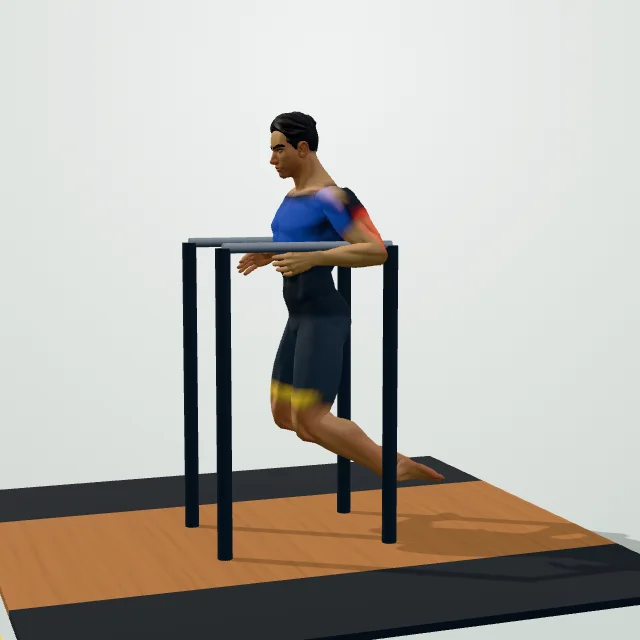
How to do it
- Grip the bars and press up to full arm extension.
- Cross your ankles behind you and lean slightly forward.
- Lower your body by bending your elbows.
- Stop when your upper arms are roughly parallel to the floor.
- Keep elbows tracking back, not flaring out.
- Press back up to full extension and repeat.
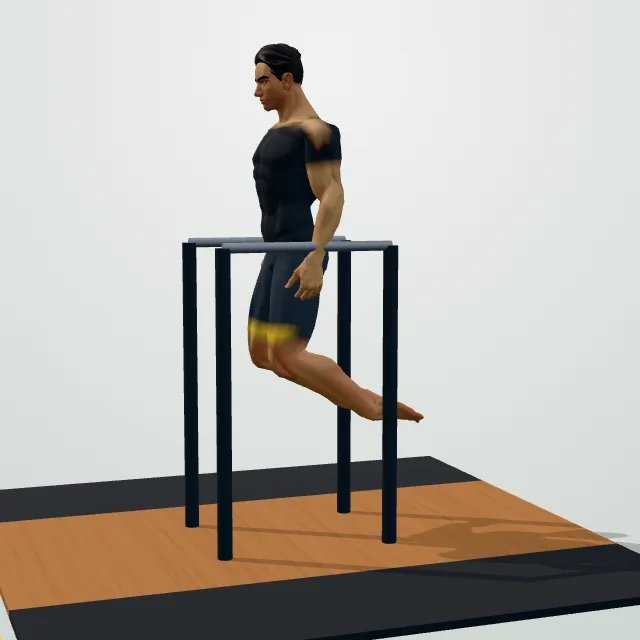
Coach cues
- Lean slightly forward, chest up.
- Lower until upper arms are parallel.
- Elbows track back, not out.
- Press up to full extension.
Breathing: Breathe in as you lower your body, and breathe out as you press back up.
Common mistakes
Make it easier / Make it harder
Sets and reps by goal
| Goal | sets | reps | Rest |
|---|---|---|---|
| Strength | 3–5 | 3–6 | 2–4 min |
| Muscle growth | 3–4 | 6–12 | 90–150 s |
| Endurance | 2–3 | 15–20 | 30–60 s |
The parallel bar dip is done suspended between two bars, lowering your body by bending your elbows and pressing back up to full extension. Because your entire bodyweight hangs from your arms with no feet touching the ground, it is one of the more demanding bodyweight exercises for the triceps and chest, and one of the best for building genuine pressing strength without a barbell.
It uses a bigger range of motion than most other triceps exercises, which is part of why it is so effective, but also why building up to it with a bench dip first is a sensible approach for beginners.
Muscles the parallel bar dip works
An upright torso position emphasizes the triceps as the main mover through elbow extension, with front deltoid and shoulder involvement helping stabilize the movement. Leaning your torso forward shifts more of the work onto the chest, similar to a chest dip, since it changes the angle at the shoulder. Your core and shoulders also work hard isometrically throughout to keep your body controlled rather than swinging between the bars.
Benefits of the parallel bar dip
- Full bodyweight loading: one of the more demanding upper-body pressing exercises, with no equipment beyond a set of bars.
- Big range of motion: stretches the chest and triceps further than most machine or free-weight pressing exercises.
- Adjustable emphasis: torso angle lets you bias triceps or chest without changing equipment.
- Scales with added weight: a dip belt lets you keep progressing well past bodyweight.
Technique: torso angle, depth and elbow path
Grip the bars and press up to support your body with arms extended, crossing your ankles behind you. Keep your torso fairly upright with a slight forward lean to emphasize the triceps, or lean further forward to bring in more chest. Lower your body by bending your elbows until your upper arms are roughly parallel to the floor — going much deeper increases stress on the front of the shoulder without much added benefit for most lifters. Press back up to full arm extension, keeping your elbows tracking back rather than flaring out to the sides.
Keep the movement controlled rather than dropping quickly into the bottom position, and avoid excessive forward lean if your goal is mainly triceps development, since more chest involvement generally means less direct triceps loading.
How to program the parallel bar dip
| Goal | Sets | Reps | Rest |
|---|---|---|---|
| Strength | 3–4 | 4–6 | 2 minutes |
| Muscle (hypertrophy) | 3 | 6–12 | 90 seconds |
| Endurance | 2–3 | 12–15 | 60 seconds |
If bodyweight dips are too easy for your target rep range, add weight with a dip belt or weighted vest; if they are too hard, use an assisted dip machine or resistance band for support while you build strength. This exercise fits well as a primary triceps or chest-and-triceps exercise — see the chest and triceps workout — and progress the reps or added weight gradually with the progressive overload guide.
Variations and progressions
- Assisted dip machine or band: reduces the effective bodyweight, a good starting point for beginners.
- Bench dip: an easier bodyweight regression using a bench instead of parallel bars — see the bench dip.
- Weighted dip: add a plate or dumbbell on a belt once bodyweight dips feel manageable for 10+ reps.
- Ring dips: gymnastic rings add an instability challenge for more advanced training.
Parallel bar dip vs bench dip vs close-grip bench press
The bench dip is a gentler regression where your feet can support some of your weight, making it a good stepping stone toward full dips. The close-grip bench press is a barbell alternative that lets you load the triceps heavily without needing dip bars or full bodyweight support. Many programs use dips as a bodyweight staple and add the close-grip bench press or pushdowns for additional volume and control over load.
Safety and who should modify it
Avoid sinking too deep into the bottom position, since going past a 90-degree elbow bend puts significant stress on the front of the shoulder and can aggravate the joint over time. If you feel shoulder pinching or pain rather than muscle fatigue, reduce the depth or switch to bench dips or the close-grip bench press instead. Build up gradually with an assisted dip machine or band if you cannot yet do a full unassisted dip with good form.
More exercises for triceps
Questions people ask
What muscles do parallel bar dips work?
How deep should I go on a dip?
I cannot do a full dip yet — how do I build up to one?
Are dips bad for the shoulders?
Should I lean forward or stay upright on dips?
Parallel bar dip vs bench dip — which is better?
General fitness information, not medical advice. Check with a doctor or physiotherapist before starting if you have a health condition, an injury or are pregnant. Stop if you feel chest pain, dizziness or sharp pain.