Legs · Home or gym
How to do box jumps with safe landing technique
Box jumps ask you to jump from the floor onto a raised box, landing softly in a stand rather than a deep squat. The landing and the step-down matter as much as the jump itself.
- Secondary
- CalvesHamstrings
- Level
- Intermediate
- Type
- Compound · Both sides together
- Sets × reps
- 4 × 5 reps
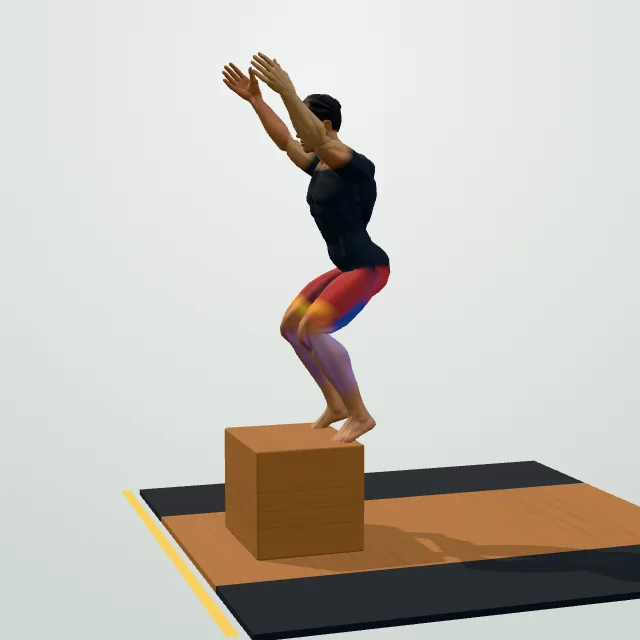
How to do it
- Stand facing the box, feet hip-width apart, a comfortable step away.
- Swing your arms back and bend your knees to load the jump.
- Swing your arms forward and drive through your feet to jump up.
- Land on the box with both feet flat, knees bending to absorb impact.
- Stand up fully straight on top of the box.
- Step back down one foot at a time; do not jump down.
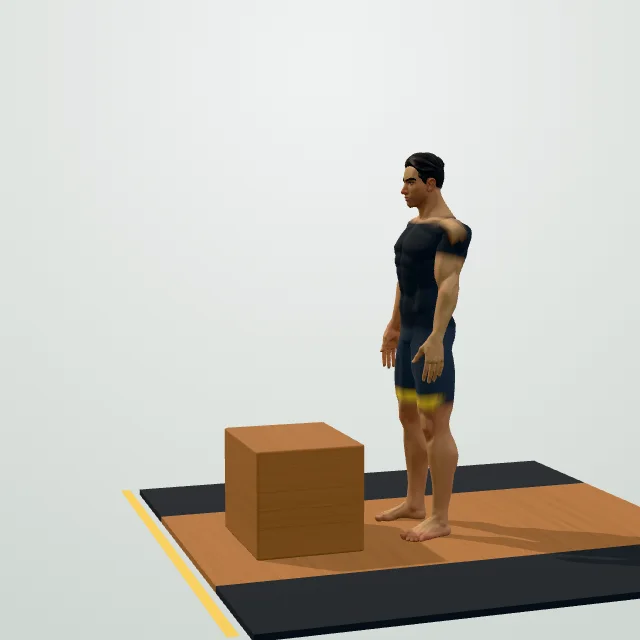
Coach cues
- Load your arms and knees, then jump.
- Land soft, both feet flat.
- Stand up tall on top of the box.
- Step back down, don’t jump down.
Breathing: Breathe out sharply as you jump, and breathe in as you land and reset for the next rep.
Common mistakes
Make it easier / Make it harder
Sets and reps by goal
| Goal | sets | reps | Rest |
|---|---|---|---|
| Strength | 3–5 | 3–6 | 2–4 min |
| Muscle growth | 3–4 | 6–12 | 90–150 s |
| Endurance | 2–3 | 15–20 | 30–60 s |
Box jumps are a plyometric exercise where you jump from standing on the floor up onto a raised box, landing in a controlled stand rather than a deep squat. The goal is producing power quickly, not just clearing height, which is why coaches care more about a clean landing than how tall the box is.
What muscles do box jumps work?
The quads and glutes — both covered in our leg exercises hub — drive the explosive jump off the floor, with the calves adding the final push through the ankle. On landing, those same muscles work eccentrically to absorb the impact, and the hamstrings and core help control your balance as you stick the landing on top of the box. Box jumps train the ability to produce force fast — a different quality from a slow, heavy squat, even though both use similar muscles.
Box jumps benefits
- Explosive power. Box jumps train your legs to produce force quickly, which carries over to sprinting, jumping and change-of-direction sports.
- Lower impact than some jumping drills. Landing on a raised box means less total drop distance than jumping and landing back on the floor.
- Conditioning. Sets of box jumps with short rest raise your heart rate quickly, useful in a HIIT-style finisher.
- Minimal equipment. A single sturdy plyo box, step or platform is all you need.
Box jump technique
Stand facing the box a comfortable half-step away, feet hip-width apart. Swing your arms back and bend your knees and hips slightly to load the jump, then swing your arms forward and drive through your feet to jump up onto the box, landing with both feet flat and your knees bending to absorb the impact. Land in a soft, athletic position and stand up fully on top of the box — do not land in a deep squat, since that usually means the box is too high or the landing is not fully controlled. Step back down one foot at a time; do not jump back down off the box, since landing down from height adds unnecessary impact.
Choose a box height where you land confidently with both feet flat and can stand up straight afterward — a lower box with a clean landing is always a better choice than a taller box with a rounded, unstable landing.
How to program box jumps
| Goal | Sets | Reps | Rest |
|---|---|---|---|
| Power development | 4 | 5 | 90-120 sec |
| Conditioning | 3-4 | 8-10, shorter rest | 45-60 sec |
Because box jumps train explosive power, low reps with full rest between sets work better than high-volume, short-rest sets — quality of each jump matters more than fatiguing your legs. Place them early in a workout, before heavier lifting or long cardio, while your legs are fresh and your landing mechanics are sharp. Two sessions a week is enough for most people; build up from jump squats before adding this exercise if you are new to jumping movements.
Box jump variations and progressions
Beginners should start with a low box or step and focus entirely on a soft, stable landing before increasing height. Step-ups are a useful lower-impact regression that trains a similar leg pattern without any jumping. More advanced athletes can try box jump overs, jumping onto the box and immediately down the other side, which adds a landing on the floor and demands more control. Add height gradually and only once landings are consistently clean at your current box.
Safety and who should modify it
Always step down from the box; never jump down. Choose a height you can land on with both feet flat and stand up straight, not one that forces a deep, wobbly landing.
Avoid box jumps if you have knee, ankle or Achilles pain, or are early in recovery from a lower-body injury — check with a doctor or physiotherapist before adding jumping exercises back into your training. Stop the set once your landings start losing control, since fatigued landing mechanics are when most jumping injuries happen. Our exercise safety guide covers more general signs it is time to stop.
More exercises for legs
Questions people ask
Are box jumps plyometrics?
What muscles do box jumps work?
How do you do box jumps safely?
Are box jumps good for beginners?
How high should a box jump be?
Are box jumps cardio or strength?
Why should you step down instead of jumping down from a box?
General fitness information, not medical advice. Check with a doctor or physiotherapist before starting if you have a health condition, an injury or are pregnant. Stop if you feel chest pain, dizziness or sharp pain.