Chest · Gym
Low-to-high cable fly: an upper chest finishing move
Pulling the cable up and across from a low pulley puts the upper chest under load in a way pressing rarely does. Here is the setup and the angle that make it work.
- Primary
- Chest
- Secondary
- Front delts
- Level
- Intermediate
- Type
- Isolation · Both sides together
- Sets × reps
- 3 × 12-15 reps
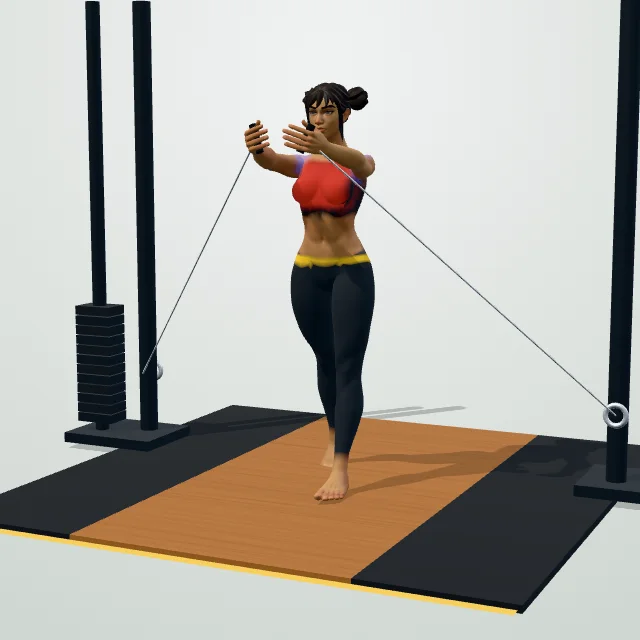
How to do it
- Set both pulleys to their lowest position.
- Grab a handle in each hand and step forward, taking a staggered stance.
- Keep a slight, fixed bend in your elbows.
- Sweep the handles up and across your body to chest height.
- Squeeze your upper chest at the top.
- Lower back down under control along the same path.
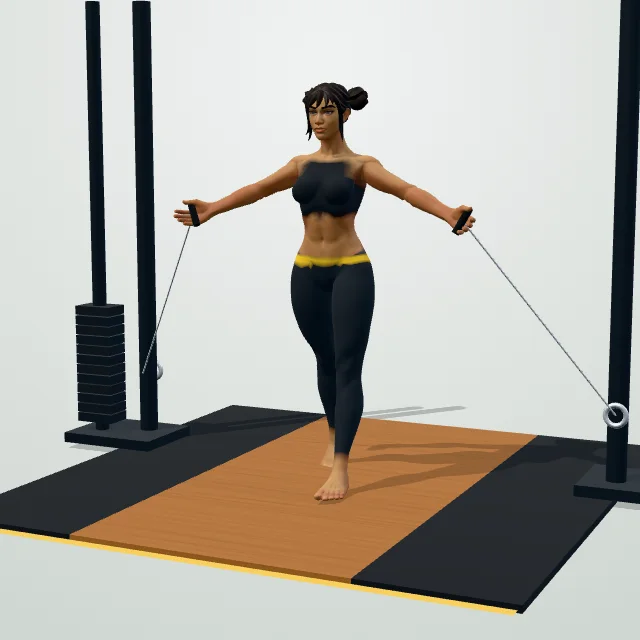
Coach cues
- Fixed elbow bend, slight forward lean.
- Sweep up and across to chest height.
- Squeeze the upper chest at the top.
- Lower under control, do not let it snap back.
Breathing: Breathe out as you sweep the handles up and across, then breathe in as you lower back down.
Common mistakes
Make it easier / Make it harder
Sets and reps by goal
| Goal | sets | reps | Rest |
|---|---|---|---|
| Strength | 3–5 | 6–8 | 90–120 s |
| Muscle growth | 3–4 | 10–15 | 60–90 s |
| Endurance | 2–3 | 15–20 | 30–60 s |
The low-to-high cable fly is a standing chest fly where the pulleys start low, near the floor, and you sweep the handles up and across your body to about chest or shoulder height. That upward angle is what sets it apart from a standard cable crossover, and it puts noticeably more work on the upper chest.
Muscles worked and why
The upper (clavicular) fibers of the chest do most of the work, since pulling upward and across mirrors the direction those fibers pull the arm. The front shoulders assist through the arc. This upward line is essentially the reverse of a standard high-to-low cable crossover, which instead targets the lower chest.
Benefits
Many chest exercises — flat presses, push-ups, dips — reach the lower and middle chest far more than the upper chest. This exercise, along with incline pressing, is one of the more direct ways to close that gap, and because it is cable-based, the chest stays under tension through the entire crossing motion rather than losing resistance near the top the way a dumbbell fly does.
Setup, stance and body lean
Set both pulleys to their lowest position and grab a handle in each hand, standing or taking a small step forward of the machine so the cables stay taut from the start. A slight forward lean and a small stagger in your stance helps you stay balanced as you pull upward.
With a slight, fixed bend in your elbows, sweep the handles up and across your body until your hands meet around chest or shoulder height, squeezing your upper chest at the top. Lower back down under control along the same path, keeping the elbow bend constant rather than letting your arms straighten into a press. Keep your torso still — the movement comes from your arms and shoulders sweeping through the arc, not from rocking your body to help the cable up.
How to program it
Use this as an accessory after your main pressing work, especially if upper chest is a priority or an incline press does not fit your shoulders well. 3 sets of 12–15 reps with 60–90 seconds of rest is typical, since the constant cable tension suits higher reps. Leave a couple of reps in reserve rather than grinding to failure every set (see the RPE and RIR guide), and progress mainly through added reps before adding weight, following progressive overload.
Variations and progressions
The incline dumbbell press trains the same upper chest fibers with a heavier load and a lockout, and pairs well with this exercise as the main lift while the cable fly serves as the finisher. The cable crossover with pulleys set higher instead targets the lower chest, so switching pulley height between the two gives you both ends of the chest in one session. A single-arm version, one side at a time, adds a small core-stability challenge.
Low-to-high vs high-to-low cable fly
The direction of pull decides which part of the chest works hardest: pulling up and across (low-to-high) emphasizes the upper chest, while pulling down and across from a high pulley (a standard cable crossover) emphasizes the lower chest. Neither is "better" — they train different fibers of the same muscle, and a well-rounded chest routine can use both across a week or a month.
Safety: who should modify it
Keep the weight light enough to control the full arc smoothly, and avoid letting the cables pull your arms back further than a comfortable stretch, which is the main way this exercise strains the shoulder. Keep a slight, fixed bend in your elbows rather than locking them out. If you feel pinching at the front of the shoulder, lower the weight or shorten the range, and see a physiotherapist if the discomfort continues.
Single-arm version
Doing this exercise one arm at a time, with your free hand resting on your hip or the machine frame, adds a small anti-rotation challenge for your core, since your torso wants to twist toward the working side as you pull. It also lets you focus fully on the feel of the upper chest contracting without a stronger arm doing slightly more of the work, which is easy to miss when both arms pull at once. Use a lighter weight per side than you would with both arms together, and keep your hips and shoulders square to the machine throughout the set rather than letting them rotate with the pull.
Questions people ask
What muscles does the low-to-high cable fly work?
How is the low-to-high cable fly different from a regular cable crossover?
How heavy should the low-to-high cable fly be?
How many reps should I do for low-to-high cable fly?
Can I do a low-to-high cable fly with dumbbells?
Is the low-to-high cable fly good for beginners?
Where should my hands finish on a low-to-high cable fly?
General fitness information, not medical advice. Check with a doctor or physiotherapist before starting if you have a health condition, an injury or are pregnant. Stop if you feel chest pain, dizziness or sharp pain.