Abs and core · Gym
Cable crunch: how to load your abs through a full crunch
The cable crunch lets you add resistance to a basic crunch so your abs can keep getting stronger once bodyweight reps stop being a challenge.
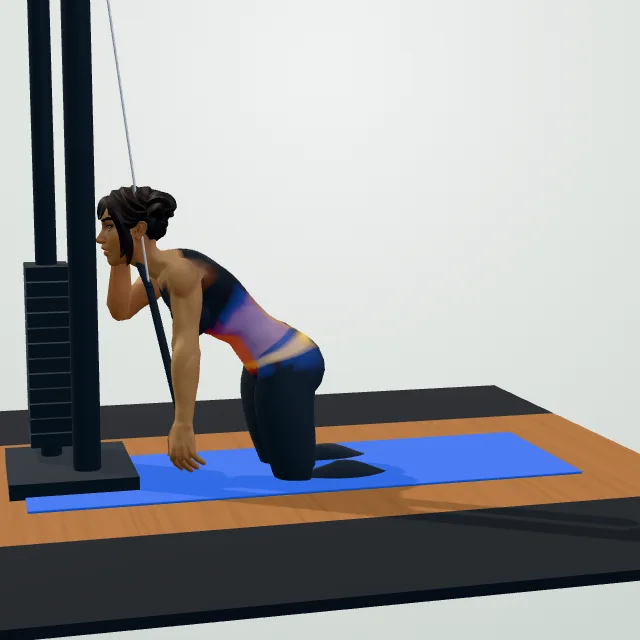
How to do it
- Attach a rope to a high pulley and kneel a couple of feet in front of it.
- Hold the rope by your temples, elbows pointed forward.
- Let your hips settle back over your heels and keep them still.
- Curl your ribcage down toward your hips, rounding your upper spine.
- Squeeze your abs hard at the bottom of the crunch.
- Let the weight return you to the start under control.
- Reset your posture before the next rep.
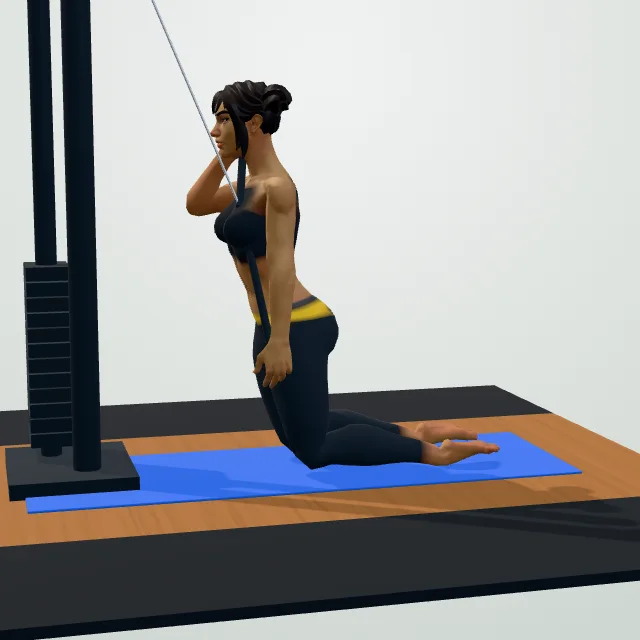
Coach cues
- Hips stay still, only your spine curls.
- Lead with your chest dropping down.
- Squeeze your abs at the bottom.
- Control the weight back up, no snapping.
Breathing: Breathe out as you curl down and crunch, breathe in as you return to the start.
Common mistakes
Make it easier / Make it harder
Sets and reps by goal
| Goal | sets | reps | Rest |
|---|---|---|---|
| Strength | 3–5 | 6–8 | 90–120 s |
| Muscle growth | 3–4 | 10–15 | 60–90 s |
| Endurance | 2–3 | 15–20 | 30–60 s |
The cable crunch is a kneeling exercise where you pull a rope attachment down toward the floor by curling your torso, not your arms, using the weight stack to add resistance to a basic crunch. Because you can add load in small increments, it is one of the few direct ab exercises that still lets you progress like a real strength lift once bodyweight crunches feel easy.
What muscles the cable crunch works
The cable crunch is a spinal flexion exercise: your rectus abdominis (the "abs") shortens to curl your ribcage down toward your hips, working through a longer range than a floor crunch because the resistance stays constant instead of falling off near the top. Your obliques assist to keep the movement straight, especially if you round slightly to one side, and your hip flexors stay mostly uninvolved if your hips stay still — which is exactly the point of using the cable instead of a sit-up. Your lats and forearms grip and stabilize the rope, but they are not the target muscles here.
Benefits of the cable crunch
- Loadable direct ab work. Unlike a floor crunch, you can keep adding small amounts of weight for years of progress.
- Isolates spinal flexion. Kneeling and anchoring your hips takes your hip flexors mostly out of the movement, so more of the work lands on your abs.
- Easy on the neck. With the rope held near your head rather than pulled with your hands, most lifters find it easier to avoid yanking on the neck than a weighted floor crunch.
- Works well as a finisher. It pairs naturally at the end of a training session once your grip and back are already warm from other cable work.
Technique: how to do the cable crunch correctly
Attach a rope to a high pulley and kneel a couple of feet in front of it, facing the machine. Hold the rope ends by your ears or temples with your elbows pointed forward, not flared out wide, and let your hips sit back over your heels — your hips should barely move for the whole set. From here, the rep is a curl of the spine: round your upper back down and bring your ribcage toward your pelvis, leading with your chest dropping rather than your head nodding forward. Think about crunching your abs the way you would crunch a piece of paper, not bowing forward from the hips.
Squeeze hard at the bottom for a moment, then let the weight pull you back to the start under control rather than snapping upright. Keep the rope path close to your body throughout, and choose a light weight the first time you try this so you can feel where the movement should come from before you add load.
How to program the cable crunch
| Goal | Sets | Reps | Rest |
|---|---|---|---|
| Muscle / hypertrophy | 3 | 12–15 | 45–60s |
| Endurance / finisher | 2–3 | 15–20 | 30–45s |
Pick a weight where the last 2–3 reps of each set genuinely challenge your abs without your hips starting to rock to generate momentum. Add weight in small jumps once you can complete every set for the full rep count with good form — the same progressive overload approach used for any other exercise. Cable crunches usually sit at the end of a training day, after your main lifts, two to three times a week.
Variations
A standing cable crunch, done from a high pulley without kneeling, shifts more stability demand onto your legs and is a reasonable option if kneeling is uncomfortable, though it is slightly harder to keep the hips still. A single-arm or twisting cable crunch, curling diagonally toward one knee, brings the obliques in more directly. If you train at home without a cable stack, a reverse crunch or a banded crunch from a high anchor point are reasonable substitutes for the same loaded flexion pattern.
Cable crunch vs. crunch machine vs. bodyweight crunch
A seated ab crunch machine locks you into a fixed arc and is often easier to learn on day one, while the cable version demands more control of your own torso but lets you fine-tune the weight in smaller steps and change the angle. A bodyweight crunch is the right starting point if you cannot yet control the cable version without your hips swinging, and it needs no equipment at all. None of the three is strictly "better" — the cable crunch is simply the one that keeps progressing once bodyweight reps stop being a challenge.
Safety: who should modify or avoid it
Stop if you feel sharp pain in your lower back or neck rather than muscle effort in your abs — this usually means the hips are moving too much or the rope is being pulled with the arms instead of the torso curling. If you have a current back injury, are pregnant, or have had recent abdominal surgery, check with a doctor or physiotherapist before adding loaded ab work.
Workout plans with this exercise
More exercises for abs and core
Questions people ask
What muscles does the cable crunch work?
How much weight should I use for cable crunches?
Is the cable crunch better than a crunch machine?
Can I do cable crunches standing?
Why do my hips move during cable crunches?
How often should I do cable crunches?
General fitness information, not medical advice. Check with a doctor or physiotherapist before starting if you have a health condition, an injury or are pregnant. Stop if you feel chest pain, dizziness or sharp pain.