Back · Home or gym
Band pull-apart: a 30-second fix for rounded shoulders
Hold a resistance band at arm's length and pull it apart until it touches your chest — one of the simplest exercises in the gym, and one of the most useful.
- Primary
- Rear deltsUpper back
- Secondary
- Traps
- Level
- Beginner
- Type
- Isolation · Both sides together
- Sets × reps
- 3 × 15-20 reps
How to do it
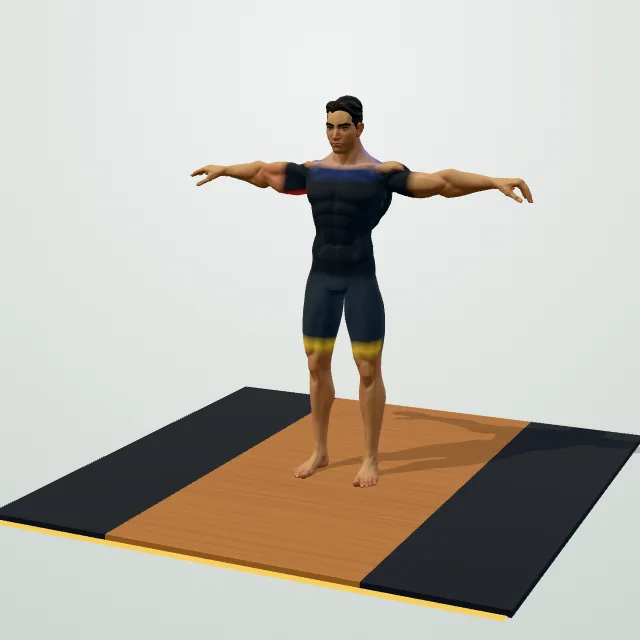
- Hold the band with both hands at shoulder-width, arms out at shoulder height.
- Take up the slack so there is tension at the start.
- Pull your hands apart, squeezing your shoulder blades together.
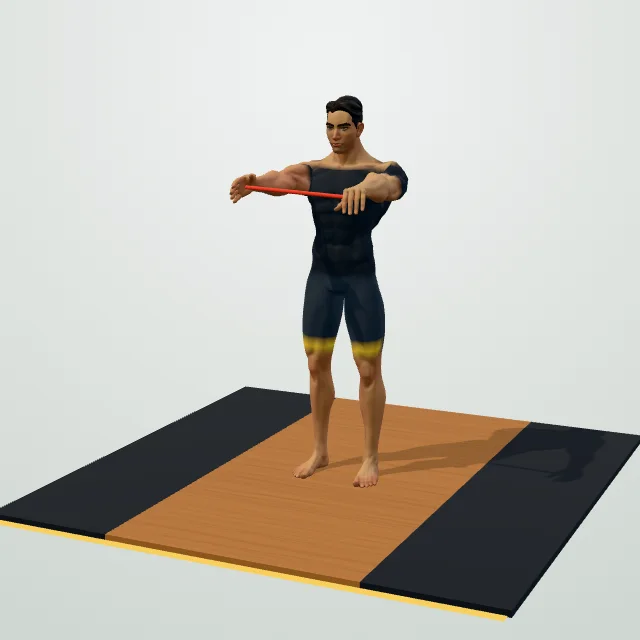
- Bring the band to touch your chest, keeping your arms straight.
- Return under control and repeat without losing tension.
Coach cues
- Arms straight, shoulder height.
- Squeeze your shoulder blades together.
- Band touches your chest.
- Control the return, no snapping back.
Breathing: Breathe out as you pull the band apart, breathe in as you return to the start.
Common mistakes
Make it easier / Make it harder
Sets and reps by goal
| Goal | sets | reps | Rest |
|---|---|---|---|
| Strength | 3–5 | 6–8 | 90–120 s |
| Muscle growth | 3–4 | 10–15 | 60–90 s |
| Endurance | 2–3 | 15–20 | 30–60 s |
What muscles does the band pull-apart work
The main targets are your rear delts and the muscles across your upper back that pull your shoulder blades together, plus your traps helping to control the movement. The pecs (chest) act as the opposing muscle being stretched rather than the muscle doing the work — so despite a passing resemblance to a reverse chest fly, the pull-apart is a back and rear-delt exercise, not a chest one.
Benefits
Because pressing exercises (bench press, push-ups, overhead work) are common in most training programs and the muscles that pull the shoulder back are comparatively undertrained, the band pull-apart is a quick, low-load way to balance that out. It also needs almost no space or equipment, making it one of the most practical exercises to do at a desk, before a workout, or while traveling with just a light band in a bag. Because the movement is so quick to set up, it is easy to build into a daily habit rather than something reserved only for dedicated training days.
Technique: grip, tension and the squeeze
Hold a resistance band with both hands at shoulder-width, arms straight out in front of you at shoulder height, with enough tension in the band that it is not slack at the start. Pull your hands apart, driving your arms out to the sides while squeezing your shoulder blades together, keeping your arms straight throughout rather than bending your elbows, which turns it into a row instead of a pull-apart. Bring the band to touch your chest at the peak of the movement, pause briefly, then return under control rather than letting the band snap your arms back together — the return is just as valuable as the pull.
Adjust your hand spacing to change the difficulty: a narrower grip increases the resistance, a wider grip makes it easier. You should feel this across your upper back and rear shoulders, not in your neck or lower back — if your shoulders shrug up toward your ears, the band is likely too heavy for good form.
How to program band pull-aparts
2–3 sets of 15–20 reps, 2–4 times a week, is a common approach since this is primarily an endurance and postural exercise rather than a maximum-strength one. It works well as a warm-up before pressing or pulling exercises, as filler between sets of a heavier lift, or as a quick habit done independently of any workout at all — many people keep a light band at their desk for exactly this reason.
Alternatives
A face pull on a cable machine trains a similar pattern with an added external-rotation finish, and a prone Y-T-W raise targets the same upper-back muscles lying face-down if a band is not available. If you do not have a resistance band, doing the movement with just your arms and no resistance, focusing purely on the shoulder-blade squeeze, still has some value as a posture drill, and a light towel held taut between both hands works as an improvised substitute in a pinch.
Safety
Choose a band with light enough resistance that you can control both the pull and the return without your shoulders shrugging or your lower back arching. If you feel pinching at the front of the shoulder rather than a squeeze across your upper back, check that your arms are staying straight and your shoulder blades are moving down and back, not up. As with any shoulder exercise, ease off if you have an existing rotator cuff issue and are unsure how it will respond.
Workout plans with this exercise
Questions people ask
What muscles does the band pull-apart work?
Is the band pull-apart a good warm-up exercise?
How heavy should my band be for pull-aparts?
Band pull-apart vs face pull: which is better?
Can I do band pull-aparts every day?
Why do I feel band pull-aparts in my neck?
General fitness information, not medical advice. Check with a doctor or physiotherapist before starting if you have a health condition, an injury or are pregnant. Stop if you feel chest pain, dizziness or sharp pain.