Legs · Home, no equipment
Nordic hamstring curl: the eccentric hamstring exercise
The nordic hamstring curl trains your hamstrings to resist being stretched under load, which is exactly what happens in a sprint or a sudden lunge. It is simple to describe and genuinely hard to do.
- Primary
- Hamstrings
- Level
- Advanced
- Type
- Isolation · Both sides together
- Sets × reps
- 3 × 3-6 reps
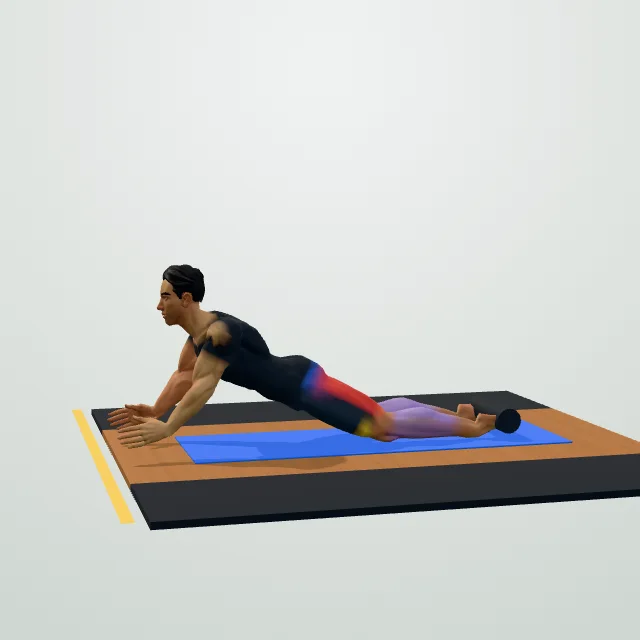
How to do it
- Kneel on a folded mat with your ankles firmly anchored under a bar, bench, or partner's hands.
- Brace your core and squeeze your glutes so your body forms one straight line from knees to shoulders.
- Slowly tip forward, resisting the fall with your hamstrings for as long as you can control it.
- When you can no longer resist, catch yourself softly with your hands on the floor.
- Push back to the start with your hands and hamstrings together, or reset on your knees.
- Repeat, keeping your hips extended the whole time — do not fold at the hips.
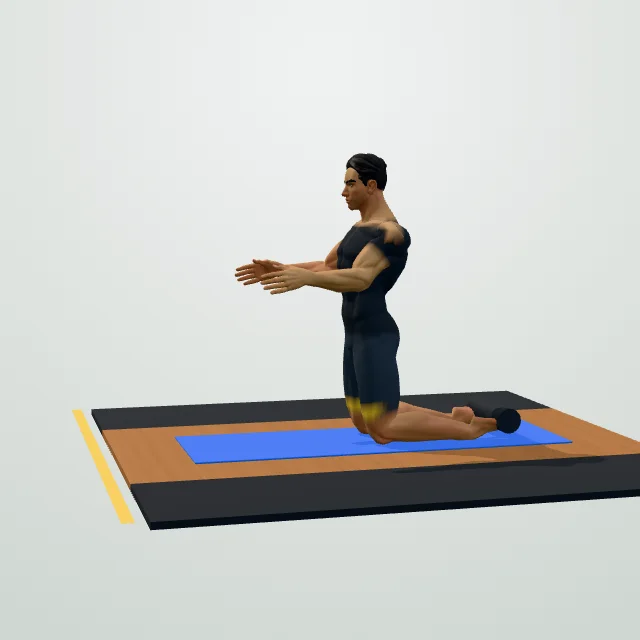
Coach cues
- Ankles locked, hips fully extended.
- Fall forward as slowly as you can.
- Keep one straight line, knees to shoulders.
- Catch softly, then reset.
Breathing: Breathe in as you brace before descending, and breathe out as you push back up to the start.
Common mistakes
Make it easier / Make it harder
Sets and reps by goal
| Goal | sets | reps | Rest |
|---|---|---|---|
| Strength | 4–5 | 6–8 | 90–120 s |
| Muscle growth | 3–4 | 10–15 | 60–90 s |
| Endurance | 2–3 | 15–25+ | 30–60 s |
The nordic hamstring curl is a bodyweight exercise where you kneel, anchor your ankles, and lower your torso toward the floor as slowly as you can, using only your hamstrings to control the descent. It is one of the few exercises built almost entirely around the eccentric (lengthening) part of a muscle contraction, which is why sports teams use it to reduce hamstring strain rates.
Muscles worked and why it feels so different
The hamstrings do almost all the work here, helped by the glutes and calves, which stabilize your hips and ankles while your ankles stay pinned. Every other hamstring exercise (leg curls, Romanian deadlifts) trains the muscle mostly in its shortened or lengthened position under a fairly constant load. The nordic curl asks the hamstrings to fight gravity through almost the entire range while your body weight increases as you tip forward, so the challenge builds sharply toward the bottom.
Benefits: why coaches like it
Research in football and rugby squads links regular eccentric hamstring work with meaningfully fewer hamstring strains, particularly in sports with sprinting and sudden deceleration. Beyond injury prevention, the exercise builds hamstring strength and length-tension capacity that carries over to sprint speed and change of direction. It also needs no equipment beyond something to anchor your ankles.
Technique in detail
Kneel on a folded mat with your ankles locked under a heavy bar, a partner's hands, or a nordic curl bench. Keep a straight line from your knees through your hips and shoulders — do not let your hips pike backward or your lower back arch. Brace your abs and glutes, then let your torso tip forward as one rigid unit, fighting the fall with your hamstrings for as long as you can. Most people can only resist for a short distance before the hamstrings give out; that is the moment to catch yourself with your hands, absorb the fall, and push back up to the start (or simply reset for the next rep). Keep your hips extended throughout — bending at the hips to "cheat" the range takes the load off the hamstrings and turns it into a hip-flexor exercise.
Progression: almost nobody starts with the full movement
Very few people can control a full-range nordic curl on day one, and that is fine. Start with a shorter range: only lower a small amount before catching yourself, and add range over several weeks as your hamstrings adapt. A training partner or a resistance band looped around your chest and anchored in front of you can also assist the bottom portion, letting you build the eccentric strength and confidence to go deeper. Some gyms have a dedicated nordic curl bench or a glute-ham machine that pads the ankles and adds a chest pad, which is a comfortable alternative to a partner holding your ankles.
Programming: low reps, plenty of recovery
Because the exercise is almost pure eccentric loading, it produces unusually deep muscle soreness the first few times you try it — treat your first sessions as a trial run with only a handful of reps. Once you have adapted, 3 sets of 3–6 controlled reps, once or twice a week, is a common dose in return-to-play and injury-prevention programs. Rest 60–90 seconds between sets and place it early in a session, before your hamstrings are fatigued from squats or deadlifts. Expect soreness for several days after a new range or a rep increase; see our guide to muscle soreness for what is normal and when to back off.
Nordic curl vs. lying leg curl
A lying leg curl trains the hamstrings with a machine that controls the resistance for you, which makes it easier to load heavy and safer to push to failure. The nordic curl trains the same muscles eccentrically, using your own body weight and control, and is harder to scale precisely — but the evidence for reducing hamstring injuries is specifically built around this eccentric pattern. Many programs use both: leg curls for hamstring size and easy overload, nordic curls for eccentric strength and durability.
Safety notes
This is an advanced exercise — build a base of general hamstring and glute strength first, for example with single-leg glute bridges or Romanian deadlifts, before adding nordic curls. Anyone with an existing hamstring strain, or knee pain from kneeling, should get clearance from a physiotherapist before starting. Stop if you feel a sharp pull behind the thigh rather than the expected deep muscular burn, and always warm up your hips and hamstrings first.
More exercises for legs
Questions people ask
What is a nordic hamstring curl?
Are nordic hamstring curls good for hamstring injury prevention?
How do you do a nordic hamstring curl at home without equipment?
Do nordic hamstring curls build muscle?
How many nordic hamstring curls should a beginner do?
What is a good nordic hamstring curl alternative?
Why are nordic hamstring curls so sore the next day?
General fitness information, not medical advice. Check with a doctor or physiotherapist before starting if you have a health condition, an injury or are pregnant. Stop if you feel chest pain, dizziness or sharp pain.