Legs · Gym
The Romanian deadlift: barbell hip-hinge form
The Romanian deadlift — RDL for short — is a barbell hip hinge that starts from standing, not the floor. It builds hamstring and glute strength through a controlled stretch under load.
- Primary
- HamstringsGlutes
- Secondary
- Lower backForearms
- Level
- Intermediate
- Type
- Compound · Both sides together
- Sets × reps
- 3 × 8-10 reps
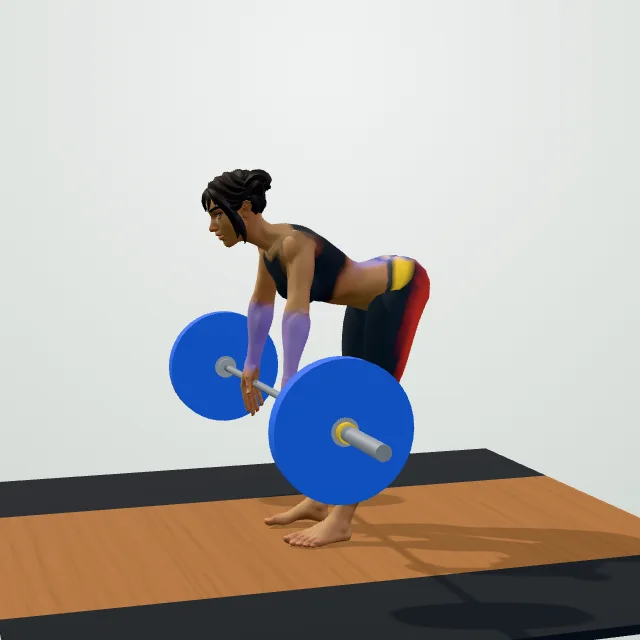
How to do it
- Stand with the bar close to your shins, feet hip-width apart.
- Grip the bar just outside your legs.
- Keep a slight, fixed bend in your knees throughout.
- Push your hips back, keeping the bar close to your thighs.
- Lower until you feel a strong hamstring stretch, back flat.
- Drive your hips forward to stand tall, squeezing your glutes.
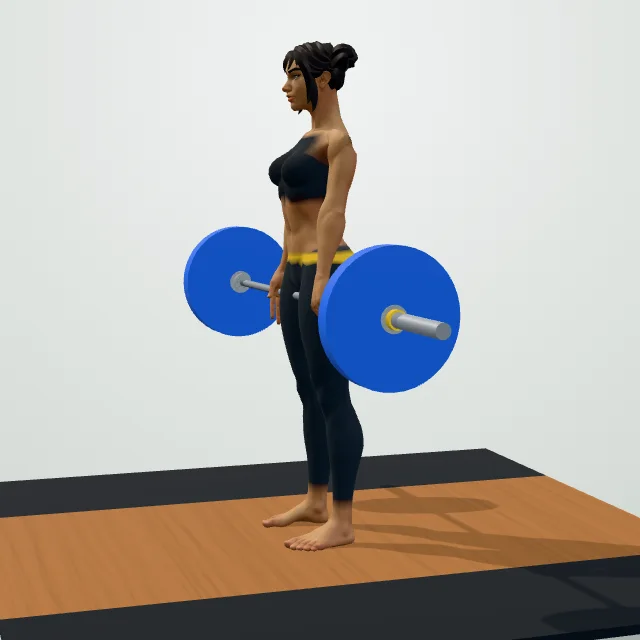
Coach cues
- Slight knee bend, hips push back.
- Bar stays close to your legs.
- Lower until your hamstrings stretch hard.
- Drive your hips forward to stand.
Breathing: Breathe in and brace before lowering the bar, breathe out as you drive your hips forward to stand.
Common mistakes
Make it easier / Make it harder
Sets and reps by goal
| Goal | sets | reps | Rest |
|---|---|---|---|
| Strength | 3–5 | 3–6 | 2–4 min |
| Muscle growth | 3–4 | 6–12 | 90–150 s |
| Endurance | 2–3 | 15–20 | 30–60 s |
The Romanian deadlift, or RDL, is a barbell hip hinge that starts and ends from a standing position, unlike a conventional deadlift, which starts from the floor. Keeping a soft, near-fixed bend in the knees, you push your hips back to lower the bar down your legs, then drive your hips forward to stand — a pattern built specifically to load the hamstrings and glutes under a long, controlled stretch.
What muscles does the Romanian deadlift work?
The hamstrings — covered in our leg exercises hub — do most of the work controlling the lowering phase and driving the hips back to standing, with the glutes finishing the hip extension at the top of each rep. The lower back works isometrically to keep your spine in a neutral position under load, and your forearms and grip work throughout to hold the bar. Because the range of motion is built around hip flexion and extension with almost no knee bend, the RDL isolates the hamstrings and glutes more directly than a conventional deadlift, which also uses the quads heavily off the floor.
Romanian deadlift benefits
- Hamstring and glute strength. Few common exercises load the hamstrings through as long a range as the RDL.
- A functional hip-hinge pattern. The hip hinge underpins deadlifts, kettlebell swings and safe lifting technique in daily life.
- Grip and lower-back endurance. Holding a loaded bar builds the forearm and postural strength that supports other lifts.
- Works alongside squats. Since squats emphasize the quads more, the RDL fills the hamstring gap in a balanced leg program.
Romanian deadlift technique
Stand with the barbell close to your shins, feet hip-width apart, and grip it just outside your legs. Keep a slight, fixed bend in your knees throughout the set — you are not squatting down, you are hinging at the hips. Push your hips straight back while keeping the bar dragging close along your thighs, letting your torso lean forward as your hips move back, and keep your lower back neutral rather than rounding. Lower the bar until you feel a strong hamstring stretch, usually around mid-shin to just below the knee, or as far as you can go while keeping your back flat — depth is limited by your hamstring flexibility, not by touching the floor. Drive your hips forward to reverse the movement and stand tall, squeezing your glutes at the top rather than leaning back.
Focus on feeling the stretch load your hamstrings, not on how low the bar travels — a shorter range with a neutral spine beats a lower bar path with a rounded back.
How to program Romanian deadlifts
| Goal | Sets | Reps | Rest |
|---|---|---|---|
| Strength | 3-4 | 6-8 | 90-120 sec |
| Muscle | 3 | 8-10 | 60-90 sec |
| Endurance | 2-3 | 12-15 | 45-60 sec |
Choose a weight where the last 2-3 reps of each set feel hard to control with good form, roughly 2-3 reps in reserve, and increase load in small steps of about 5-10% once every rep feels solid. The RDL works well after a squat or as the main hip-hinge movement on a hamstring-focused day, once or twice a week. A plate calculator can help you load the bar quickly for small jumps.
Romanian deadlift vs deadlift vs good morning
A conventional deadlift starts from the floor with the knees more bent, using the quads more and asking for a fresh setup on every rep. The Romanian deadlift starts from standing and keeps the knees only slightly bent, isolating the hip hinge and the hamstrings more directly. A good morning uses the same hip-hinge pattern as the RDL but with the bar on your back instead of in your hands, which shifts more balance demand onto your lower back and hips. All three train a hip hinge, but the RDL is generally considered the safest entry point for learning the pattern with a barbell.
Safety and who should modify it
Keep your lower back neutral throughout the set — if you cannot maintain a flat back at a given depth, that depth is your current range limit, not the bar reaching the floor.
Avoid holding your breath through the heaviest reps if you have high blood pressure or a heart condition; breathe out steadily as you stand instead. Stop if you feel sharp lower-back pain rather than normal hamstring effort, and check with a doctor or physiotherapist before loading a hip hinge if you have a current back injury or ongoing lower-back pain.
Workout plans with this exercise
Build muscle · Intermediate
Push Pull Legs Split (6 Days)
Strength · Intermediate
Upper/Lower Split (4 Days)
Build muscle · Intermediate
4-Day Muscle-Building Workout Plan
Build muscle · Intermediate
5-Day Body-Part Split (Bro Split)
Build muscle · Beginner
Glute Workout Plan (Gym and Home)
Build muscle · Intermediate
Leg Day Workout (Gym)
More exercises for legs
Questions people ask
What is a Romanian deadlift?
What is the difference between a Romanian deadlift and a deadlift?
What muscles does the Romanian deadlift work?
Is the Romanian deadlift good for the lower back?
How low should you go in a Romanian deadlift?
Do Romanian deadlifts build muscle?
Can I do Romanian deadlifts without a barbell?
General fitness information, not medical advice. Check with a doctor or physiotherapist before starting if you have a health condition, an injury or are pregnant. Stop if you feel chest pain, dizziness or sharp pain.