Legs · Home, no equipment
The pistol squat: a full step-by-step progression
The pistol squat — a single-leg squat with the other leg held straight out in front — is one of the hardest bodyweight leg exercises to earn. Here is what it trains and how to build up to it safely.
- Secondary
- AbsCalvesHip flexors
- Level
- Advanced
- Type
- Compound · One side, then the other
- Sets × reps
- 3 × 3-6 reps per side
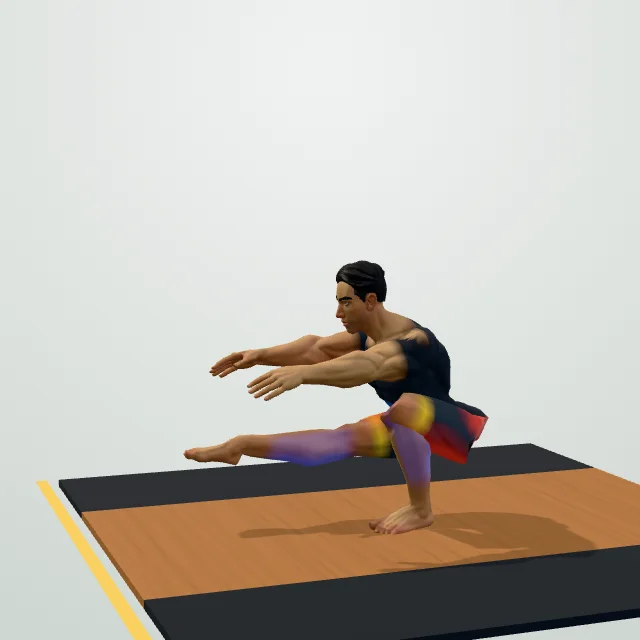
How to do it
- Stand on one leg, arms out in front for counterbalance.
- Lift the other leg off the floor, straight out in front of you.
- Bend your standing knee and hip to lower under control.
- Keep your heel down and your chest as upright as possible.
- Go as deep as you can control, ideally to full depth.
- Drive through your standing foot to return to a full stand.
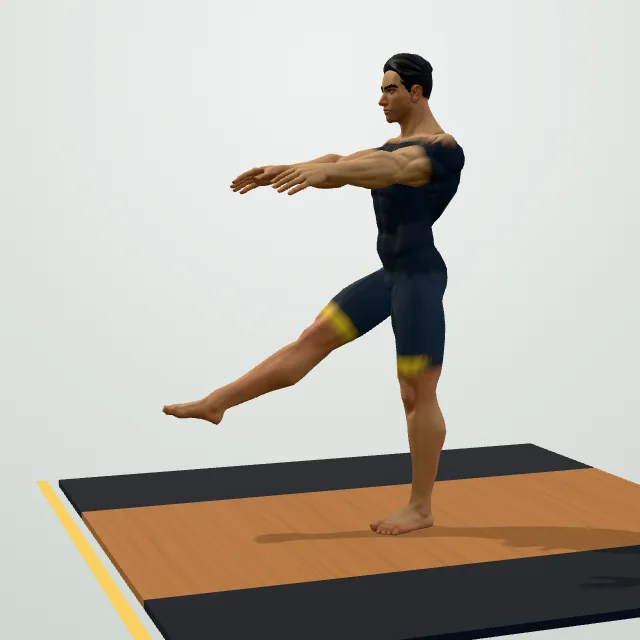
Coach cues
- Arms forward, other leg held straight out.
- Sit back and down, heel stays planted.
- Chest tall, control the whole way down.
- Drive through the whole foot to stand.
Breathing: Breathe in as you lower under control, breathe out as you drive back up to standing.
Common mistakes
Make it easier / Make it harder
Sets and reps by goal
| Goal | sets | reps | Rest |
|---|---|---|---|
| Strength | 4–5 | 3–6 | 2–4 min |
| Muscle growth | 3–4 | 6–12 | 90–150 s |
| Endurance | 2–3 | 15–25+ | 30–60 s |
The pistol squat is a single-leg squat where you lower your whole body weight on one leg while holding the other leg straight out in front of you for balance. It demands quad strength, ankle mobility, hip control and balance all at once, which is why it is treated as a skill to build toward rather than something to attempt cold.
What muscles does the pistol squat work?
The standing leg's quads and glutes do the heavy lifting through the full squat range, working harder than in a two-leg squat because they carry your entire body weight alone. Your abs and lower back brace hard to keep your torso from folding forward, your calves and ankle muscles make constant small adjustments to keep you balanced on one foot, and your hip flexors work isometrically to hold the opposite leg extended in the air for the whole rep.
Pistol squat benefits
- Unilateral leg strength. Training one leg at a time exposes and fixes strength imbalances that two-leg squats can hide.
- Ankle and hip mobility. Reaching full depth on one leg requires more ankle dorsiflexion and hip flexibility than most people start with, so training toward it builds that range.
- Balance and body control. Holding the position on one foot trains the small stabilizer muscles around the ankle, knee and hip.
- No equipment needed. Like other pure bodyweight moves, it needs nothing but floor space, and it scales with countless assisted versions.
How to build up to a pistol squat
Very few people can do a strict pistol squat on day one, and that is normal — it is a skill built in stages, not a beginner exercise:
- Box or bench-assisted single-leg squat. Sit back and down to a box or bench on one leg, then stand back up, to build strength through a safe, controlled range.
- Assisted pistol squat. Hold a doorframe, TRX strap or sturdy rail lightly with one hand to support balance while you lower and rise.
- Elevated-heel pistol squat. Prop your heel on a small plate or wedge if tight ankles stop you reaching depth without your heel lifting.
- Partial-range pistol squat. Lower only to the depth you can control, then gradually extend the range over weeks.
- Full pistol squat. Once you can control the assisted version for several reps, remove the support.
Work on this progression two to three times a week, and expect it to take weeks to months depending on your starting strength and ankle mobility — that timeline is normal for this exercise.
How to program pistol squats
| Goal | Sets | Reps (each side) | Rest |
|---|---|---|---|
| Skill practice (learning) | 3-4 | 3-6 | 60-90 sec |
| Strength (once mastered) | 3-4 | 5-8 | 90 sec |
Because a strict pistol squat is already close to your effort limit on one leg, low reps with full control matter more than chasing higher numbers. Once you own the full range, you can add a dumbbell held at your chest for weighted reps to keep progressing strength — see our progressive overload guide for how to add load safely over time. Fit this work early in a leg-focused session, before your legs are fatigued from other squats or lunges.
Pistol squat variations and alternatives
If a full pistol squat is not yet realistic for your knees or ankles, a Bulgarian split squat or Cossack squat both build single-leg or one-side-loaded strength with more support under the working leg. More advanced lifters can progress to a weighted version holding a light dumbbell, or a "dragon" variation where the rear leg is elevated behind you for extra range and difficulty. All of these fit well in a calisthenics-based program.
Safety and who should modify it
The pistol squat loads the knee and ankle through a large range on one leg. Build strength and mobility through the progression above before attempting a full rep.
If you have knee pain, limited ankle mobility, or balance problems, use an assisted version and progress slowly rather than forcing depth. Stop if you feel sharp knee or ankle pain — normal muscle fatigue is expected, joint pain is not. Anyone recovering from a knee or hip injury should check with a doctor or physiotherapist before training toward this exercise.
More exercises for legs
Questions people ask
What is a pistol squat?
What muscles does the pistol squat work?
How do you build up to a pistol squat?
Are pistol squats hard?
Are pistol squats bad for your knees?
Can everyone do a pistol squat?
How do you make pistol squats easier?
General fitness information, not medical advice. Check with a doctor or physiotherapist before starting if you have a health condition, an injury or are pregnant. Stop if you feel chest pain, dizziness or sharp pain.