Back · Home or gym
Resistance band row: build your back anywhere
Anchor a band around your feet or a door, sit or stand tall, and row it toward your ribs — a portable way to train your back without a cable machine.
- Primary
- LatsUpper back
- Secondary
- BicepsRear delts
- Level
- Beginner
- Type
- Compound · Both sides together
- Sets × reps
- 3 × 12-15 reps
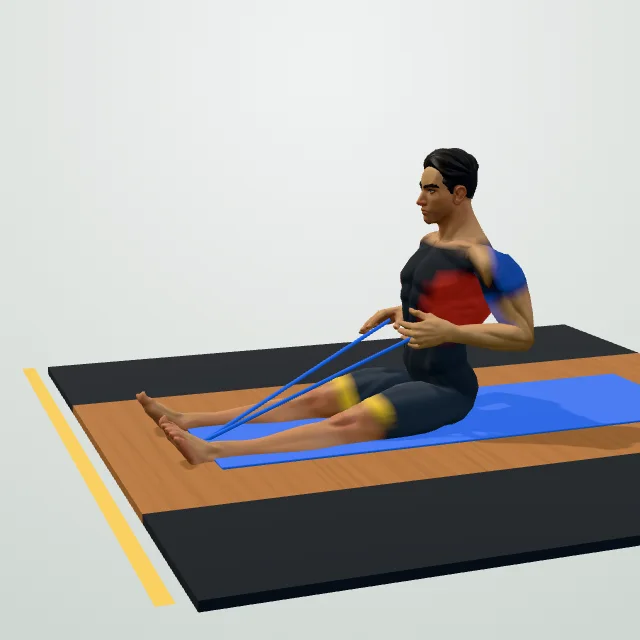
How to do it
- Anchor the band around your feet or a sturdy post at chest height.
- Sit or stand tall with a slight natural arch in your lower back.
- Pull the handles toward your ribs, elbows driving back and close to your sides.
- Squeeze your shoulder blades together at the finish.
- Return slowly under control, resisting the band the whole way.
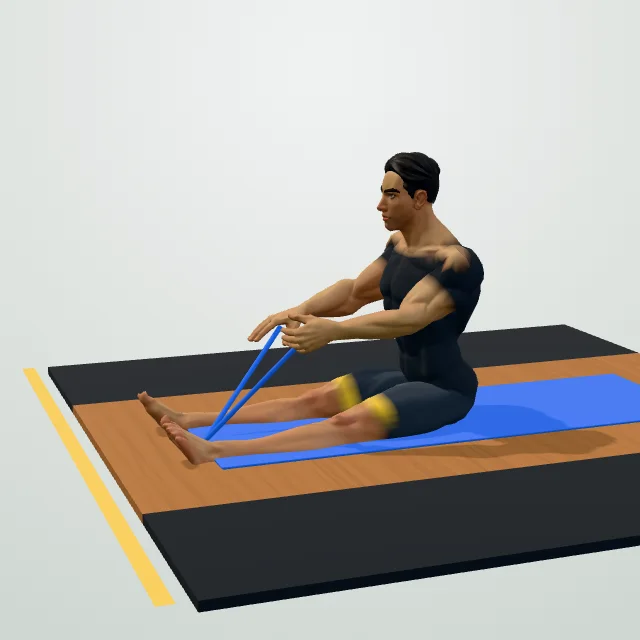
Coach cues
- Sit or stand tall to start.
- Elbows back, close to your sides.
- Squeeze your shoulder blades together.
- Control the return, resist the band.
Breathing: Breathe out as you pull the band toward your ribs, breathe in as you return to the start.
Common mistakes
Make it easier / Make it harder
Sets and reps by goal
| Goal | sets | reps | Rest |
|---|---|---|---|
| Strength | 3–5 | 3–6 | 2–4 min |
| Muscle growth | 3–4 | 6–12 | 90–150 s |
| Endurance | 2–3 | 15–20 | 30–60 s |
What muscles does the resistance band row work
The prime movers are your lats and upper back, the muscles that pull your arms and shoulder blades back toward your torso. Your biceps assist with bending the elbow through the pull, and your rear delts help at the finish as your shoulder blades draw together. Because the movement pattern is nearly identical to a cable row, it trains the same muscles a machine would, just with resistance from stretching the band instead of a weight stack.
Benefits
A resistance band packs into a bag and needs no rack, cable station or bar, which makes it one of the most travel-friendly ways to train a full back-pulling pattern. Because band tension increases the further you stretch it, the resistance curve also naturally gets harder right at the point of the strongest muscle contraction, which some lifters find matches the movement well. It is a practical option for home workouts, hotel rooms, or as a lighter substitute on days when heavier rowing is not appropriate. It is also joint-friendly enough to use during a return from injury, once cleared for pulling exercises, since band tension can be dialed down more precisely than jumping between fixed weight plates.
Technique: anchor point, posture and pull
Sit on the floor with your legs extended and the band looped around both feet, or stand with the band anchored to a sturdy door anchor or post at roughly chest height. Sit or stand tall with a slight natural arch in your lower back, not slouched or rounded forward, and hold the handles with arms extended toward the anchor point. Pull the handles back toward your ribs by driving your elbows behind your torso, keeping them close to your sides, and squeeze your shoulder blades together at the finish. Return slowly, letting your arms extend and your shoulder blades stretch forward slightly, resisting the band's pull back rather than letting it yank your arms forward.
Keep your torso still throughout — leaning back to help the pull or rounding forward as you return both reduce how much work your back muscles actually do. You should feel this across your upper back and lats, not primarily in your lower back or arms; if your lower back is doing most of the work, sit taller and brace your core before you start.
How to program resistance band rows
3 sets of 12–15 reps, resting 60–90 seconds, works well for most goals. Because band tension is harder to judge precisely than a weight stack, adjust difficulty by choosing a thicker band, shortening the band by wrapping it around your hand, or moving further from the anchor point rather than by counting an exact "weight." It fits naturally into a resistance band full-body workout or as the main back exercise in a home session.
Alternatives
A seated cable row is the closest machine equivalent if a cable station is available, offering more consistent resistance throughout the range. A doorframe row or inverted row both train a similar pulling pattern using only bodyweight if you do not have a band at all.
Safety
Check the band for nicks or wear before each use, since a snapped band under tension can whip back unpredictably, and make sure any door anchor is secured on the far side of a closed, sturdy door. Keep tension controlled on both the pull and the return rather than letting the band snap your arms forward, and stop if you feel any sharp joint pain rather than normal muscle fatigue. Replace any band showing cracks or discoloration rather than continuing to use it past its useful life.
Workout plans with this exercise
Questions people ask
What muscles does a resistance band row work?
Resistance band row vs cable row: which is better?
How do I make resistance band rows harder?
Can I do resistance band rows standing up?
Is it safe to anchor a resistance band in a door?
How often should I do resistance band rows?
General fitness information, not medical advice. Check with a doctor or physiotherapist before starting if you have a health condition, an injury or are pregnant. Stop if you feel chest pain, dizziness or sharp pain.