Chest · Home, no equipment
Wall push-up: the easiest way to start pushing
A standing push-up done against a wall, ideal for complete beginners, older adults, or anyone easing back into exercise after time off. Here is how to do it well and what comes next.
- Primary
- Chest
- Secondary
- TricepsFront delts
- Level
- Beginner
- Type
- Compound · Both sides together
- Sets × reps
- 2 × 10-15 reps
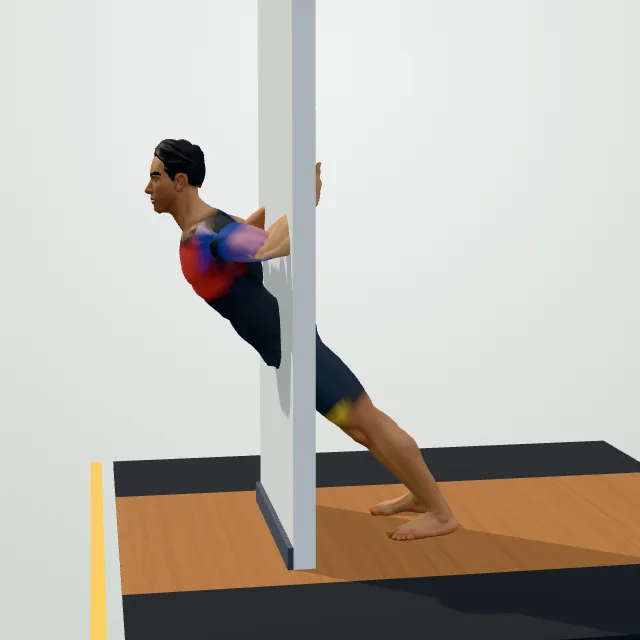
How to do it
- Stand facing a wall, slightly more than an arm's length away.
- Place hands on the wall at shoulder height and shoulder-width apart.
- Walk your feet back so your body leans toward the wall.
- Brace your core and keep a straight line from head to heels.
- Bend your elbows and lower your chest toward the wall.
- Press the wall away to return to the starting position.
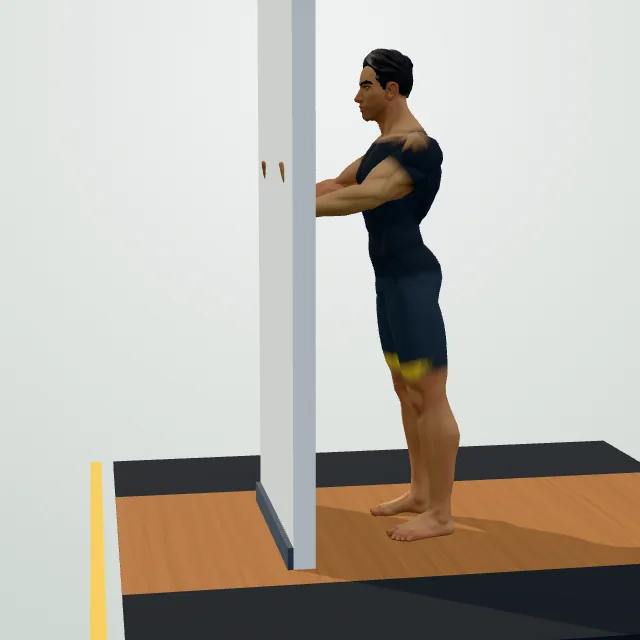
Coach cues
- Hands on the wall, shoulder-width apart.
- Body straight, lean in from your heels.
- Lower your chest toward the wall with control.
- Press the wall away, arms extend fully.
Breathing: Breathe in as you lower toward the wall, breathe out as you press away.
Common mistakes
Make it easier / Make it harder
Sets and reps by goal
| Goal | sets | reps | Rest |
|---|---|---|---|
| Strength | 4–5 | 3–6 | 2–4 min |
| Muscle growth | 3–4 | 6–12 | 90–150 s |
| Endurance | 2–3 | 15–25+ | 30–60 s |
The wall push-up is a standing push-up performed with your hands on a wall instead of the floor. Because your body weight is angled away from your hands rather than stacked directly over them, it is far easier than a floor push-up, which makes it the natural starting point for beginners, older adults, people returning from injury, or anyone building confidence before trying a full push-up.
What muscles does the wall push-up work
The wall push-up trains the same muscles as a floor push-up: the chest as the prime mover, with the front delts and triceps assisting elbow extension. The difference is intensity, not muscle selection — because so much less body weight loads your arms in a standing position, the exercise is gentler on the shoulders, elbows and wrists while still teaching the same pressing pattern you will use in every harder push-up variation later.
Benefits of wall push-ups
- Low joint stress, making it a sensible option for seniors, beginners, or anyone with wrist, elbow or shoulder sensitivity.
- Teaches correct push-up technique — bracing your core, keeping a straight body line, controlling the descent — without the full load of a floor push-up.
- Needs no equipment beyond a wall, so it can be done almost anywhere.
- A realistic answer to "will wall push ups tone my arms": they build genuine muscular endurance and light strength in the chest, shoulders and triceps, though "toning" is really fat loss plus muscle work together, not a separate effect of this exercise alone.
How to do a wall push-up correctly
Setup
Stand facing a wall, an arm's length plus a little more away. Place your hands on the wall at roughly shoulder height and shoulder-width apart, fingers pointing up. Walk your feet back slightly so your body leans toward the wall at an angle, rather than standing bolt upright.
The rep
Brace your core and keep a straight line from your head to your heels — the same body position as a floor push-up, just rotated to standing. Bend your elbows and lower your chest toward the wall, keeping your elbows at roughly a 45-degree angle from your torso rather than flaring them straight out. Push back to the starting position by pressing the wall away.
What you should feel
You should feel light-to-moderate work across the chest and the back of the upper arms. If it feels too easy, standing further from the wall increases the angle and the load; standing closer reduces it.
Wall push-up karne ke liye deewar se ek haath ki doori par khade hoen, haath kandhon ki chaudai par deewar par rakhein. Shareer ko seedha rakhein, kohniyon ko 45 degree ke kono par mode. Chaati ko deewar ki taraf le jaayein, phir wapas dhakelein. Yeh beginners aur senior citizens ke liye sabse aasaan push-up hai.
Sets, reps and how often to train it
Because the load is light, most beginners do well with 2–3 sets of 10–15 reps, resting 45–60 seconds between sets. It can be trained more frequently than harder push-up variations, up to most days of the week, since recovery demand is low — though building in at least one rest day is still sensible as you adapt to regular exercise. As it gets easy, that is your cue to progress rather than simply adding more reps indefinitely. See gym for beginners and progressive overload for how to structure early training, or try the low-impact workout for seniors and beginners, which uses this exercise directly.
Progressing beyond the wall push-up
Once 3 sets of 15 wall push-ups feel easy with good form, the next steps are an incline push-up with hands on a sturdy table or bench, then a knee push-up, and finally a full push-up on the floor. Each step increases the percentage of your body weight your arms have to lift, so progress through them gradually rather than jumping straight from the wall to the floor. The push-up progression plan lays out this exact path week by week.
Safety and who benefits most
Wall push-ups are one of the safest pressing exercises available and are widely recommended for seniors, beginners, pregnant women (with a doctor's clearance), and people recovering from illness or a period of inactivity. Even so, stop if you feel sharp pain in the wrist, elbow or shoulder, and keep your neck neutral rather than craning it toward the wall. If you have a recent upper-body injury, joint replacement, or a heart or blood-pressure condition, check with a doctor or physiotherapist before starting any new exercise routine, including this one.
Questions people ask
What is a wall push-up?
Are wall push-ups effective?
What muscles do wall push-ups work?
How many wall push-ups should a beginner do?
Are wall push-ups good for seniors?
Will wall push-ups tone my arms?
What comes after wall push-ups?
General fitness information, not medical advice. Check with a doctor or physiotherapist before starting if you have a health condition, an injury or are pregnant. Stop if you feel chest pain, dizziness or sharp pain.