Back · Gym
Back extension: strengthen your lower back safely
Hinge forward at the hips over a Roman chair pad and raise your torso back to neutral — a controlled way to build a resilient lower back and glutes.
- Primary
- Lower backGlutes
- Secondary
- Hamstrings
- Level
- Beginner
- Type
- Isolation · Both sides together
- Sets × reps
- 3 × 10-15 reps
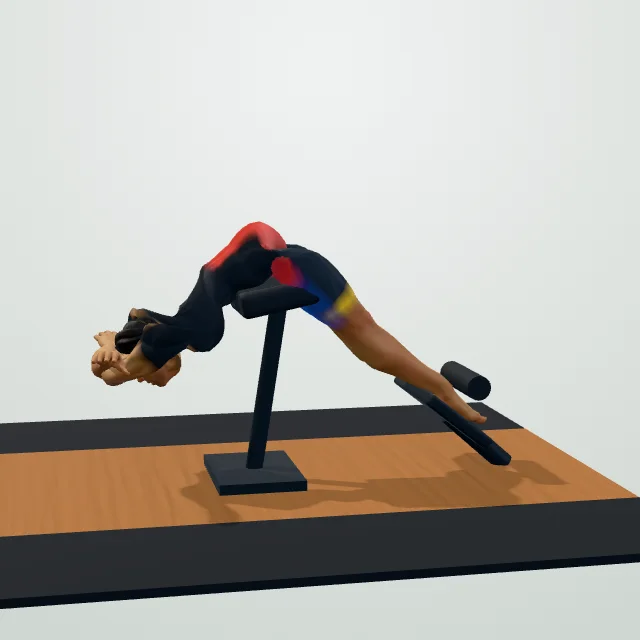
How to do it
- Position your hips at the edge of the pad, ankles secured under the rear rollers.
- Cross your arms over your chest or hold a plate.
- Hinge forward at the hips until you feel a stretch in your hamstrings and low back.
- Squeeze your glutes and raise your torso back to a straight line.
- Lower under control and repeat without arching past neutral at the top.
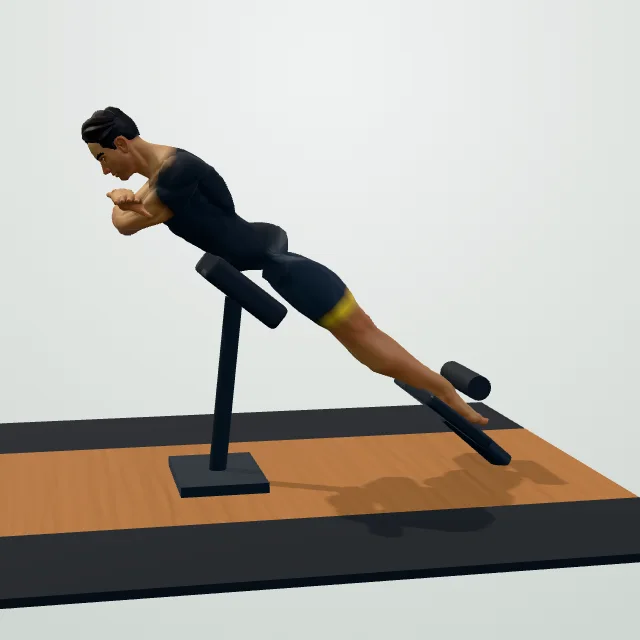
Coach cues
- Hinge at the hips, not the spine.
- Squeeze your glutes on the way up.
- Stop at a straight line, no arching.
- Lower slowly, under control.
Breathing: Breathe in as you hinge forward and down, breathe out as you rise back to neutral.
Common mistakes
Make it easier / Make it harder
Sets and reps by goal
| Goal | sets | reps | Rest |
|---|---|---|---|
| Strength | 3–5 | 6–8 | 90–120 s |
| Muscle growth | 3–4 | 10–15 | 60–90 s |
| Endurance | 2–3 | 15–20 | 30–60 s |
What muscles does the back extension work
The prime mover is your lower back — specifically the erector spinae, the long muscles running up either side of your spine that extend your torso. Your glutes assist heavily, especially at the top of the movement, and your hamstrings help extend the hip as well. Despite the name, this is not purely a "lower back" exercise in isolation — the glutes and hamstrings are working the whole time, which is part of why the exercise also shows up in glute-focused programs.
Benefits
A strong lower back that can hold a neutral spine under load is protective for almost every other lift in the gym, from squats to rows, and for everyday bending and lifting. Training the erector spinae directly, rather than only as a stabilizer in bigger lifts, can help build the specific endurance needed to hold good posture through a long set of deadlifts or a long day of manual work. It is also a movement most people can load progressively for years, from bodyweight to a heavy weight plate held at the chest, which makes it useful whether you are new to training or already lifting heavy on your main lifts.
Technique: setup, hinge and range
Adjust the pad on the machine so your hips can hinge freely at the front edge, with your ankles secured under the rear pads. Cross your arms over your chest to start, or hold a plate once bodyweight feels easy. Bend forward from the hips, not by rounding your spine, until you feel a stretch through your hamstrings and lower back, then reverse the movement by squeezing your glutes and driving your hips forward until your body forms one straight line from head to heels — do not hyperextend past that neutral line by arching your lower back further, which adds no benefit and unnecessary spinal load.
Move slowly, especially on the way down; a 2–3 second lowering phase keeps tension where you want it instead of letting momentum swing you. You should feel this through the length of your lower back and into your glutes and hamstrings, not as a sharp or pinching sensation anywhere in the spine.
How to program back extensions
3 sets of 10–15 reps with bodyweight or a light plate held at the chest works well for building endurance and resilience in the lower back. Because this is a smaller muscle group than a squat or deadlift, it usually fits as an accessory near the end of a leg or back session, done for higher reps rather than near-maximal loads. It pairs naturally with hip-hinge work in a leg day workout or after deadlift variations on a pulling-focused day.
Back extension vs good morning
A good morning uses a barbell on your back and puts you under continuous load through a similar hip hinge, which makes it a heavier, more advanced version of the same pattern. The back extension is supported by the pad and machine, which makes it more accessible for beginners and safer to train with higher reps for building lower-back endurance before progressing to loaded, free-standing hinges.
Safety and lower back pain
Avoid hyperextending past a neutral spine at the top — stop when your body forms a straight line, rather than arching further for extra range. If you have current lower back pain, disc issues, or sciatica, this exercise can be appropriate for some people as part of supervised rehabilitation but is not automatically safe for everyone with those conditions — check with a doctor or physiotherapist first rather than guessing. Stop immediately for any sharp or radiating pain, as opposed to normal muscle fatigue, and warm up with a few bodyweight reps before adding load.
Questions people ask
What muscles does a back extension work?
Is a back extension good for lower back pain?
How do I do a back extension without a machine?
Should I hyperextend at the top of a back extension?
Back extension vs good morning: which should I do?
How heavy should I go on back extensions?
General fitness information, not medical advice. Check with a doctor or physiotherapist before starting if you have a health condition, an injury or are pregnant. Stop if you feel chest pain, dizziness or sharp pain.