Legs · Home or gym
The dumbbell Romanian deadlift: hip-hinge form at home
The dumbbell Romanian deadlift trains the same hip-hinge pattern as the barbell version, using two dumbbells at your sides instead of a bar. It is an easier entry point for learning the hinge.
- Primary
- HamstringsGlutes
- Secondary
- Lower backForearms
- Level
- Beginner
- Type
- Compound · Both sides together
- Sets × reps
- 3 × 10-12 reps
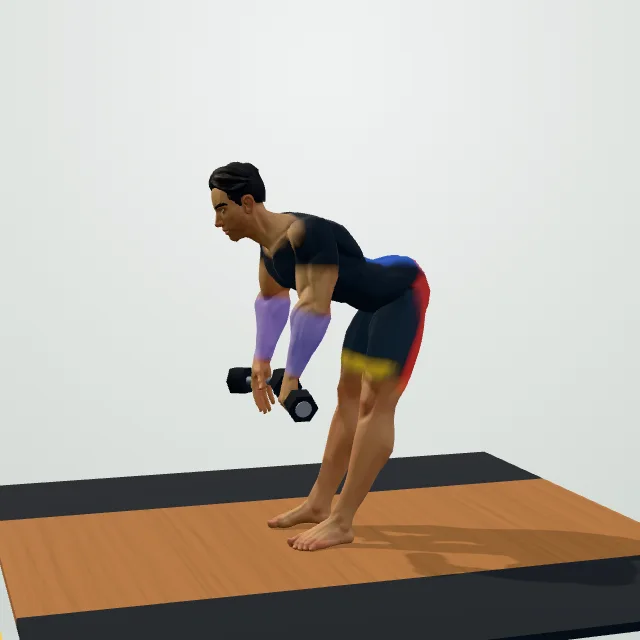
How to do it
- Stand holding a dumbbell in each hand, feet hip-width apart.
- Keep a slight, fixed bend in your knees.
- Push your hips back, dumbbells sliding down close to your legs.
- Let your torso lean forward as your hips move back.
- Lower until you feel a strong hamstring stretch, back flat.
- Drive your hips forward to stand tall, squeezing your glutes.
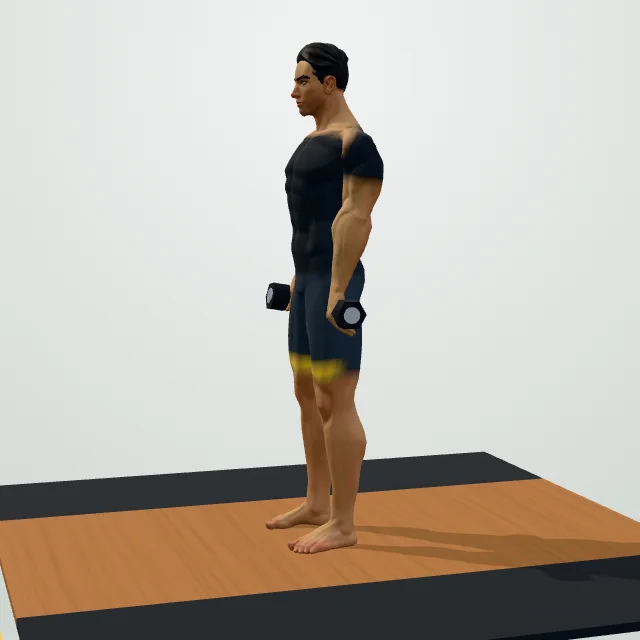
Coach cues
- Slight knee bend, hips push back.
- Dumbbells stay close to your legs.
- Lower until your hamstrings stretch.
- Drive your hips forward to stand.
Breathing: Breathe in and brace before lowering the dumbbells, breathe out as you drive your hips forward to stand.
Common mistakes
Make it easier / Make it harder
Sets and reps by goal
| Goal | sets | reps | Rest |
|---|---|---|---|
| Strength | 3–5 | 3–6 | 2–4 min |
| Muscle growth | 3–4 | 6–12 | 90–150 s |
| Endurance | 2–3 | 15–20 | 30–60 s |
The dumbbell Romanian deadlift is a hip-hinge exercise done holding a dumbbell in each hand at your sides, instead of a barbell in front of your thighs. It trains the same hamstring-and-glute stretch-and-drive pattern as the barbell RDL, but the setup is simpler and the load easier to control, which makes it a common starting point at home or in the gym.
What muscles does the dumbbell RDL work?
The hamstrings — covered in our leg exercises hub — control the lowering phase and help drive your hips forward to stand, while the glutes finish that hip extension at the top of the rep. Your lower back holds a neutral, braced position throughout, and your forearms and grip work continuously to hold both dumbbells. Because each hand moves independently, the dumbbell RDL also asks for a little more shoulder and upper-back stability to keep the weights tracking evenly than a single barbell does.
Dumbbell Romanian deadlift benefits
- An easier way to learn the hip hinge. Dumbbells at your sides are simpler to control than a barbell, making this a good entry point before progressing to loaded barbell work.
- Works well at home. A single pair of dumbbells is enough, with no bar or rack needed.
- Even loading on both sides. Holding a weight in each hand highlights and helps correct any left-right imbalance in your hip hinge.
- A natural step toward single-leg work. Once the two-leg version feels solid, it leads directly into single-leg Romanian deadlifts.
Dumbbell RDL proper form
Stand holding a dumbbell in each hand in front of your thighs, feet hip-width apart, with a slight, fixed bend in your knees. Push your hips straight back, letting the dumbbells travel down close along the front of your legs as your torso leans forward, keeping your back neutral rather than rounding. Lower until you feel a strong stretch through your hamstrings, typically around knee height or just below, then drive your hips forward to return to standing, squeezing your glutes at the top. Keep the dumbbells close to your legs the whole way, since letting them drift forward pulls the weight away from your center of balance and strains your lower back.
How to program the dumbbell RDL
| Goal | Sets | Reps | Rest |
|---|---|---|---|
| Strength | 3 | 8-10 | 75-90 sec |
| Muscle | 3-4 | 10-12 | 60 sec |
| Endurance | 2-3 | 12-15 | 45 sec |
Because dumbbell weight jumps are usually smaller than barbell plate jumps, small, frequent load increases work well as your hip-hinge strength improves — a good target is finishing each set 2-3 reps before your form would start to break down. Fit the dumbbell RDL after your main squat or lunge in a dumbbell full-body workout, once or twice a week.
Dumbbell RDL vs barbell RDL
A barbell Romanian deadlift generally allows heavier total loading once your technique is solid, since a barbell is easier to load in larger increments and keeps the weight centered in front of your body. The dumbbell version is usually the better starting point for learning the hinge, since it needs less setup and each hand can adjust independently to keep the movement even. Many lifters use dumbbells to learn and warm up the pattern, then move to a barbell for the heaviest working sets.
Dumbbell RDL variations and progressions
Once the two-leg dumbbell RDL feels solid, progress to a single-leg Romanian deadlift to add a balance and unilateral strength challenge. A dumbbell RDL to row — adding a row of both dumbbells at the bottom of the hinge before standing — combines the hip hinge with upper-back work, though it is best saved until your hinge form is already reliable under load.
Safety and who should modify it
Keep the dumbbells close to your legs and your lower back neutral throughout. If your back starts to round before you feel a hamstring stretch, that is your depth limit for now.
Avoid holding your breath through heavier sets if you have high blood pressure or a heart condition — breathe out steadily as you stand. Stop for sharp lower-back pain, and check with a doctor or physiotherapist before loading a hip hinge if you have a current back injury.
Workout plans with this exercise
General fitness · Beginner
Beginner Full-Body Gym Workout
Build muscle · Beginner
Full-Body Dumbbell Workout Plan
Fat loss · Beginner
4-Week Fat-Loss Workout Plan
General fitness · Beginner
Beginner Gym Workout Plan for Women
More exercises for legs
Questions people ask
What is a dumbbell Romanian deadlift?
Can you do a Romanian deadlift with dumbbells?
What muscles does the dumbbell RDL work?
Dumbbell RDL vs barbell RDL: which is better?
How low should you go in a dumbbell RDL?
Does the dumbbell RDL work the lower back?
What is a good next step after the dumbbell RDL?
General fitness information, not medical advice. Check with a doctor or physiotherapist before starting if you have a health condition, an injury or are pregnant. Stop if you feel chest pain, dizziness or sharp pain.