Legs · Home, no equipment
How to do the forward lunge, the classic lunge pattern
The forward lunge is what most people picture when they hear "lunges": step forward, bend both knees, then push back to start. Here is the full technique and how it fits into a leg routine.
- Secondary
- HamstringsInner thighsCalves
- Level
- Beginner
- Type
- Compound · Alternate sides
- Sets × reps
- 3 × 10-12 reps per side
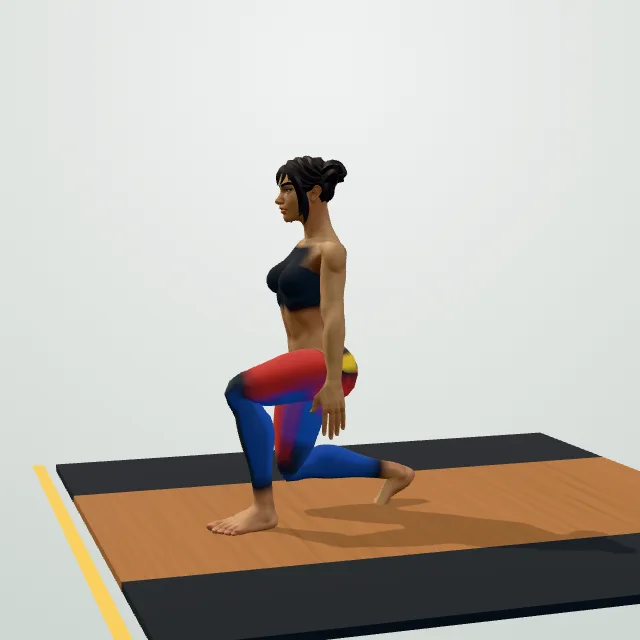
How to do it
- Stand tall with feet hip-width apart.
- Step one leg forward into a long stride.
- Bend both knees, lowering your back knee toward the floor.
- Keep your front knee over your ankle and your torso upright.
- Push through your front foot to return to standing.
- Repeat on the same leg, or alternate legs each rep.
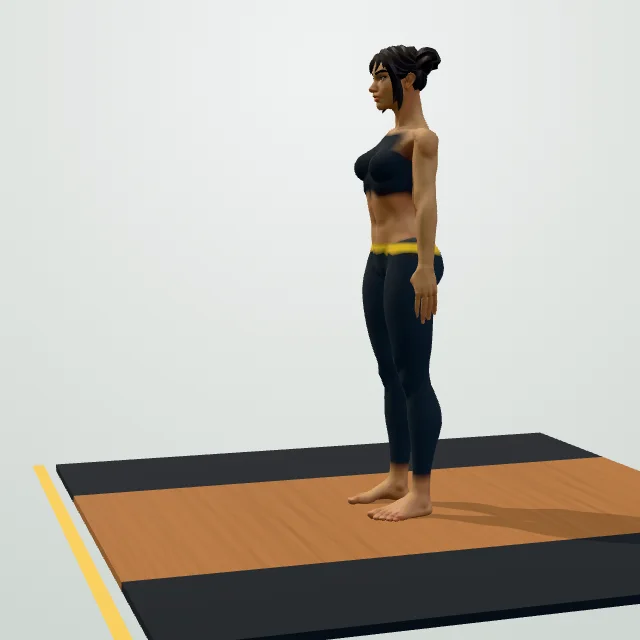
Coach cues
- Step forward into a long, controlled stride.
- Front knee stays over your ankle, not past your toes.
- Keep your chest tall and core braced.
- Push the floor away to stand back up.
Breathing: Breathe in as you step forward and lower, breathe out as you push back up to standing.
Common mistakes
Make it easier / Make it harder
Sets and reps by goal
| Goal | sets | reps | Rest |
|---|---|---|---|
| Strength | 4–5 | 3–6 | 2–4 min |
| Muscle growth | 3–4 | 6–12 | 90–150 s |
| Endurance | 2–3 | 15–25+ | 30–60 s |
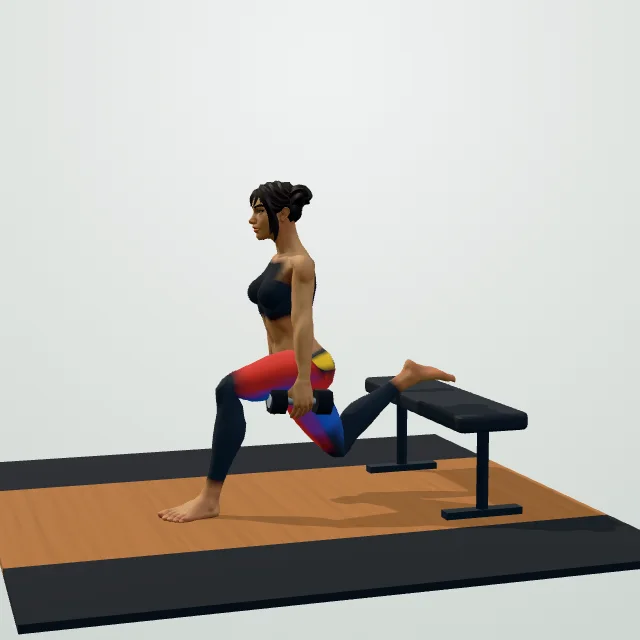
The forward lunge is the reference lunge: stand tall, step one leg forward, bend both knees until your back knee nears the floor, then push back through your front leg to the start position. It is the pattern most people mean when they say "lunges," and it is a fair test of single-leg strength, balance and hip mobility all at once.
What muscles do forward lunges work?
Your front leg does most of the work: the quads straighten the knee back to standing, and the glutes drive hip extension, especially if you keep your torso upright and push through your front heel rather than your toes. The hamstrings and adductors help control the descent and stabilize your hip, and your calves and core work to keep you balanced on a narrow, single-leg base. Because you step forward into the position, the forward lunge asks your front leg to decelerate your body weight on the way down as well as produce force on the way up, a demand a stationary squat does not place on one leg at a time.
Forward lunge benefits
- Single-leg strength and balance. Training one leg at a time exposes and helps correct side-to-side strength imbalances that two-legged exercises can hide.
- No equipment required. Bodyweight forward lunges are one of the most useful no-equipment leg exercises, and they load easily with dumbbells later.
- Carries over to daily movement and sport. Stepping, climbing stairs and changing direction all use the same forward-step, bend-and-drive pattern.
- Hip flexor and quad stretch. The back leg's hip flexor lengthens under load each rep, which can help offset stiffness from long periods of sitting.
How to do a forward lunge correctly
Step forward far enough that when you lower, your front shin stays close to vertical and your front knee sits roughly over your ankle, not far past your toes. Let your back knee drop straight down toward the floor rather than forward, so most of your weight loads the front leg. Keep your torso upright and your core braced instead of leaning forward, and lower until your front thigh is close to parallel with the floor, or as deep as your hips and knees allow with good control. From the bottom, push through your whole front foot, mid-foot and heel, not just your toes, to stand back up to the start rather than continuing forward into a walking lunge. Step length changes the emphasis slightly: a shorter step shifts more work to the quads, while a longer step recruits the glutes and hamstrings more.
Forward lunge vs walking lunge
A forward lunge steps out and returns to the same starting spot each rep, which keeps the exercise stationary and easier to control in a small space. A walking lunge instead continues forward into the next step, turning it into a longer, more dynamic set that also challenges momentum and coordination over distance. Beginners and anyone working on knee tracking usually do better starting with the stationary forward lunge before progressing to walking lunges.
Forward lunge vs reverse lunge
A reverse lunge uses the same muscles but steps backward instead of forward, which reduces the shear force on the front knee because your front foot is already planted before it takes the load. If forward lunges bother your knees, or stepping forward feels unstable, the reverse lunge is usually the easier substitute with a very similar training effect.
How to program forward lunges
| Goal | Sets | Reps (per leg) | Rest |
|---|---|---|---|
| Strength | 3 | 8-10 | 60-90 sec |
| Muscle | 3-4 | 10-12 | 45-60 sec |
| Endurance | 2-3 | 15-20 | 30-45 sec |
Bodyweight forward lunges are usually programmed by reps rather than load; aim for a pace where the last 2-3 reps per leg feel hard but your knee tracking stays clean. Add dumbbells once bodyweight sets past 12-15 reps per leg feel easy, following progressive overload principles, small, steady increases rather than large jumps. Two to three sessions a week is enough for most people; fit forward lunges into a home workout plan or after your main squat or hinge movement on leg day.
Forward lunge variations
- Dumbbell or barbell forward lunge: hold dumbbells at your sides or a barbell on your back once bodyweight form is solid.
- Walking lunge: continue forward into the next step instead of returning, for a longer, more dynamic set.
- Reverse lunge: step backward instead, easier on the front knee and a good substitute if forward lunges feel unstable.
- Lateral lunge: step sideways instead of forward for a change of plane that emphasizes the inner thigh.
- Split squat: keep the same staggered stance without stepping, removing the balance demand of stepping in and out.
- Jumping lunge: add a jump between legs once you are comfortable with control, for power and conditioning.
Forward lunge safety
Keep your front knee tracking in line with your toes and avoid letting it collapse inward, especially as you add load or reps.
If you have knee pain, try a shorter step and shallower depth, or switch to reverse lunges, which load the front knee less. Hold a wall or chair for support if balance is the limiting factor rather than strength. Check with a doctor or physiotherapist before lunging with a recent knee, hip or ankle injury, and stop for sharp joint pain, general muscle fatigue in the thighs and glutes is expected, sharp pain in a joint is not. See our guide to exercise for knee pain for more detail.
Workout plans with this exercise
More exercises for legs
Questions people ask
How do you do a forward lunge?
What muscles do forward lunges work?
Forward lunge vs reverse lunge: which is better?
How many lunges should I do a day?
Are lunges better than squats?
Can you do lunges without any weights?
Is it bad if my front knee goes past my toes in a lunge?
General fitness information, not medical advice. Check with a doctor or physiotherapist before starting if you have a health condition, an injury or are pregnant. Stop if you feel chest pain, dizziness or sharp pain.