Legs · Home, no equipment
The split squat: static-lunge form, muscles and holds
The split squat — often called a static lunge — sets your feet in a fixed front-and-back stance and keeps them there for every rep, unlike a walking or forward lunge.
- Secondary
- HamstringsInner thighs
- Level
- Beginner
- Type
- Compound · One side, then the other
- Sets × reps
- 3 × 10-12 reps per side
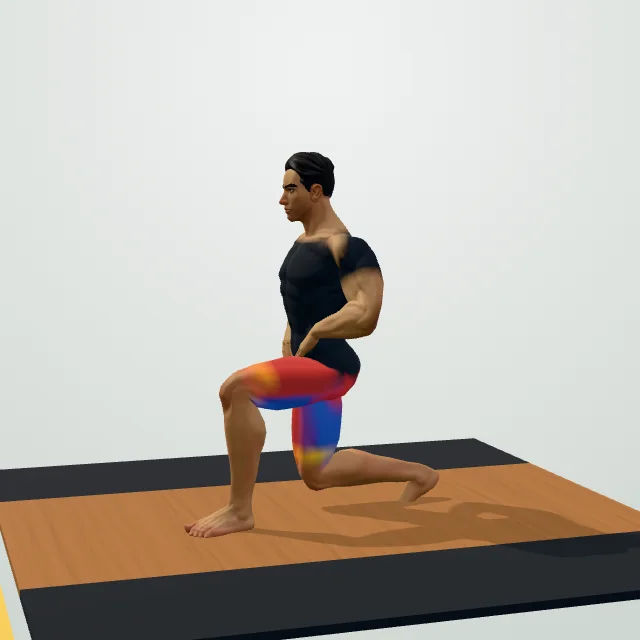
How to do it
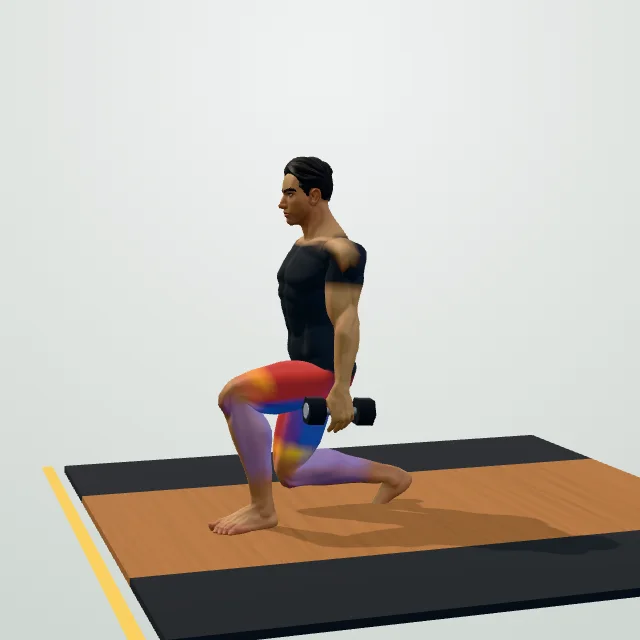
- Step one foot forward and one foot back into a long, fixed stance.
- Lift your back heel, weight on the ball of your back foot.
- Keep your torso upright, front shin close to vertical.
- Bend both knees to lower your back knee toward the floor.
- Keep your front knee tracking over your toes.
- Push through your front foot to stand back up without moving your feet.
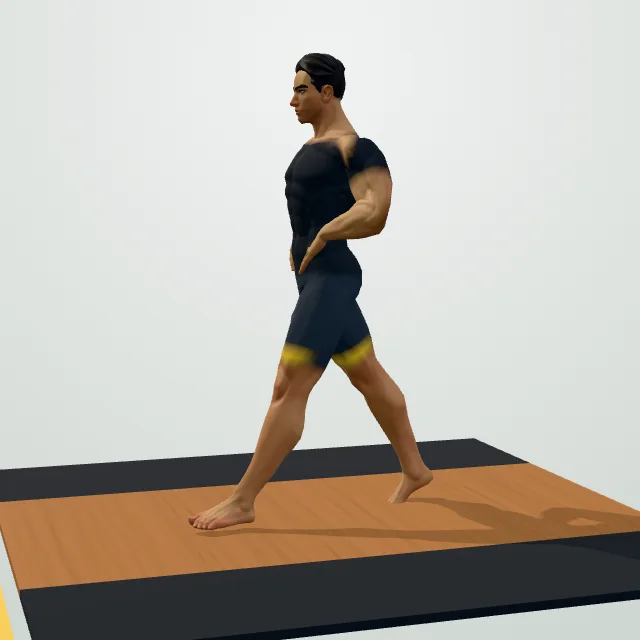
Coach cues
- Long stance, back heel lifted.
- Torso tall, front shin vertical.
- Lower until your back knee nearly touches down.
- Push through your front foot to stand.
Breathing: Breathe in as you lower your back knee down, breathe out as you push through your front foot to stand.
Common mistakes
Make it easier / Make it harder
Sets and reps by goal
| Goal | sets | reps | Rest |
|---|---|---|---|
| Strength | 4–5 | 3–6 | 2–4 min |
| Muscle growth | 3–4 | 6–12 | 90–150 s |
| Endurance | 2–3 | 15–25+ | 30–60 s |
The split squat, also called a static lunge, is a single-leg squat done with your feet set in a fixed front-and-back stance that does not move between reps. That fixed stance is what separates it from a walking or forward lunge, where you step forward each rep — the split squat lets you focus purely on the up-and-down movement without also managing a step.
What muscles does the split squat work?
The front leg's quads and glutes — both covered in our leg exercises hub — handle most of the load lowering and raising your body weight, while the hamstrings and inner-thigh adductors assist through the hip. Because your feet stay fixed for the whole set, the front leg carries a larger, more continuous share of the work than in a walking lunge, where some effort resets with every step. The back leg mainly balances and adds a light stretch through its hip flexor.
Split squat benefits
- Focused single-leg strength. A fixed stance removes the stepping and balance demands of a walking lunge, so you can concentrate on depth and control.
- Easy to load. Because your feet do not move, split squats are simple to load with dumbbells, a barbell or a bench for extra range.
- Time under tension. The fixed stance makes split squats well suited to slow tempos and isometric holds for extra muscle work.
- No equipment needed. A bodyweight split squat needs only floor space and works well for beginners building up to weighted lunges.
Split squat proper form
Step one foot forward and one foot back into a stance long enough that your front knee can bend to 90 degrees without traveling past your toes. Keep your back heel lifted, weight on the ball of that foot, and your torso upright. Bend both knees to lower your back knee toward the floor, keeping your front shin close to vertical, then push through your front foot to stand back up without your feet moving. Keep your front knee tracking over your toes and your torso tall rather than tipping forward, and go only as deep as you can control — a light back-knee touch to the floor is a good depth target for most people.
How to program split squats
| Goal | Sets | Reps (each side) | Rest |
|---|---|---|---|
| Strength | 3-4 | 8-10 | 60-90 sec |
| Muscle | 3 | 10-12 | 45-60 sec |
| Split squat hold (isometric) | 2-3 | 20-30 sec held at the bottom | 45-60 sec |
Start with bodyweight split squats to learn the stance and knee tracking, then add a pair of dumbbells once the movement feels stable, following the small, steady jumps described in our progressive overload guide. A split squat hold — pausing at the bottom of the rep for time instead of counting reps — is a useful finisher that builds extra quad and glute endurance without needing more equipment. Two to three sessions a week works well as part of a leg day workout or a home program.
Split squat vs lunge vs Bulgarian split squat
A reverse lunge resets your feet to a standing position between reps and adds a stepping motion, which makes it slightly more demanding on balance and coordination than a split squat. Keeping your feet fixed instead isolates the up-and-down strength work more directly. Once the flat-ground version feels easy, propping your back foot on a bench turns it into a Bulgarian split squat, which adds range of motion and further shifts the load onto the front leg — a natural next step once your strength and balance are solid.
Safety and who should modify it
Set your stance long enough that your front knee stays behind your toes at the bottom. A stance that is too short is the most common cause of knee discomfort in this exercise.
If you have knee pain, use a shorter range of motion and check that your front knee is not traveling far past your toes. Anyone with balance problems should do split squats near a wall or rail for light support, and people recovering from a knee, hip or ankle injury should confirm with a doctor or physiotherapist before adding single-leg loading to their program.
Workout plans with this exercise
More exercises for legs
Questions people ask
What is the difference between a split squat and a lunge?
What is a static lunge?
What muscles does the split squat work?
Are split squats bad for your knees?
How do you do a split squat hold?
Are split squats better than regular squats?
How many split squats should I do?
General fitness information, not medical advice. Check with a doctor or physiotherapist before starting if you have a health condition, an injury or are pregnant. Stop if you feel chest pain, dizziness or sharp pain.