Cardio · Gym
Rowing machine: full-body cardio with almost no impact
A rowing machine trains your legs, back and arms in one continuous stroke, with none of the pounding of running. Here is the stroke sequence and pacing that make it worth the learning curve.
- Secondary
- Upper backGlutesHamstringsBicepsAbs
- Level
- Beginner
- Type
- Compound · Both sides together
- Sets × reps
- 1 × 10 min
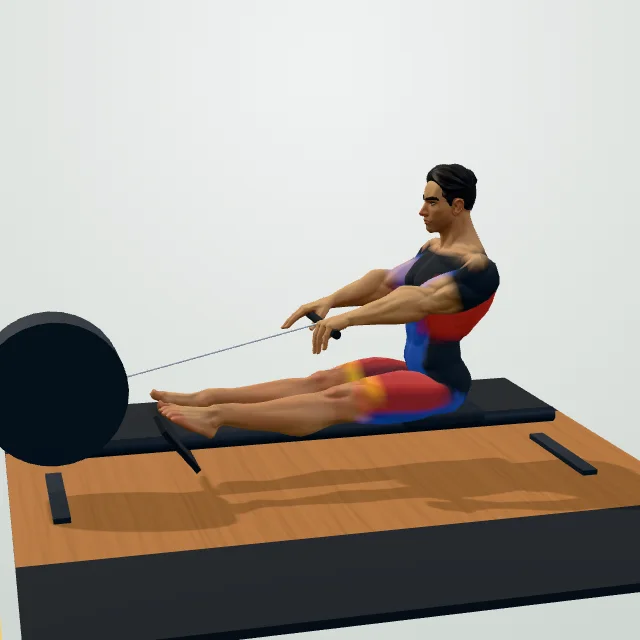
How to do it
- Sit with knees bent, shins vertical, feet strapped in.
- Grip the handle with arms straight, reaching forward.
- Push through your legs first, keeping arms straight.
- Lean your torso back slightly as the legs finish extending.
- Pull the handle to your lower ribs, elbows close to your body.
- Reverse the sequence smoothly to slide back to the start.
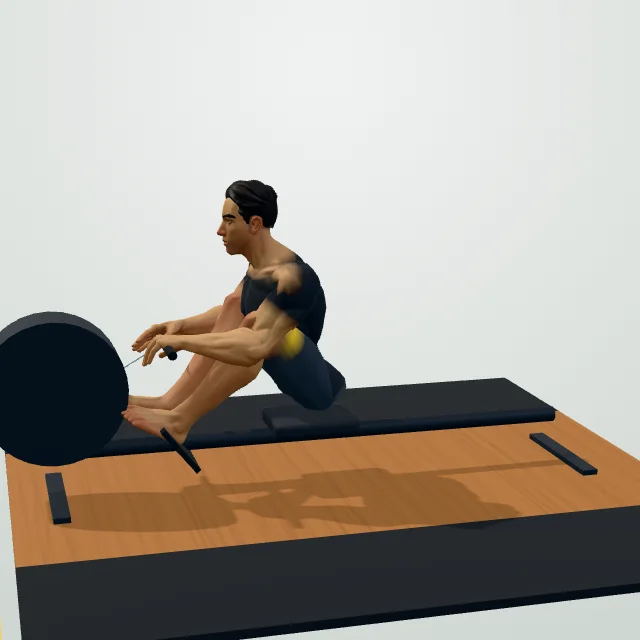
Coach cues
- Legs drive first, arms stay straight.
- Lean back slightly as the legs finish.
- Pull the handle to your ribs.
- Reverse smoothly back to the start.
Breathing: Exhale as you drive and pull; inhale as you extend your arms and slide back to the start.
Common mistakes
Make it easier / Make it harder
The rowing machine pulls the whole body into one repeating stroke — legs, back, then arms — making it one of the few cardio machines that trains upper and lower body together with almost no impact through the joints. It rewards learning the stroke sequence properly far more than most cardio equipment: get it right and each stroke feels powerful; get it wrong and it just tires your arms out fast.
What muscles does the rowing machine work?
Each stroke starts with the legs: the quads drive the initial push away from the footplate, which is where most of the power in a good stroke comes from. As the legs finish extending, the glutes and hamstrings help drive the hips back, then the lats and upper back pull the handle in toward the torso, with the biceps finishing the pull at the elbows. The abs and lower back stay braced throughout to transfer force from the legs to the handle without the spine collapsing forward or arching.
Benefits
- Low-impact cardio. Because you are seated and the feet stay in the straps, there is none of the repetitive landing impact that running or jump rope create.
- Full-body engagement. Few cardio machines combine leg drive, hip hinge and a back-and-arm pull in a single continuous movement.
- Posture and pulling strength. The pulling pattern balances out pushing-dominant training and can support upper-back posture over time.
- Scalable intensity. The stroke rate and resistance can be adjusted for anything from an easy recovery session to a maximal sprint.
Technique: the stroke sequence
The stroke has a clear order — legs, then back, then arms on the drive; arms, then back, then legs on the recovery — and reversing it wastes most of the power. Start with knees bent, shins vertical, arms straight and reaching forward. Push through your legs first while your arms stay straight, then as the legs near full extension, lean your torso back slightly and finish by pulling the handle to your lower ribs with your elbows close to your body. On the way back, extend the arms first, hinge the torso forward, then bend the knees to slide back to the start position, letting the sequence unwind in reverse. The most common technical error is pulling with the arms and back before the legs have finished driving, which turns a powerful full-body stroke into a weak, arm-only row. Keep your back reasonably upright rather than rounded forward at the catch, since a rounded lower back under load is the main way rowing irritates the spine.
How to program rowing machine training
| Use | Work | Rest |
|---|---|---|
| Steady-state cardio | 15-30 min, moderate pace | continuous |
| Interval cardio | 250-500 m or 30-60 sec, hard effort | 60-120 sec, repeat 6-10 rounds |
| Warm-up | 5 min, easy pace | none, move into your workout |
Rowing suits both long, steady sessions and short intervals equally well, which is part of why it appears in the gym cardio workout alongside the treadmill and bike. An interval timer keeps a distance- or time-based interval session honest, and checking your heart-rate zone helps you tell a genuine steady-state session (zone 2-3) from an interval that is actually hard enough to count (zone 4-5). For calorie tracking, the calories burned calculator gives a reasonable estimate, though rowing machines with their own power output tend to be more accurate than a generic calculator for this particular exercise.
Variations and progressions
Beginners should spend their first sessions at low resistance and a slow stroke rate, focusing entirely on the leg-back-arms sequence rather than speed or distance. Once the sequence feels automatic, interval work — alternating hard 250-500 metre efforts with easy recovery rowing — builds both power and conditioning faster than steady rowing alone. Rowing machines with adjustable damper settings let you simulate a heavier or lighter boat feel; a lower damper setting suits faster stroke rates and interval work, while a higher setting rewards a more powerful, deliberate leg drive.
Rowing machine vs. treadmill and stationary bike
Compared with the treadmill, rowing puts far less repetitive impact through the knees and shins, while also working the back and arms that running does not touch — a real advantage for anyone managing joint issues or wanting more upper-body involvement in their cardio. Against the stationary bike, rowing works more total muscle mass per stroke, which can make it feel harder at the same perceived effort, but it also has a steeper technique learning curve than pedalling. All three are reasonable low-impact options; rotating between them adds variety and spreads the joint and muscle demands around.
Safety and who should modify it
Keep resistance and stroke rate lower while you learn the sequence, and check with a doctor or physiotherapist first if you have a lower-back injury or are recovering from one.
Rowing is generally easy on the joints, but a rounded lower back under load, especially at higher resistance, is a known way people irritate their spine on this machine. Keep the back reasonably upright through the drive, build resistance and volume gradually, and stop for sharp back pain, chest pain, dizziness or unusual breathlessness.
Workout plans with this exercise
More exercises for cardio
Questions people ask
What muscles does the rowing machine work?
Is the rowing machine good exercise?
How do I use a rowing machine properly?
Is the rowing machine bad for your back?
Rowing machine vs. treadmill — which is better?
How long should a beginner row for?
Is rowing good for weight loss?
General fitness information, not medical advice. Check with a doctor or physiotherapist before starting if you have a health condition, an injury or are pregnant. Stop if you feel chest pain, dizziness or sharp pain.