Shoulders · Gym
Reverse pec deck: supported rear delt isolation
Sitting chest-first into the pec deck lets you swing the handles backward with a strict arc, hitting the rear delt without any lower back involvement.
- Primary
- Rear delts
- Secondary
- Upper back
- Level
- Beginner
- Type
- Isolation · Both sides together
- Sets × reps
- 3 × 12-15 reps
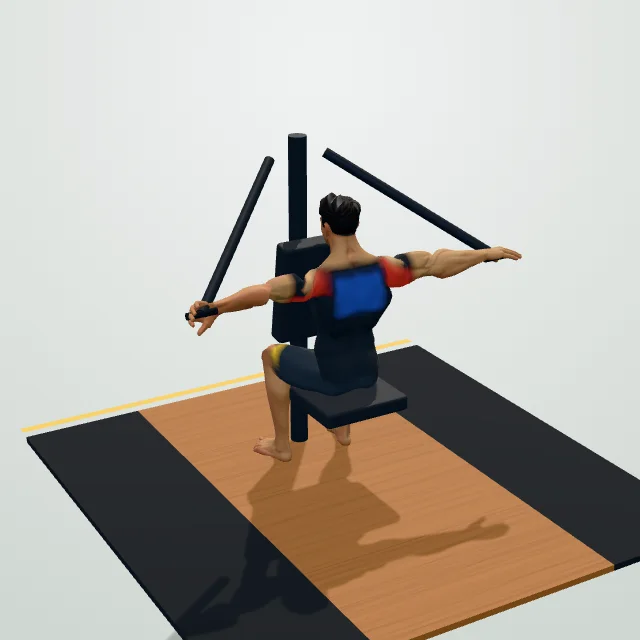
How to do it
- Set the seat so the handles sit roughly at shoulder height.
- Sit facing into the pad with your chest supported.
- Grip a handle in each hand, arms extended in front of you.
- Pull both handles out and back, leading with your elbows.
- Squeeze your shoulder blades together at the end range.
- Return with control back to the start position.
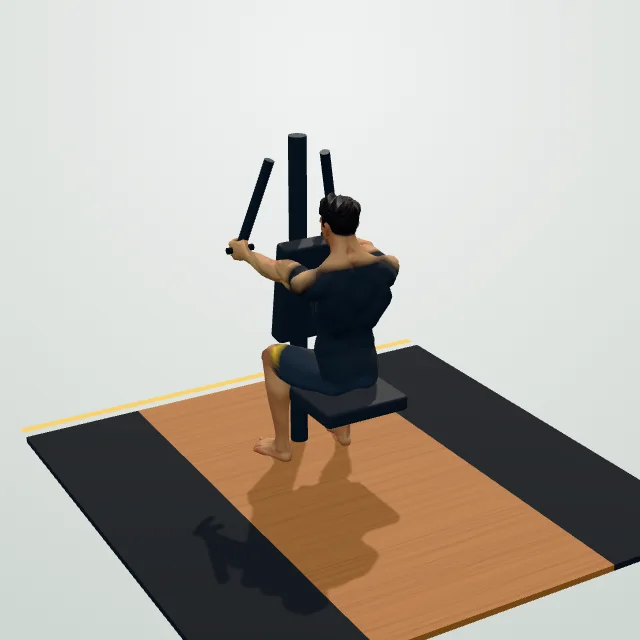
Coach cues
- Chest pressed into the pad.
- Lead with your elbows, arc out and back.
- Squeeze your shoulder blades together.
- Return with control, no slamming.
Breathing: Breathe out as you pull the handles back, and breathe in as you return them to the start.
Common mistakes
Make it easier / Make it harder
Sets and reps by goal
| Goal | sets | reps | Rest |
|---|---|---|---|
| Strength | 3–5 | 6–8 | 90–120 s |
| Muscle growth | 3–4 | 10–15 | 60–90 s |
| Endurance | 2–3 | 15–20 | 30–60 s |
The reverse pec deck flips the pec deck machine around: instead of squeezing your arms together in front of your chest, you push the handles apart and back, training the rear delt from a fully supported seated position with your chest resting against the pad.
Muscles worked
The rear delt is the prime mover, pulling your arms backward and out against the machine's resistance. Your upper back and traps assist by squeezing your shoulder blades together at the end of each rep. Because the chest pad supports your torso, none of your lower back or core is needed to hold a hinged position, which lets you focus the effort entirely on the rear delt itself.
Benefits
- Fully supported position. No hinge to hold, so all your effort goes into the working muscle.
- Consistent resistance curve. The machine's arc is fixed and repeatable, which makes it easy to track progress week to week.
- Easy to load precisely. Small weight-stack increments make gradual progression simple.
- Beginner-friendly. A safe way to learn the rear delt fly motion before trying a free-weight version.
- Repeatable setup. The same seat position and pin weight every session make it simple to track real progress over time.
Technique and setup
Adjust the seat height so the handles sit roughly at shoulder height when you grip them, and sit facing into the pad with your chest supported. Grip a handle in each hand with your arms extended in front of you and a soft bend in your elbows.
Pull both handles out and back in a wide arc, leading with your elbows and squeezing your shoulder blades together at the end range. Pause briefly, then return with control to the start rather than letting the weight stack slam down. Keep your chest pressed into the pad throughout so your torso does not rock to help the movement.
Sets, reps and where it fits
| Goal | Sets × reps | Rest | Load |
|---|---|---|---|
| Muscle growth | 3 × 12–15 | 45–60 sec | RPE 8–9 |
| Endurance | 2–3 × 15–20 | 30–45 sec | Light |
Use the reverse pec deck near the end of a shoulder workout or pulling day, once your heavier compound lifts are done. Because the seat height and arm position are fixed by the machine, it is a reliable way to compare your rear delt strength and progress from week to week.
Reverse pec deck vs rear delt fly vs face pull
Against the free-weight bent-over rear delt fly, the machine removes the lower back and balance demand entirely, which is useful if hinging over is uncomfortable or you simply want to isolate the muscle more purely. A face pull trains the rear delts through a pulling pattern with more external rotation, so rotating between the two adds useful variety to your rear delt training.
A quick warm-up set first
Run one light warm-up set on the reverse pec deck before your working weight to find the seat height that feels right and to prime the rear delt, since this is a small muscle that responds well to a proper warm-up rather than jumping straight to a heavy stack. Pair it with a face pull earlier in your session for a well-rounded rear delt routine, and track your seat height and weight in my workouts so setup is quick every time.
Safety notes
Set the seat so the handles line up with your shoulders — too high or too low changes the angle and can put unwanted stress on the joint. Keep the weight light enough to control the return; letting the stack drop with a bang wastes the negative portion of the rep and adds unnecessary jolt to the shoulder.
Because the machine supports your torso and controls the arc, the reverse pec deck is one of the safest ways for beginners to learn and build the rear delt.
Workout plans with this exercise
More exercises for shoulders
Questions people ask
What muscles does the reverse pec deck work?
How do you use a reverse pec deck machine?
Reverse pec deck vs rear delt fly — which should I use?
What is the right seat height for the reverse pec deck?
Is the reverse pec deck good for posture?
How much weight should I use on the reverse pec deck?
Can beginners use the reverse pec deck?
General fitness information, not medical advice. Check with a doctor or physiotherapist before starting if you have a health condition, an injury or are pregnant. Stop if you feel chest pain, dizziness or sharp pain.