Back · Gym
Straight-arm pulldown: how to isolate your lats on the cable
A single-joint cable move that trains your lats without your biceps taking over, so you finally feel your back working on every rep.
- Primary
- Lats
- Level
- Intermediate
- Type
- Isolation · Both sides together
- Sets × reps
- 3 × 12-15 reps
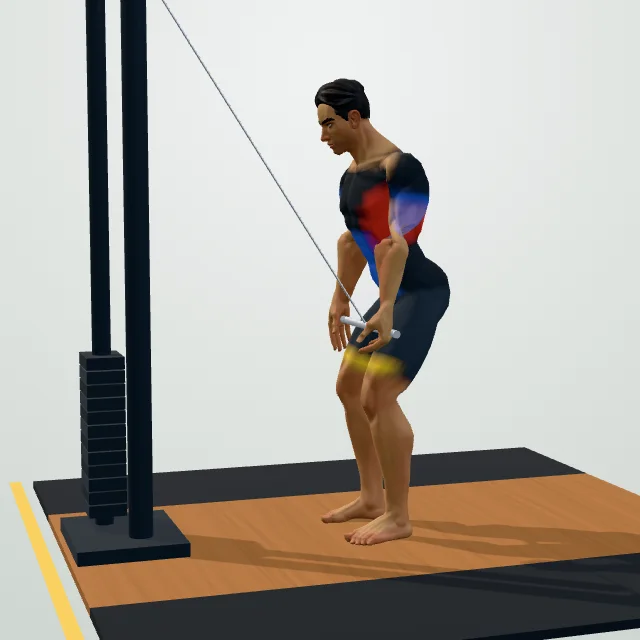
How to do it
- Attach a straight bar or rope to the high pulley and grip it shoulder-width, palms down.
- Step back, hinge slightly at the hips, and set a small fixed bend in your elbows.
- Brace your core and pull the bar down in an arc, leading with your upper arms.
- Squeeze your lats as the bar reaches your thighs, keeping your elbows locked in place.
- Control the bar back up to the start without letting your shoulders shrug or round forward.
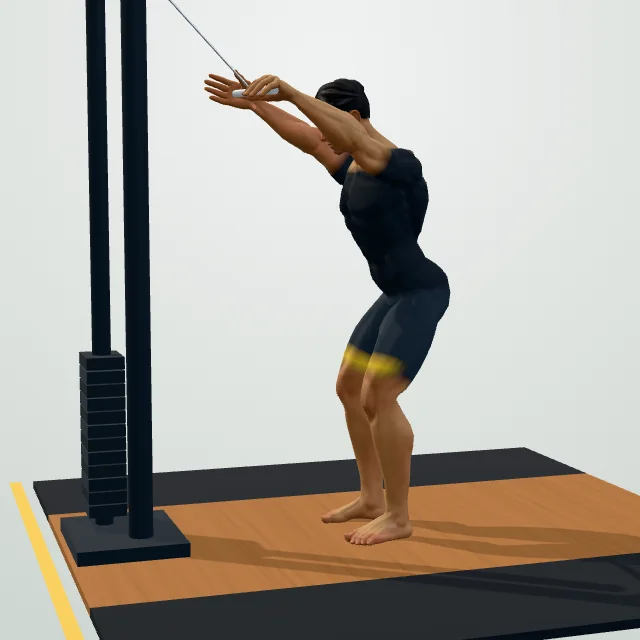
Coach cues
- Soft bend in the elbows, and keep it there.
- Pull with your armpits, not your hands.
- Squeeze when the bar reaches your thighs.
- Control it back up, no swinging.
Breathing: Breathe out as you pull the bar down and squeeze, breathe in as you let it return.
Common mistakes
Make it easier / Make it harder
Sets and reps by goal
| Goal | sets | reps | Rest |
|---|---|---|---|
| Strength | 3–5 | 6–8 | 90–120 s |
| Muscle growth | 3–4 | 10–15 | 60–90 s |
| Endurance | 2–3 | 15–20 | 30–60 s |
What muscles does the straight-arm pulldown work
The prime mover is the lats (latissimus dorsi) — the big sheet of muscle that pulls your upper arm down and back toward your body. Because your elbows stay fixed, the movement isolates that single job instead of sharing it with the biceps, which is why the straight-arm pulldown is often called a cable pullover. Your triceps work hard to keep the elbow angle locked, and your abs brace to stop your torso from swaying as the bar passes your hips. This makes it a genuine back-and-triceps isolation move, not just an arm exercise with a cable attached.
Benefits
Because grip and biceps fatigue rarely limit the set, you can push the lats closer to failure than on a pull-up or row, which is useful if your arms tire out before your back does on other pulling exercises. The long stretch at the top can also help build mind-muscle connection with the lats — many lifters use it specifically to learn what a "lat squeeze" should feel like before they try to replicate that feel in heavier rows and pulldowns.
Technique: bar path, stance and tempo
Set the cable to the top pulley and attach a straight bar or rope. Stand far enough back that your arms are roughly parallel to the floor at the start, with a slight forward hip hinge and soft knees — this is not a standing-tall exercise. Take a shoulder-width, overhand grip and keep a small, fixed bend in your elbows for the whole set; the mistake is letting that bend change as you pull, which turns it into a pushdown for the triceps instead of a pullover for the lats.
Pull the bar in an arc down toward your thighs, leading with your upper arms rather than your hands, and pause briefly when the bar reaches your hips or thighs — that is where the lat contraction is strongest. Control the return just as carefully; letting the cable snap your arms back up wastes most of the benefit. A 2-second pull, a short squeeze, and a 2-to-3-second return is a good starting tempo. You should feel this under your armpits and along the sides of your back, not in your front shoulders — if your shoulders round forward or shrug up toward your ears, drop the weight and reset your stance.
Straight-arm pulldown vs lat pulldown
A regular lat pulldown is a compound pull: elbows bend, biceps assist, and you can load it heavier. The straight-arm pulldown is an isolation move: elbows stay fixed, load is lighter, and the lats do almost all the work. They are not interchangeable — most programs use the lat pulldown (or pull-ups) as the main back exercise and the straight-arm pulldown afterward, as a finisher that isolates the same muscle when it is already partly fatigued.
How to program the straight-arm pulldown
Because it is an isolation exercise for a muscle that also gets worked by bigger lifts, most lifters place it at the end of a back workout, for 3 sets of 12–15 reps with 60–90 seconds rest. Pick a weight where the last 2–3 reps are hard to control with good form (roughly 2–3 reps in reserve) rather than one so heavy that your elbows start bending. Training the lats this way 1–2 times a week alongside your main pulling work is enough for most goals; it fits well in an upper-back or back-and-biceps session or as an accessory in a push-pull-legs split.
Variations and alternatives
No cable machine? A dumbbell pullover on a bench trains the same stretch-to-squeeze pattern with free weight instead of a cable, and a resistance band anchored overhead lets you do a similar arc at home. If your gym is busy, a single-arm version — one hand at a time on a D-handle — lets you focus on each side and correct any left-right imbalance. Once the pattern feels natural, you can also use it as a light warm-up before pull-ups or rows to prime the lats.
Safety and common sense
This is a low-risk exercise for most people, but keep the load light enough that you never need to jerk your torso to move the bar, and stop if you feel pinching at the front of the shoulder rather than a stretch through the back. If you have a shoulder injury or recent surgery, check with a physiotherapist before adding overhead pulling patterns like this one.
Workout plans with this exercise
Questions people ask
What does the straight-arm pulldown work?
Is a straight-arm pulldown the same as a cable pullover?
Straight-arm pulldown vs lat pulldown: which should I do?
Can I do a straight-arm pulldown without a cable machine?
How heavy should a straight-arm pulldown be?
Why can I feel this in my shoulders instead of my back?
General fitness information, not medical advice. Check with a doctor or physiotherapist before starting if you have a health condition, an injury or are pregnant. Stop if you feel chest pain, dizziness or sharp pain.