Back · Home or gym
Chin-up: the underhand pull-up that adds biceps
A bodyweight pulling exercise done with palms facing you, which shares most of the pull-up's back work but pulls your biceps in as a bigger helper.
- Secondary
- Upper backForearms
- Level
- Intermediate
- Type
- Compound · Both sides together
- Sets × reps
- 3 × 5-10 reps
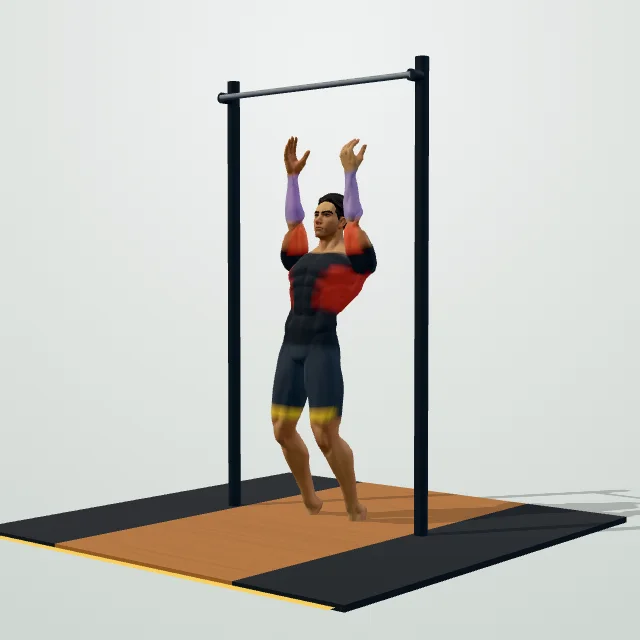
How to do it
- Grip the bar shoulder-width apart with your palms facing you.
- Hang with straight arms and set your shoulder blades down and back.
- Pull your elbows down and back, keeping them close to your sides.
- Drive your chest up toward the bar until your chin clears it.
- Lower back to a full hang under control over 2–3 seconds.
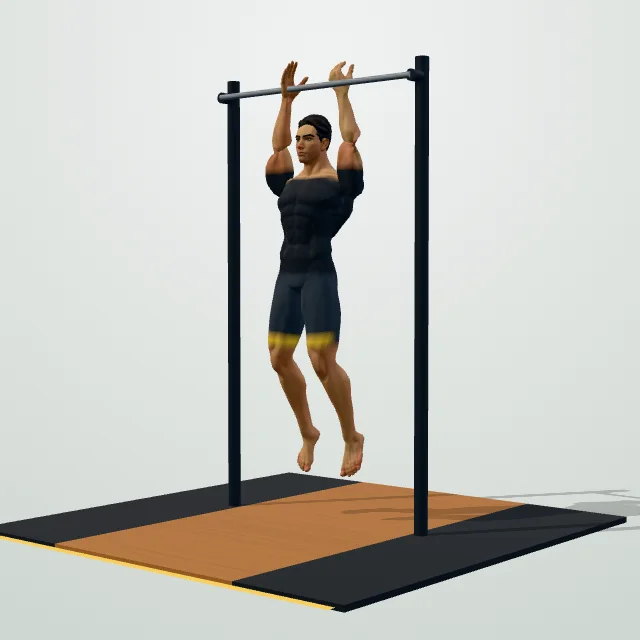
Coach cues
- Underhand grip, shoulder-width.
- Set your shoulders before you pull.
- Chest to the bar, elbows in.
- Lower slow, all the way down.
Breathing: Breathe in at the bottom of the hang, breathe out as you pull your chest to the bar.
Common mistakes
Make it easier / Make it harder
Sets and reps by goal
| Goal | sets | reps | Rest |
|---|---|---|---|
| Strength | 3–5 | 3–6 | 2–4 min |
| Muscle growth | 3–4 | 6–12 | 90–150 s |
| Endurance | 2–3 | 15–20 | 30–60 s |
What muscles does the chin-up work
Your lats still do most of the pulling, exactly like a pull-up, but the underhand grip puts your biceps in a stronger mechanical position, so they contribute more to bending the elbow through the rep. Your upper back and forearms stabilize the bar and your shoulder blades, and your abs keep your torso from swinging. That extra biceps involvement is the whole story behind "chin-up vs pull-up" comparisons: same back muscles, more arm help.
Benefits
Because the biceps share more of the work, most people can do more chin-ups than pull-ups with identical effort, which makes the chin-up a practical entry point if a strict pull-up is currently out of reach. It also doubles as biceps training that does not need a barbell or dumbbells — useful on a day when your gym's curl bars are all taken, or at a home pull-up bar. Many lifters chasing visible back width and biceps thickness together treat the chin-up as one of the most time-efficient exercises in the whole gym, since one set trains both areas at once.
Proper chin-up technique
Take a shoulder-width, underhand grip and hang with straight arms and your shoulder blades pulled down and back before you move. Pull your elbows down and slightly back, keeping them close to your torso rather than flared out, and drive your chest up toward the bar rather than just poking your chin over it — this keeps the lats in the movement instead of turning it into a pure arm curl on a bar. Lower yourself back to a dead hang under control, taking 2–3 seconds; rushing the descent is the single biggest reason people plateau on chin-ups.
Keep your legs still and your ribs down through the whole rep. If you feel this mostly in your forearms and not your back or biceps, your grip is likely too wide or your shoulder blades were not set before you started pulling.
Chin-up vs pull-up: which is easier, which is better
For most people a chin-up is genuinely easier than a strict overhand pull-up at the same bodyweight, because the underhand grip lets the biceps take on more of the load. Neither move is strictly "better" — they train overlapping muscle with a different arm emphasis, so a balanced back program usually rotates both rather than picking one forever. If you are building toward your first pull-up, chin-ups are a sound stepping stone since the strength transfers well.
Working up to your first chin-up
If a full rep is not there yet, train negatives with an underhand grip (step or jump to the top, then lower over 4–5 seconds), and build grip and shoulder endurance with a dead hang. A resistance band looped over the bar and under your knee or foot removes some bodyweight so you can practice complete reps while you build strength. Two to three sessions a week of negatives, hangs and banded reps is a reliable path to a first strict chin-up.
How to program chin-ups
For strength and back and biceps size, 3 sets of as many strict reps as possible, stopping a rep or two short of failure, with 90 seconds to 2 minutes of rest works well. Once bodyweight reps pass 10–12 comfortably, add load with a dip belt instead of only chasing higher rep counts. Chin-ups fit naturally into a back and biceps workout or as the main vertical pull in an upper/lower split.
Safety
Warm your shoulders, elbows and wrists up before working sets, since the underhand grip loads the biceps tendon at the elbow more than an overhand grip does. Sharp elbow or shoulder pain (not general muscle fatigue) is a reason to stop, scale back to negatives, and get it checked if it does not settle.
Questions people ask
What muscles does a chin-up work?
Chin-up vs pull-up: which is easier?
Are chin-ups good for biceps?
How do I do a chin-up if I cannot do one yet?
Is it normal to feel chin-ups more in my forearms than my back?
Can I do chin-ups every day?
General fitness information, not medical advice. Check with a doctor or physiotherapist before starting if you have a health condition, an injury or are pregnant. Stop if you feel chest pain, dizziness or sharp pain.